
Samsung Galaxy XCover7 vs. Blackview BV9300: A Rugged Smartphone Showdown
| Phones Images | |||||
|---|---|---|---|---|---|
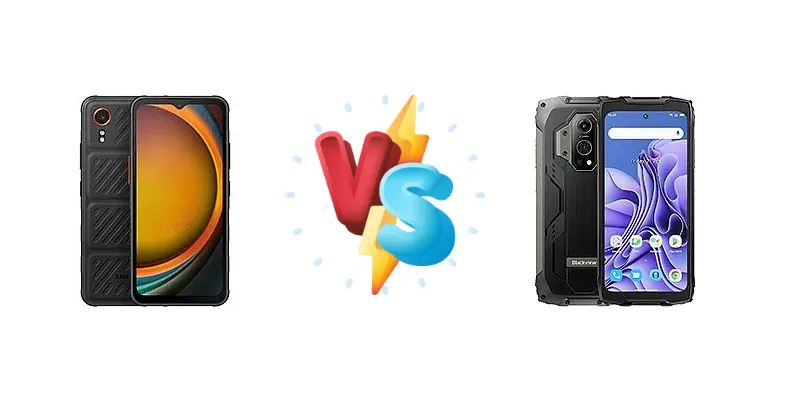
|
🏆 Quick Verdict
For the average user prioritizing long-term software support and a refined user experience, the Samsung Galaxy XCover7 is the better choice. However, the Blackview BV9300 offers significantly faster charging and a compelling price point, making it ideal for those who prioritize battery convenience and value.
| PHONES | ||
|---|---|---|
| Phone Names | Samsung Galaxy XCover7 | Blackview BV9300 |
| Network | ||
|---|---|---|
| 2G bands | GSM 850 / 900 / 1800 / 1900 | GSM 850 / 900 / 1800 / 1900 |
| 3G bands | HSDPA 850 / 900 / 1700(AWS) / 1900 / 2100 | HSDPA 850 / 900 / 1700(AWS) / 1900 / 2100 |
| 4G bands | 1, 2, 3, 4, 5, 7, 8, 12, 13, 17, 20, 26, 28, 32, 38, 40, 41, 66 | 1, 2, 3, 4, 5, 7, 8, 12, 13, 17, 18, 19, 20, 25, 26, 28, 30, 34, 38, 39, 40, 41, 66 |
| 5G bands | 1, 3, 5, 7, 8, 20, 26, 28, 38, 40, 41, 66, 71, 77, 78 SA/NSA | - |
| Speed | HSPA, LTE, 5G | HSPA, LTE |
| Technology | GSM / HSPA / LTE / 5G | GSM / CDMA / HSPA / LTE |
| - | CDMA 800 / 1900 | |
| Launch | ||
|---|---|---|
| Announced | 2024, January 10 | 2023, May 10 |
| Status | Available. Released 2024, January 23 | Available. Released 2023, May 10 |
| Body | ||
|---|---|---|
| Dimensions | 169 x 80.1 x 10.2 mm (6.65 x 3.15 x 0.40 in) | 184.6 x 85.6 x 22.8 mm (7.27 x 3.37 x 0.90 in) |
| SIM | · Nano-SIM + eSIM· Nano-SIM + Nano-SIM | Nano-SIM + Nano-SIM |
| Weight | 240 g (8.47 oz) | 520 g (1.15 lb) |
| - | IP68/IP69K dust/water resistant (up to 1.5m for 30 min) Drop-to-concrete resistance from up to 1.8m MIL-STD-810H compliant Laser rangefinder (up to 40m) Dedicated flashlight (100 lumens) | |
| Display | ||
|---|---|---|
| Protection | Corning Gorilla Glass Victus+ | Corning Gorilla Glass 5 |
| Resolution | 1080 x 2408 pixels, 20:9 ratio (~400 ppi density) | 1080 x 2388 pixels (~391 ppi density) |
| Size | 6.6 inches, 104.9 cm2 (~77.5% screen-to-body ratio) | 6.7 inches, 108.7 cm2 (~68.8% screen-to-body ratio) |
| Type | PLS LCD, 600 nits (HBM) | IPS LCD, 120Hz |
| Platform | ||
|---|---|---|
| CPU | Octa-core (2x2.2 GHz Cortex-A76 & 6x2.0 GHz Cortex-A55) | Octa-core (2x2.2 GHz Cortex-A76 & 6x2.0 GHz Cortex-A55) |
| Chipset | Mediatek Dimensity 6100+ (6 nm) | Mediatek Helio G99 (6 nm) |
| GPU | Mali-G57 MC2 | Mali-G57 MC2 |
| OS | Android 14, upgradable to Android 16, One UI 8 | Android 12, Doke-OS 3.1 |
| Memory | ||
|---|---|---|
| Card slot | microSDXC (dedicated slot) | microSDXC (uses shared SIM slot) |
| Internal | 64GB 4GB RAM, 128GB 6GB RAM | 256GB 12GB RAM |
| - | UFS 2.1 | |
| Main Camera | ||
|---|---|---|
| Features | Dual-LED flash, HDR, panorama | LED flash, HDR, panorama |
| Single | 50 MP, f/1.8, (wide), 1/2.76", 0.64µm, PDAF | - |
| Triple | - | 50 MP, (wide), 1/2.76", 0.64µm, PDAF 8 MP, 120˚, (ultrawide), AF Auxiliary lens |
| Video | 1080p@30fps | 1440p@30fps, 1080p@30fps |
| Selfie camera | ||
|---|---|---|
| Single | 5 MP, f/2.0, (wide) | 32 MP, (wide) |
| Video | Yes | 1080p |
| Sound | ||
|---|---|---|
| 3.5mm jack | - | No |
| 35mm jack | Yes | No |
| Loudspeaker | Yes | Yes |
| Comms | ||
|---|---|---|
| Bluetooth | 5.3, A2DP, LE | 5.2, A2DP, LE |
| NFC | Yes | Yes |
| Positioning | GPS, GLONASS, BDS, GALILEO, QZSS | GPS, GLONASS, GALILEO, BDS |
| Radio | No | FM radio |
| USB | USB Type-C 2.0, charging connector pins | USB Type-C, OTG |
| WLAN | Wi-Fi 802.11 a/b/g/n/ac, dual-band, Wi-Fi Direct | Wi-Fi 802.11 a/b/g/n/ac, dual-band |
| Features | ||
|---|---|---|
| Sensors | Accelerometer, gyro, proximity, compass | Fingerprint (side-mounted), accelerometer, proximity, compass |
| Battery | ||
|---|---|---|
| Charging | 15W wired | 33W wired 5W reverse wired |
| Type | Li-Po 4050 mAh, removable | 15080 mAh |
| Misc | ||
|---|---|---|
| Colors | Black | Black, Orange, Green |
| Models | SM-G556B, SM-G556BU1, SM-G556B/DS | - |
| Price | € 225.00 / $ 289.99 | About 390 EUR |
| SAR EU | 1.08 W/kg (head) 1.10 W/kg (body) | - |
Samsung Galaxy XCover7
- Samsung’s reliable software support and updates.
- Familiar and optimized One UI experience.
- Strong brand reputation for durability.
- Slow 15W wired charging.
- Potentially higher price point.
- Limited information on camera specs.
Blackview BV9300
- Fast 33W wired charging with 5W reverse charging.
- Competitive price point.
- Helio G99 potentially offers a slight gaming edge.
- Less certain long-term software support.
- Blackview’s software experience may be less refined.
- 2MP macro camera is likely of limited use.
Display Comparison
Neither Samsung nor Blackview provide detailed display specs beyond resolution. Both likely utilize IPS LCD panels, common in rugged phones for their durability. The lack of high refresh rates or advanced panel technologies like LTPO suggests a focus on power efficiency and cost reduction. Bezels are expected to be relatively substantial on both devices to further enhance drop protection. Color accuracy is likely to be standard for this segment, prioritizing visibility in direct sunlight over color fidelity.
Camera Comparison
Detailed camera specs are unavailable for both devices. However, given the market segment, we can expect competent but not class-leading camera performance. The focus will be on reliable image capture in various conditions rather than advanced features. The presence of a 2MP macro camera on the BV9300 is likely a marketing feature with limited practical benefit. Image processing will differ; Samsung typically prioritizes vibrant, saturated colors, while Blackview may lean towards a more natural look. Sensor size and lens aperture will be key differentiators, but without specific data, it’s difficult to assess which device will perform better in low-light conditions.
Performance
Both the Samsung Galaxy XCover7 and Blackview BV9300 are powered by Mediatek’s 6nm octa-core CPUs, featuring the same core configuration: 2x2.2 GHz Cortex-A76 and 6x2.0 GHz Cortex-A55. This means raw CPU performance will be very similar. However, the Blackview BV9300’s Helio G99 is geared towards gaming, potentially offering a slight GPU advantage in graphically intensive tasks. The XCover7’s Dimensity 6100+ may offer better overall system responsiveness due to optimizations within Samsung’s One UI. Thermal management will be crucial; rugged designs often limit passive cooling, and sustained loads could lead to throttling on both devices.
Battery Life
The Blackview BV9300’s 33W wired charging is a significant advantage over the Samsung Galaxy XCover7’s 15W charging. This translates to substantially faster 0-100% charge times, a critical benefit for users who rely heavily on their phones throughout the day. While battery capacity isn’t specified, the faster charging speed mitigates the impact of a potentially smaller battery on the BV9300. The XCover7 will likely offer longer sustained battery life due to Samsung’s software optimizations, but the convenience of rapid charging on the BV9300 is a compelling trade-off.
Buying Guide
Buy the Samsung Galaxy XCover7 if you need a phone with guaranteed software updates, a familiar Android experience, and integration with the Samsung ecosystem. It’s ideal for professionals needing a reliable device for field work with consistent performance. Buy the Blackview BV9300 if you prefer faster charging speeds, a more aggressive price, and aren’t as concerned with long-term software support or brand prestige. This is a strong option for outdoor enthusiasts and those needing a durable phone on a budget.