
Samsung Galaxy XCover7 Pro vs. Nokia XR20: A Deep Dive into Rugged Performance
| Phones Images | |||||
|---|---|---|---|---|---|
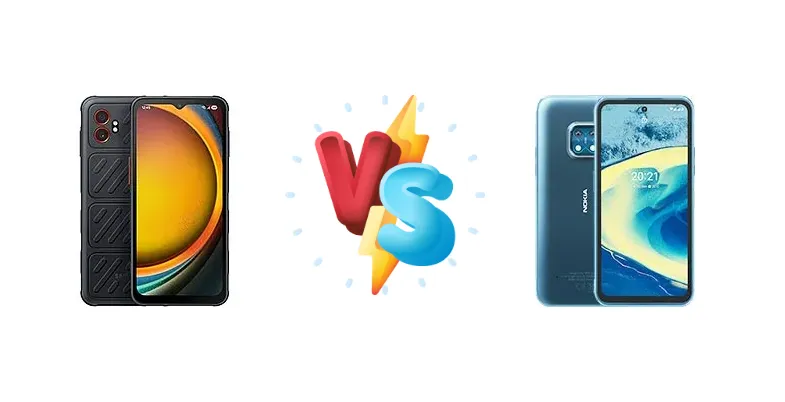
|
🏆 Quick Verdict
For users prioritizing performance and longevity, the Samsung Galaxy XCover7 Pro is the clear winner. Its Snapdragon 7s Gen 3 chipset and exceptional 38:15h battery endurance significantly outperform the Nokia XR20, making it ideal for professionals and those needing a reliable workhorse. However, the XR20 offers a compelling value proposition with wireless charging.
| PHONES | ||
|---|---|---|
| Phone Names | Samsung Galaxy XCover7 Pro | Nokia XR20 |
| Network | ||
|---|---|---|
| 2G bands | GSM 850 / 900 / 1800 / 1900 | GSM 850 / 900 / 1800 / 1900 |
| 3G bands | HSDPA 850 / 900 / 1700(AWS) / 1900 / 2100 | HSDPA 850 / 900 / 1700(AWS) / 1900 / 2100 |
| 4G bands | 1, 2, 3, 4, 5, 7, 8, 12, 13, 17, 20, 25, 26, 28, 32, 38, 40, 41, 66, 68 | 1, 2, 3, 4, 5, 7, 8, 12, 13, 14, 20, 25, 26, 28, 30, 38, 40, 41, 48, 66, 71 |
| 5G bands | 1, 3, 5, 7, 8, 20, 28, 38, 40, 41, 66, 77, 78 SA/NSA | 2, 5, 25, 38, 41, 48, 66, 77, 78 SA/NSA |
| Speed | HSPA, LTE, 5G | HSPA, LTE, 5G |
| Technology | GSM / HSPA / LTE / 5G | GSM / CDMA / HSPA / EVDO / LTE / 5G |
| - | CDMA2000 1xEV-DO | |
| Launch | ||
|---|---|---|
| Announced | 2025, April 14 | 2021, July 27 |
| Status | Available. Released 2025, May 07 | Available. Released 2021, August 04 |
| Body | ||
|---|---|---|
| Dimensions | 168.6 x 79.9 x 10.2 mm (6.64 x 3.15 x 0.40 in) | 171.6 x 81.5 x 10.6 mm (6.76 x 3.21 x 0.42 in) |
| SIM | · Nano-SIM + eSIM· Nano-SIM + Nano-SIM | · Nano-SIM· Nano-SIM + Nano-SIM |
| Weight | 240 g (8.47 oz) | 248 g (8.75 oz) |
| - | IP68 dust/water resistant (up to 1.5m for 60 min) Drop-to-concrete resistance from up to 1.8m MIL-STD-810H compliant | |
| Display | ||
|---|---|---|
| Protection | Corning Gorilla Glass Victus+, Mohs level 5 | Corning Gorilla Glass Victus |
| Resolution | 1080 x 2408 pixels, 20:9 ratio (~400 ppi density) | 1080 x 2400 pixels, 20:9 ratio (~395 ppi density) |
| Size | 6.6 inches, 104.9 cm2 (~77.9% screen-to-body ratio) | 6.67 inches, 107.4 cm2 (~76.8% screen-to-body ratio) |
| Type | PLS LCD, 120Hz | IPS LCD, 550 nits |
| Platform | ||
|---|---|---|
| CPU | Octa-core (1x2.5 GHz Cortex-A720 & 3x2.4 GHz Cortex-A720 & 4x1.8 GHz Cortex-A520) | Octa-core (2x2.0 GHz Kryo 460 & 6x1.8 GHz Kryo 460) |
| Chipset | Qualcomm SM7635 Snapdragon 7s Gen 3 (4 nm) | Qualcomm SM4350 Snapdragon 480 5G (8 nm) |
| GPU | Adreno 810 | Adreno 619 |
| OS | Android 15, upgradable to Android 16, One UI 8 | Android 11, upgradable to Android 13 |
| Memory | ||
|---|---|---|
| Card slot | microSDXC (dedicated slot) | microSDXC (uses shared SIM slot) |
| Internal | 128GB 6GB RAM, 256GB 8GB RAM | 64GB 4GB RAM, 128GB 6GB RAM |
| Main Camera | ||
|---|---|---|
| Dual | 50 MP, f/1.8, (wide), 1/2.76", 0.64µm, PDAF 8 MP, f/2.2, (ultrawide) | 48 MP, f/1.8, (wide), 1/2.25", 0.8µm, PDAF 13 MP, f/2.4, 123˚ (ultrawide), 1/3.0", 1.12µm |
| Features | Dual-LED flash, HDR, panorama | Zeiss optics, Dual-LED dual-tone flash, second LED flash, HDR, panorama |
| Single | - | 8 MP, f/2.0 (wide), 1/4.0", 1.12µm |
| Video | 4K@30fps, 1080p@30fps | 1080p@30fps |
| Selfie camera | ||
|---|---|---|
| Single | 13 MP, f/2.2, (wide) | 8 MP, f/2.0 (wide), 1/4.0", 1.12µm |
| Video | 1080p@30fps | 1080p@30fps |
| Sound | ||
|---|---|---|
| 3.5mm jack | - | Yes |
| 35mm jack | No | Yes |
| Loudspeaker | Yes, with stereo speakers (with Dolby Atmos) | Yes, with stereo speakers |
| Comms | ||
|---|---|---|
| Bluetooth | 5.4, A2DP, LE | 5.1, A2DP, LE, aptX Adaptive |
| NFC | Yes | Yes |
| Positioning | GPS, GLONASS, BDS, GALILEO, QZSS | GPS (L1+L5), GLONASS, BDS, GALILEO, QZSS, NavIC |
| Radio | No | Unspecified |
| USB | USB Type-C 3.2, charging connector pins | USB Type-C 3.0 |
| WLAN | Wi-Fi 802.11 a/b/g/n/ac/6e, tri-band, Wi-Fi Direct | Wi-Fi 802.11 a/b/g/n/ac/6, dual-band, Wi-Fi Direct |
| Features | ||
|---|---|---|
| Sensors | Fingerprint (side-mounted), accelerometer, gyro, proximity, compass | Fingerprint (side-mounted), accelerometer, gyro, proximity, compass, barometer |
| Battery | ||
|---|---|---|
| Charging | 15W wired | 18W wired 15W wireless |
| Type | Li-Po 4350 mAh, removable | Li-Po 4630 mAh |
| Misc | ||
|---|---|---|
| Colors | Black | Ultra Blue, Granite Gray |
| Models | SM-G766B, SM-G766BU1, SM-G766B/DS | TA-1368, TA-1362 |
| Price | $ 576.99 / € 437.99 | About 270 EUR |
| SAR EU | 0.81 W/kg (head) 1.03 W/kg (body) | 1.13 W/kg (head) 1.43 W/kg (body) |
| EU LABEL | ||
|---|---|---|
| Battery | 38:15h endurance, 2000 cycles | - |
| Energy | Class B | - |
| Free fall | Class A (270 falls) | - |
| Repairability | Class B | - |
Samsung Galaxy XCover7 Pro
- Superior processing power with Snapdragon 7s Gen 3
- Exceptional battery life (38:15h endurance)
- Longer battery lifespan (2000 charge cycles)
- Slower wired charging (15W)
- Potentially higher price point
Nokia XR20
- Wireless charging support
- More affordable price
- Solid build quality for rugged use
- Significantly weaker processor (Snapdragon 480)
- Shorter battery life
- Less future-proof chipset
Display Comparison
Neither device boasts a cutting-edge display, focusing instead on durability. While specific display specs are missing, the XCover7 Pro’s focus on usability suggests a brighter panel for outdoor visibility. The XR20’s display is likely adequate, but the XCover7 Pro’s newer chipset could potentially drive a higher refresh rate, improving smoothness. Bezels are expected to be substantial on both, prioritizing screen protection over a modern, edge-to-edge design.
Camera Comparison
Camera details are limited, but the focus should be on practical utility rather than flagship-level photography. Both phones likely prioritize robust image stabilization for capturing clear photos in challenging conditions. The XCover7 Pro’s chipset likely offers superior image signal processing (ISP) capabilities, resulting in better dynamic range and noise reduction. While both may include a basic macro lens, their utility is questionable. The larger sensor size (if present on the XCover7 Pro) would be a key differentiator, capturing more light and detail.
Performance
The performance gap is significant. The Samsung Galaxy XCover7 Pro’s Qualcomm SM7635 Snapdragon 7s Gen 3 (4nm) is a substantial upgrade over the Nokia XR20’s Snapdragon 480 5G (8nm). The 4nm process node of the Snapdragon 7s Gen 3 translates to improved power efficiency and reduced thermal throttling under sustained load. The XCover7 Pro’s octa-core CPU, with its higher clock speeds (2.5 GHz Cortex-A720), will deliver noticeably faster application loading, smoother multitasking, and a more responsive user experience. The XR20’s Kryo 460 cores, while capable, are simply outmatched in both raw power and efficiency.
Battery Life
Battery life is a major differentiator. The Samsung Galaxy XCover7 Pro’s 38:15h endurance is exceptional, indicating a significantly longer runtime than the Nokia XR20. This is likely due to the more efficient Snapdragon 7s Gen 3 chipset and optimized power management. While the XR20 offers 18W wired and 15W wireless charging, the XCover7 Pro’s 15W wired charging is slower. However, the XCover7 Pro’s 2000 charge cycles suggest a longer overall battery lifespan, mitigating the slower charging speed. The XR20’s wireless charging is a convenience feature, but the XCover7 Pro’s endurance is more valuable for users in the field.
Buying Guide
Buy the Samsung Galaxy XCover7 Pro if you need a phone that can handle demanding tasks, extended workdays, and require the latest chipset for future-proofing. This is the phone for field technicians, construction workers, or anyone who relies on their device in challenging environments. Buy the Nokia XR20 if you prefer a more affordable rugged option with the convenience of wireless charging and are less concerned with having the absolute fastest processor. It's a solid choice for users needing basic rugged functionality without breaking the bank.