
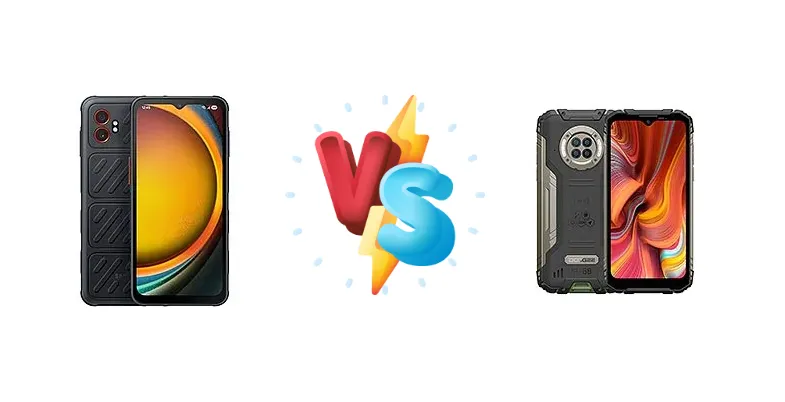
Samsung Galaxy XCover7 Pro vs. Doogee S96 Pro: Which Rugged Phone Reigns Supreme?
| Phones Images | |||||
|---|---|---|---|---|---|
|
🏆 Quick Verdict
For most users prioritizing long-term performance and software support, the Samsung Galaxy XCover7 Pro is the superior choice. Its Snapdragon 7s Gen 3 chipset offers a significant architectural advantage over the Doogee S96 Pro’s Helio G90, translating to smoother multitasking and sustained performance, despite the slower charging.
| PHONES | ||
|---|---|---|
| Phone Names | Samsung Galaxy XCover7 Pro | Doogee S96 Pro |
| Network | ||
|---|---|---|
| 2G bands | GSM 850 / 900 / 1800 / 1900 | GSM 850 / 900 / 1800 / 1900 |
| 3G bands | HSDPA 850 / 900 / 1700(AWS) / 1900 / 2100 | HSDPA 800 / 850 / 900 / 1700(AWS) / 1900 / 2100 |
| 4G bands | 1, 2, 3, 4, 5, 7, 8, 12, 13, 17, 20, 25, 26, 28, 32, 38, 40, 41, 66, 68 | 1, 2, 3, 4, 5, 7, 8, 12, 13, 17, 18, 19, 20, 25, 26, 28, 38, 40, 66 |
| 5G bands | 1, 3, 5, 7, 8, 20, 28, 38, 40, 41, 66, 77, 78 SA/NSA | - |
| Speed | HSPA, LTE, 5G | HSPA, LTE |
| Technology | GSM / HSPA / LTE / 5G | GSM / CDMA / HSPA / LTE |
| Launch | ||
|---|---|---|
| Announced | 2025, April 14 | 2020, October 26. Released 2020, November |
| Status | Available. Released 2025, May 07 | Discontinued |
| Body | ||
|---|---|---|
| Dimensions | 168.6 x 79.9 x 10.2 mm (6.64 x 3.15 x 0.40 in) | 167 x 81.4 x 15.5 mm (6.57 x 3.20 x 0.61 in) |
| SIM | · Nano-SIM + eSIM· Nano-SIM + Nano-SIM | Nano-SIM + Nano-SIM |
| Weight | 240 g (8.47 oz) | 310 g (10.93 oz) |
| Display | ||
|---|---|---|
| Protection | Corning Gorilla Glass Victus+, Mohs level 5 | Corning Gorilla Glass |
| Resolution | 1080 x 2408 pixels, 20:9 ratio (~400 ppi density) | 720 x 1520 pixels, 19:9 ratio (~270 ppi density) |
| Size | 6.6 inches, 104.9 cm2 (~77.9% screen-to-body ratio) | 6.22 inches, 96.6 cm2 (~71.0% screen-to-body ratio) |
| Type | PLS LCD, 120Hz | IPS LCD |
| Platform | ||
|---|---|---|
| CPU | Octa-core (1x2.5 GHz Cortex-A720 & 3x2.4 GHz Cortex-A720 & 4x1.8 GHz Cortex-A520) | Octa-core (2x2.0 GHz Cortex-A76 & 6x2.0 GHz Cortex-A55) |
| Chipset | Qualcomm SM7635 Snapdragon 7s Gen 3 (4 nm) | Mediatek MT6785 Helio G90 (12 nm) |
| GPU | Adreno 810 | Mali-G76 MC4 |
| OS | Android 15, upgradable to Android 16, One UI 8 | Android 10 |
| Memory | ||
|---|---|---|
| Card slot | microSDXC (dedicated slot) | microSDXC (dedicated slot) |
| Internal | 128GB 6GB RAM, 256GB 8GB RAM | 128GB 8GB RAM |
| Main Camera | ||
|---|---|---|
| Dual | 50 MP, f/1.8, (wide), 1/2.76", 0.64µm, PDAF 8 MP, f/2.2, (ultrawide) | - |
| Features | Dual-LED flash, HDR, panorama | Quad-LED flash, HDR, panorama |
| Quad | - | 48 MP, f/1.8, (wide), PDAF 8 MP, f/2.2, 130˚, (ultrawide) 20 MP, f/2.8, (night vision), 4 infrared night vision lights 2 MP (macro) |
| Video | 4K@30fps, 1080p@30fps | 1080p |
| Selfie camera | ||
|---|---|---|
| Single | 13 MP, f/2.2, (wide) | 16 MP, f/2.0, (wide) |
| Video | 1080p@30fps | 1080p |
| Sound | ||
|---|---|---|
| 35mm jack | No | Yes |
| Loudspeaker | Yes, with stereo speakers (with Dolby Atmos) | Yes |
| Comms | ||
|---|---|---|
| Bluetooth | 5.4, A2DP, LE | 5.0, A2DP, LE |
| NFC | Yes | Yes |
| Positioning | GPS, GLONASS, BDS, GALILEO, QZSS | GPS, GLONASS, BDS, GALILEO |
| Radio | No | FM radio |
| USB | USB Type-C 3.2, charging connector pins | USB Type-C 2.0, OTG |
| WLAN | Wi-Fi 802.11 a/b/g/n/ac/6e, tri-band, Wi-Fi Direct | Wi-Fi 802.11 a/b/g/n/ac, dual-band |
| Features | ||
|---|---|---|
| Sensors | Fingerprint (side-mounted), accelerometer, gyro, proximity, compass | Fingerprint (side-mounted), accelerometer, gyro, proximity, compass |
| Battery | ||
|---|---|---|
| Charging | 15W wired | 24W wired 10W wireless |
| Type | Li-Po 4350 mAh, removable | 6350 mAh |
| Misc | ||
|---|---|---|
| Colors | Black | Black, Orange, Green |
| Models | SM-G766B, SM-G766BU1, SM-G766B/DS | - |
| Price | $ 576.99 / € 437.99 | About 280 EUR |
| SAR EU | 0.81 W/kg (head) 1.03 W/kg (body) | - |
| EU LABEL | ||
|---|---|---|
| Battery | 38:15h endurance, 2000 cycles | - |
| Energy | Class B | - |
| Free fall | Class A (270 falls) | - |
| Repairability | Class B | - |
Samsung Galaxy XCover7 Pro
- Superior processor efficiency and performance
- Guaranteed software updates and support
- Exceptional battery endurance (38:15h)
- Slower charging speed (15W)
- Potentially higher price point
Doogee S96 Pro
- Faster charging (24W wired, 10W wireless)
- Potentially lower price
- Aggressive value proposition
- Older, less efficient chipset
- Limited software update commitment
- Potential for thermal throttling
Display Comparison
Neither device's display specifications are provided, so we must infer. Given Samsung's history, the XCover7 Pro likely features a higher quality panel with better color accuracy and potentially higher peak brightness. The Doogee S96 Pro, aiming for value, likely utilizes a more basic LCD. The absence of LTPO on either device suggests neither prioritizes variable refresh rates for power saving. Bezels are likely substantial on both, given the ruggedized design focus.
Camera Comparison
Without detailed camera specs, a direct comparison is difficult. However, Samsung generally prioritizes image processing and software optimization. The Doogee S96 Pro may rely more on hardware, but likely lacks the sophisticated algorithms found in Samsung’s devices. The absence of information regarding sensor sizes makes it impossible to determine which phone captures more light, but Samsung’s experience suggests a more refined camera experience overall. We can assume both devices will include a basic macro lens, but its utility is limited in both cases.
Performance
The core difference lies in the chipsets. The Samsung Galaxy XCover7 Pro’s Qualcomm SM7635 Snapdragon 7s Gen 3 (4nm) is a modern design, boasting a tri-cluster configuration (1x2.5 GHz Cortex-A720, 3x2.4 GHz Cortex-A720, 4x1.8 GHz Cortex-A520). This contrasts sharply with the Doogee S96 Pro’s MediaTek MT6785 Helio G90 (12nm), utilizing a dual-cluster setup (2x2.0 GHz Cortex-A76 & 6x2.0 GHz Cortex-A55). The 4nm process node of the Snapdragon offers significantly improved power efficiency and thermal performance, meaning the XCover7 Pro will likely sustain higher performance for longer periods without throttling. The Snapdragon's newer Cortex-A720 cores also provide a generational leap in IPC (Instructions Per Clock) over the Helio G90’s Cortex-A76 cores.
Battery Life
The Samsung Galaxy XCover7 Pro boasts a remarkable 38:15h endurance rating, suggesting excellent real-world battery life. While the Doogee S96 Pro’s capacity is unknown, its 24W wired and 10W wireless charging capabilities offer faster replenishment than the XCover7 Pro’s 15W wired charging. However, the Snapdragon 7s Gen 3’s superior efficiency likely offsets the slower charging, providing longer overall usage time. The XCover7 Pro also claims 2000 charge cycles, indicating a longer lifespan for the battery itself.
Buying Guide
Buy the Samsung Galaxy XCover7 Pro if you need a rugged phone backed by a reputable brand with guaranteed software updates, a more efficient processor for demanding tasks, and a longer-lasting battery with proven endurance. Buy the Doogee S96 Pro if you prioritize faster charging speeds (including wireless) and are comfortable with a potentially less refined software experience and a chipset that may struggle with intensive applications over extended periods.