
Samsung Galaxy XCover FieldPro vs. Nokia XR20: Which Rugged Phone Reigns Supreme?
| Phones Images | |||||
|---|---|---|---|---|---|
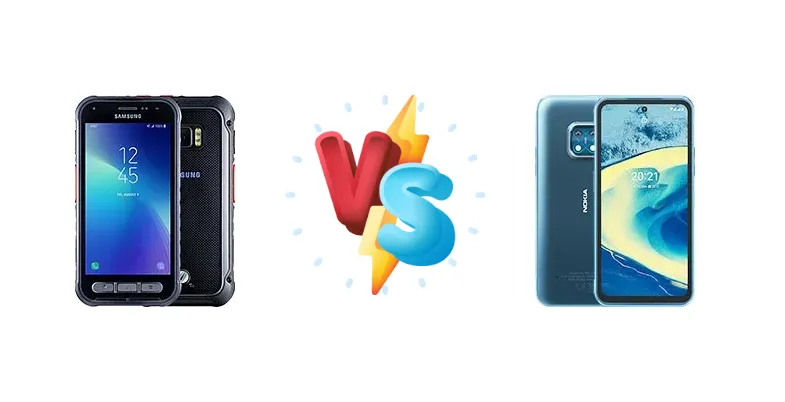
|
🏆 Quick Verdict
For users prioritizing raw processing power and who frequently utilize demanding applications, the Samsung Galaxy XCover FieldPro is the better choice. However, the Nokia XR20 offers a more modern chipset fabrication process (8nm vs 10nm) and the convenience of wireless charging, making it a compelling option for those seeking a balance of durability and modern features.
| PHONES | ||
|---|---|---|
| Phone Names | Samsung Galaxy XCover FieldPro | Nokia XR20 |
| Network | ||
|---|---|---|
| 2G bands | GSM 850 / 900 / 1800 / 1900 | GSM 850 / 900 / 1800 / 1900 |
| 3G bands | HSDPA 850 / 900 / 1700(AWS) / 1900 / 2100 - USA | HSDPA 850 / 900 / 1700(AWS) / 1900 / 2100 |
| 4G bands | 1, 2, 3, 4, 5, 7, 12, 14, 20, 29, 30, 38, 39, 40, 41, 66 - USA | 1, 2, 3, 4, 5, 7, 8, 12, 13, 14, 20, 25, 26, 28, 30, 38, 40, 41, 48, 66, 71 |
| 5G bands | - | 2, 5, 25, 38, 41, 48, 66, 77, 78 SA/NSA |
| Speed | HSPA 42.2/5.76 Mbps, LTE (3CA) Cat11 600/75 Mbps | HSPA, LTE, 5G |
| Technology | GSM / HSPA / LTE | GSM / CDMA / HSPA / EVDO / LTE / 5G |
| - | CDMA2000 1xEV-DO | |
| Launch | ||
|---|---|---|
| Announced | 2019, October. Released 2020, April 06 | 2021, July 27 |
| Status | Discontinued | Available. Released 2021, August 04 |
| Body | ||
|---|---|---|
| Dimensions | 158.5 x 80.7 x 14.2 mm (6.24 x 3.18 x 0.56 in) | 171.6 x 81.5 x 10.6 mm (6.76 x 3.21 x 0.42 in) |
| SIM | Single SIM (Micro-SIM) or Dual SIM (Micro-SIM, dual stand-by) | · Nano-SIM· Nano-SIM + Nano-SIM |
| Weight | 256 g (9.03 oz) | 248 g (8.75 oz) |
| IP68 dust/water resistant (up to 1.5m for 30 mins) MIL-STD-810G compliant DGUV112-139 certified Emergency PTT key | IP68 dust/water resistant (up to 1.5m for 60 min) Drop-to-concrete resistance from up to 1.8m MIL-STD-810H compliant | |
| Display | ||
|---|---|---|
| Protection | - | Corning Gorilla Glass Victus |
| Resolution | 1440 x 2560 pixels, 16:9 ratio (~576 ppi density) | 1080 x 2400 pixels, 20:9 ratio (~395 ppi density) |
| Size | 5.1 inches, 71.7 cm2 (~56.1% screen-to-body ratio) | 6.67 inches, 107.4 cm2 (~76.8% screen-to-body ratio) |
| Type | IPS LCD | IPS LCD, 550 nits |
| Platform | ||
|---|---|---|
| CPU | Octa-core (4x2.7 GHz Mongoose M3 & 4x1.8 GHz Cortex-A55) | Octa-core (2x2.0 GHz Kryo 460 & 6x1.8 GHz Kryo 460) |
| Chipset | Exynos 9810 (10 nm) | Qualcomm SM4350 Snapdragon 480 5G (8 nm) |
| GPU | Mali-G72 MP18 | Adreno 619 |
| OS | Android 8.0 (Oreo) | Android 11, upgradable to Android 13 |
| Memory | ||
|---|---|---|
| Card slot | microSDXC (dedicated slot) | microSDXC (uses shared SIM slot) |
| Internal | 64GB 4GB RAM | 64GB 4GB RAM, 128GB 6GB RAM |
| UFS 2.1 | - | |
| Main Camera | ||
|---|---|---|
| Dual | - | 48 MP, f/1.8, (wide), 1/2.25", 0.8µm, PDAF 13 MP, f/2.4, 123˚ (ultrawide), 1/3.0", 1.12µm |
| Features | Triple-LED flash, HDR, panorama | Zeiss optics, Dual-LED dual-tone flash, second LED flash, HDR, panorama |
| Single | 12 MP, f/1.5-2.4, (wide), 1/2.55", 1.4µm, PDAF | 8 MP, f/2.0 (wide), 1/4.0", 1.12µm |
| Video | 1080p@30fps | 1080p@30fps |
| Selfie camera | ||
|---|---|---|
| Features | HDR | - |
| Single | 8 MP, f/1.7 | 8 MP, f/2.0 (wide), 1/4.0", 1.12µm |
| Video | 1080p@30fps | 1080p@30fps |
| Sound | ||
|---|---|---|
| 3.5mm jack | Yes | Yes |
| 35mm jack | Yes | Yes |
| Loudspeaker | Yes, with dual speakers | Yes, with stereo speakers |
| Comms | ||
|---|---|---|
| Bluetooth | 5.0, A2DP, LE | 5.1, A2DP, LE, aptX Adaptive |
| NFC | Yes | Yes |
| Positioning | GPS, GLONASS, GALILEO | GPS (L1+L5), GLONASS, BDS, GALILEO, QZSS, NavIC |
| Radio | FM radio | Unspecified |
| USB | USB Type-C 2.0 | USB Type-C 3.0 |
| WLAN | Wi-Fi 802.11 a/b/g/n/ac/6/i/r, dual-band, Wi-Fi Direct | Wi-Fi 802.11 a/b/g/n/ac/6, dual-band, Wi-Fi Direct |
| Features | ||
|---|---|---|
| Sensors | Fingerprint (rear-mounted), accelerometer, gyro, proximity, compass, barometer | Fingerprint (side-mounted), accelerometer, gyro, proximity, compass, barometer |
| Battery | ||
|---|---|---|
| Charging | - | 18W wired 15W wireless |
| Type | Li-Po 4500 mAh, removable | Li-Po 4630 mAh |
| Misc | ||
|---|---|---|
| Colors | Black | Ultra Blue, Granite Gray |
| Models | SM-G889F, SM-G889A | TA-1368, TA-1362 |
| Price | About 1020 EUR | About 270 EUR |
| SAR | 1.20 W/kg (head) 0.67 W/kg (body) | - |
| SAR EU | 0.80 W/kg (head) 1.37 W/kg (body) | 1.13 W/kg (head) 1.43 W/kg (body) |
Samsung Galaxy XCover FieldPro
- Superior processing power with the Exynos 9810.
- Potentially better multitasking capabilities.
- Samsung’s established software ecosystem.
- Older 10nm chipset may generate more heat.
- Charging speed and wireless charging support are unknown.
- Potentially shorter software support lifecycle.
Nokia XR20
- More efficient 8nm Snapdragon 480 chipset.
- 5G connectivity for faster data speeds.
- 18W wired and 15W wireless charging support.
- Lower processing power compared to the Exynos 9810.
- May struggle with demanding applications.
- Potentially less refined software experience.
Display Comparison
Neither device boasts a cutting-edge display. Details on panel type and resolution are missing for both, but their rugged focus suggests prioritizing durability over visual fidelity. The absence of high refresh rates is expected. The key difference lies in potential software optimizations; Samsung’s display calibration is generally more accurate. However, without specific nit brightness data, it’s difficult to assess outdoor visibility.
Camera Comparison
Camera details are sparse, but the focus on ruggedness suggests neither phone prioritizes photographic excellence. The absence of information regarding sensor size and image stabilization makes a direct comparison difficult. It’s likely both devices feature modest camera setups suitable for documentation and basic photography. The Nokia XR20’s inclusion of 15W wireless charging suggests a slightly more modern feature set, potentially extending to image processing algorithms, but this is speculative without further data.
Performance
The Samsung Galaxy XCover FieldPro’s Exynos 9810 (10nm) offers a clear performance advantage over the Nokia XR20’s Snapdragon 480 (8nm). The Exynos utilizes a custom Mongoose M3 core alongside Cortex-A55s, resulting in superior single-core and multi-core performance. While the Snapdragon 480 benefits from a smaller fabrication node – potentially leading to better efficiency – it’s a lower-tier chipset designed for basic 5G connectivity and everyday tasks. The FieldPro will handle demanding applications and multitasking with greater ease. The 8nm process of the Snapdragon 480 should, however, result in less heat generation under sustained load compared to the 10nm Exynos.
Battery Life
Battery capacity is not specified for either device. However, the Snapdragon 480’s 8nm process should contribute to better power efficiency, potentially offsetting a smaller battery capacity compared to the FieldPro. The Nokia XR20’s 18W wired and 15W wireless charging capabilities provide greater flexibility and convenience, while the FieldPro’s charging speed is unknown. Users prioritizing all-day battery life and convenient charging will likely favor the XR20.
Buying Guide
Buy the Samsung Galaxy XCover FieldPro if you need a rugged phone capable of handling intensive tasks like CAD viewing, complex data analysis, or running specialized field service applications. Its Exynos 9810 provides a significant performance advantage. Buy the Nokia XR20 if you prefer a more energy-efficient device with 5G connectivity, wireless charging, and a longer software support commitment, ideal for users focused on communication, basic productivity, and extended field deployments.