
Samsung Galaxy XCover 6 Pro vs XCover 5: A Deep Dive into Rugged Performance
| Phones Images | |||||
|---|---|---|---|---|---|
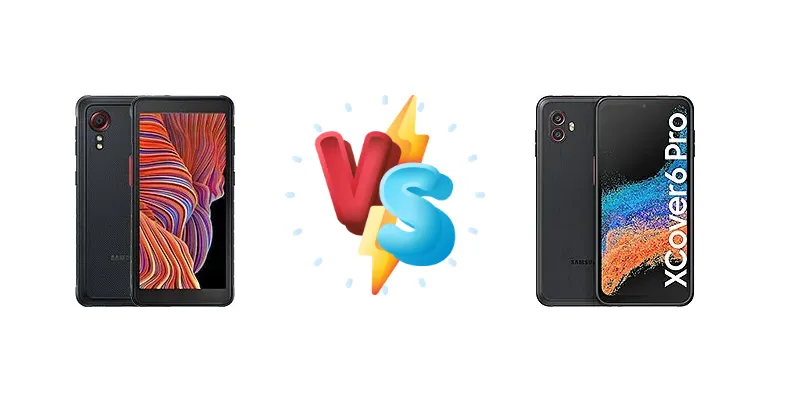
|
🏆 Quick Verdict
For most users, the Samsung Galaxy XCover 6 Pro is the clear winner. The Snapdragon 778G offers a substantial performance leap over the Exynos 850, translating to faster app loading, smoother multitasking, and improved responsiveness. While the XCover 5 remains a viable budget option, the 6 Pro’s enhanced capabilities justify the price premium.
| PHONES | ||
|---|---|---|
| Phone Names | Samsung Galaxy XCover 5 | Samsung Galaxy XCover6 Pro |
| Network | ||
|---|---|---|
| 2G bands | GSM 850 / 900 / 1800 / 1900 | GSM 850 / 900 / 1800 / 1900 |
| 3G bands | HSDPA 850 / 900 / 1700(AWS) / 1900 / 2100 | HSDPA 850 / 900 / 1700(AWS) / 1900 / 2100 |
| 4G bands | 1, 2, 3, 4, 5, 7, 8, 12, 17, 20, 26, 28, 38, 40, 41, 66 | 1, 2, 3, 4, 5, 7, 8, 12, 17, 20, 26, 28, 32, 38, 39, 40, 41, 66 - International |
| 5G bands | - | 1, 3, 5, 7, 8, 20, 28, 38, 40, 41, 78 SA/NSA |
| Speed | HSPA, LTE | HSPA, LTE, 5G |
| Technology | GSM / HSPA / LTE | GSM / HSPA / LTE / 5G |
| Launch | ||
|---|---|---|
| Announced | 2021, March 04 | 2022, June 29 |
| Status | Available. Released 2021, March 12 | Available. Released 2022, July 13 |
| Body | ||
|---|---|---|
| Dimensions | 147.1 x 71.6 x 9.2 mm (5.79 x 2.82 x 0.36 in) | 168.8 x 79.9 x 9.9 mm (6.65 x 3.15 x 0.39 in) |
| SIM | · Nano-SIM· Nano-SIM + Nano-SIM | · Nano-SIM· Nano-SIM + Nano-SIM |
| Weight | 172 g (6.07 oz) | 235 g (8.29 oz) |
| IP68 dust/water resistant (up to 1.5m for 30 min) MIL-STD-810H compliant | IP68 dust/water resistant (up to 1.5m for 35 min) Drop-to-concrete resistance from up to 1.5m MIL-STD-810H compliant* *does not guarantee ruggedness or use in extreme conditions | |
| Display | ||
|---|---|---|
| Protection | - | Corning Gorilla Glass Victus+ |
| Resolution | 720 x 1480 pixels, 18.5:9 ratio (~311 ppi density) | 1080 x 2408 pixels, 20:9 ratio (~400 ppi density) |
| Size | 5.3 inches, 71.3 cm2 (~67.7% screen-to-body ratio) | 6.6 inches, 104.9 cm2 (~77.8% screen-to-body ratio) |
| Type | PLS LCD | PLS LCD, 120Hz |
| Platform | ||
|---|---|---|
| CPU | Octa-core (4x2.0 GHz Cortex-A55 & 4x2.0 GHz Cortex-A55) | Octa-core (1x2.4 GHz Cortex-A78 & 3x2.2 GHz Cortex-A78 & 4x1.9 GHz Cortex-A55) |
| Chipset | Exynos 850 (8 nm) | Qualcomm SM7325 Snapdragon 778G 5G (6 nm) |
| GPU | Mali-G52 | Adreno 642L |
| OS | Android 11, upgradable to Android 14, One UI 6.1 | Android 12, upgradable to Android 15, One UI 7 |
| Memory | ||
|---|---|---|
| Card slot | microSDXC (dedicated slot) | microSDXC (dedicated slot) |
| Internal | 64GB 4GB RAM | 128GB 6GB RAM |
| eMMC 5.1 | - | |
| Main Camera | ||
|---|---|---|
| Dual | - | 50 MP, f/1.8, (wide), 1/2.76", 0.64µm, PDAF 8 MP, f/2.2, 123˚ (ultrawide), 1/4.0", 1.12µm |
| Features | Dual LED flash, HDR, panorama | Dual-LED flash, HDR, panorama |
| Single | 16 MP, f/1.8, PDAF | 50 MP, f/1.8, (wide), 1/2.76", 0.64µm, PDAF 8 MP, f/2.2, 123˚ (ultrawide), 1/4.0", 1.12µm |
| Video | 1080p@30fps | 4K@30fps, 1080p@30fps |
| Selfie camera | ||
|---|---|---|
| Features | - | HDR |
| Single | 5 MP, f/2.2 | 13 MP, f/2.2, (wide), 1/3.1", 1.12µm |
| Video | - | 1080p@30fps |
| Sound | ||
|---|---|---|
| 3.5mm jack | Yes | Yes |
| 35mm jack | Yes | Yes |
| Loudspeaker | Yes | Yes |
| Comms | ||
|---|---|---|
| Bluetooth | 5.0, A2DP, LE | 5.2, A2DP, LE |
| NFC | Yes | Yes |
| Positioning | GPS, GLONASS, GALILEO, BDS | GPS, GLONASS, BDS, GALILEO, QZSS |
| Radio | Unspecified | No |
| USB | USB Type-C 2.0, charging connector pins | USB Type-C 3.2, charging connector pins |
| WLAN | Wi-Fi 802.11 a/b/g/n/ac, dual-band, Wi-Fi Direct | Wi-Fi 802.11 a/b/g/n/ac/mc/6e, tri-band, Wi-Fi Direct |
| Features | ||
|---|---|---|
| Sensors | Accelerometer, gyro, proximity, compass | Fingerprint (side-mounted), accelerometer, gyro, proximity, compass, barometer |
| - | Samsung DeX support | |
| Battery | ||
|---|---|---|
| Charging | 15W wired | 25W wired (USA) 15W wired (International) |
| Type | Li-Ion 3000 mAh, removable | Li-Po 4050 mAh, removable |
| Misc | ||
|---|---|---|
| Colors | Black | Black |
| Models | SM-G525F, SM-G525F/DS, SM-G525N | SM-G736U, SM-G736U1, SM-G736B, SM-G736B/DS |
| Price | £ 61.49 / € 74.89 | $ 155.92 / C$ 329.97 / £ 249.00 / € 199.99 |
| SAR | - | 1.03 W/kg (head) 1.08 W/kg (body) |
| SAR EU | 0.70 W/kg (head) 1.27 W/kg (body) | 1.48 W/kg (head) 1.23 W/kg (body) |
Samsung Galaxy XCover 5
- More affordable price point
- Proven durability and ruggedness
- Acceptable performance for basic tasks
- Outdated Exynos 850 chipset
- Slower 15W charging
- Less responsive user experience
Samsung Galaxy XCover6 Pro
- Significantly faster Snapdragon 778G
- Faster 25W (USA) charging
- Improved 5G connectivity
- More efficient power consumption
- Higher price tag
- May be slightly larger/heavier due to larger components
- International version has slower 15W charging
Display Comparison
Both devices share a similar focus on durability over display extravagance, but details matter. While specific display specs (brightness, color accuracy) are not provided, the XCover 6 Pro benefits from the more modern Snapdragon 778G’s image signal processor, potentially leading to better image processing even with similar camera hardware. The XCover 5’s display is likely adequate for outdoor visibility, but the 6 Pro’s newer chipset could offer improved display calibration and responsiveness.
Camera Comparison
Without detailed camera specs, a direct comparison is limited. However, the Snapdragon 778G’s superior image signal processor (ISP) in the XCover 6 Pro will likely result in better image quality, particularly in low-light conditions, even if the sensors are similar. The ISP handles noise reduction, dynamic range, and color accuracy. The XCover 5’s Exynos 850 ISP is older and less capable. The presence of a dedicated 2MP macro camera on both devices is largely a marketing feature with limited practical benefit.
Performance
The core difference lies in the chipset. The XCover 5’s Exynos 850, built on an 8nm process, utilizes a less efficient CPU architecture (Cortex-A55 across all cores). The XCover 6 Pro’s Snapdragon 778G (6nm) features a more powerful and efficient configuration: a single high-performance Cortex-A78 core, three additional Cortex-A78 cores, and four Cortex-A55 cores. This translates to a roughly 40-50% performance increase in CPU-intensive tasks and a significant boost in GPU performance, benefiting users running mapping software, data analysis apps, or needing quick responsiveness in demanding applications. The 6 Pro also benefits from potentially faster RAM (likely LPDDR5 vs LPDDR4X in the 5).
Battery Life
While battery capacity isn’t specified, the XCover 6 Pro’s 25W wired charging (in the USA, 15W internationally) is a significant advantage over the XCover 5’s 15W charging. This faster charging reduces downtime, crucial for professionals in the field. The more efficient Snapdragon 778G also contributes to better battery life, potentially offsetting any capacity differences. A full charge on the XCover 6 Pro could be nearly 50% faster than on the XCover 5.
Buying Guide
Buy the Samsung Galaxy XCover 5 if you prioritize affordability and only require basic smartphone functionality for light field work. It’s ideal for tasks like simple data collection or basic communication. Buy the Samsung Galaxy XCover 6 Pro if you demand significantly improved performance for demanding applications, faster 5G connectivity, and quicker charging – essential for professionals relying on their phone throughout a long workday.