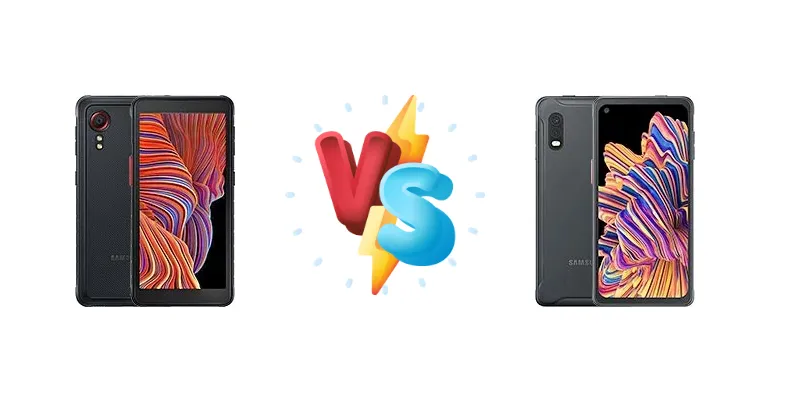
Samsung's XCover line caters to a specific niche: users needing a durable, reliable smartphone for demanding environments. The XCover 5 and XCover Pro represent two generations of this philosophy, but significant internal differences dictate which model is best suited for your needs. This comparison dissects those differences, focusing on performance, battery, and real-world usability.
🏆 Quick Verdict
For most users prioritizing performance and future-proofing, the Samsung Galaxy XCover Pro is the better choice. Its Exynos 9611 chipset offers a noticeable performance uplift over the XCover 5’s Exynos 850, making it more capable with demanding applications. However, the XCover 5 remains a viable option for basic use cases where budget is a primary concern.
| Network |
|---|
| 2G bands | GSM 850 / 900 / 1800 / 1900 | GSM 850 / 900 / 1800 / 1900 |
| 3G bands | HSDPA 850 / 900 / 1700(AWS) / 1900 / 2100 | HSDPA 850 / 900 / 1900 / 2100 - International |
| 4G bands | 1, 2, 3, 4, 5, 7, 8, 12, 17, 20, 26, 28, 38, 40, 41, 66 | 1, 2, 3, 5, 7, 8, 20, 28, 38, 40, 41 - International |
| Speed | HSPA, LTE | HSPA 42.2/5.76 Mbps, LTE (3CA) Cat11 600/50 Mbps |
| Technology | GSM / HSPA / LTE | GSM / HSPA / LTE |
| | - | 1, 2, 3, 4, 5, 7, 12, 13, 14, 20, 29, 38, 40, 41, 66 - Canada |
| Launch |
|---|
| Announced | 2021, March 04 | 2020, January |
| Status | Available. Released 2021, March 12 | Available. Released 2020, January |
| Body |
|---|
| Dimensions | 147.1 x 71.6 x 9.2 mm (5.79 x 2.82 x 0.36 in) | 159.9 x 76.7 x 10 mm (6.30 x 3.02 x 0.39 in) |
| SIM | · Nano-SIM· Nano-SIM + Nano-SIM | · Nano-SIM· Nano-SIM + Nano-SIM |
| Weight | 172 g (6.07 oz) | 218 g (7.69 oz) |
| | IP68 dust/water resistant (up to 1.5m for 30 min)
MIL-STD-810H compliant | IP68 dust/water resistant (up to 1.5m for 35 min)
Drop-to-concrete resistance from up to 1.5m
MIL-STD-810G compliant*
*does not guarantee ruggedness or use in extreme conditions |
| Display |
|---|
| Protection | - | Corning Gorilla Glass 5 |
| Resolution | 720 x 1480 pixels, 18.5:9 ratio (~311 ppi density) | 1080 x 2340 pixels, 19.5:9 ratio (~409 ppi density) |
| Size | 5.3 inches, 71.3 cm2 (~67.7% screen-to-body ratio) | 6.3 inches, 97.4 cm2 (~79.4% screen-to-body ratio) |
| Type | PLS LCD | IPS LCD |
| Platform |
|---|
| CPU | Octa-core (4x2.0 GHz Cortex-A55 & 4x2.0 GHz Cortex-A55) | Octa-core (4x2.3 GHz Cortex-A73 & 4x1.7 GHz Cortex-A53) |
| Chipset | Exynos 850 (8 nm) | Exynos 9611 (10 nm) |
| GPU | Mali-G52 | Mali-G72 MP3 |
| OS | Android 11, upgradable to Android 14, One UI 6.1 | Android 10, upgradable to Android 13, One UI 5 |
| Memory |
|---|
| Card slot | microSDXC (dedicated slot) | microSDXC (dedicated slot) |
| Internal | 64GB 4GB RAM | 64GB 4GB RAM |
| | eMMC 5.1 | - |
| Main Camera |
|---|
| Dual | - | 25 MP, f/1.7, 26mm (wide), PDAF
8 MP, f/2.2, 123˚ (ultrawide), 1/4.0", 1.12µm |
| Features | Dual LED flash, HDR, panorama | Dual-LED flash, HDR, panorama |
| Single | 16 MP, f/1.8, PDAF | - |
| Video | 1080p@30fps | 1080p@30fps |
| Selfie camera |
|---|
| Features | - | HDR |
| Single | 5 MP, f/2.2 | 13 MP, f/2.0, (wide), 1/3.1", 1.12µm |
| Video | - | 1080p@30fps |
| Sound |
|---|
| 3.5mm jack | Yes | Yes |
| 35mm jack | Yes | Yes |
| Loudspeaker | Yes | Yes |
| Comms |
|---|
| Bluetooth | 5.0, A2DP, LE | 5.0, A2DP, LE |
| NFC | Yes | Yes |
| Positioning | GPS, GLONASS, GALILEO, BDS | GPS, GLONASS, GALILEO, BDS |
| Radio | Unspecified | FM radio (market/region dependent) |
| USB | USB Type-C 2.0, charging connector pins | USB Type-C 2.0 |
| WLAN | Wi-Fi 802.11 a/b/g/n/ac, dual-band, Wi-Fi Direct | Wi-Fi 802.11 a/b/g/n/ac/k/v/r, dual-band, Wi-Fi Direct |
| Features |
|---|
| Sensors | Accelerometer, gyro, proximity, compass | Fingerprint (side-mounted), accelerometer, gyro, proximity, compass |
| | - | ANT+ |
| Battery |
|---|
| Charging | 15W wired | 15W wired |
| Type | Li-Ion 3000 mAh, removable | Li-Po 4050 mAh, removable |
| Misc |
|---|
| Colors | Black | Black |
| Models | SM-G525F, SM-G525F/DS, SM-G525N | SM-G715FN/DS, SM-G715FN, SM-G715F, SM-G715W, SM-G715U, SM-G715U1 |
| Price | £ 61.49 / € 74.89 | About 120 EUR |
| SAR EU | 0.70 W/kg (head) 1.27 W/kg (body) | 0.47 W/kg (head) 1.23 W/kg (body) |
Samsung Galaxy XCover 5
- Potentially longer battery life due to less powerful chipset
- More affordable price point
- Rugged design for durability
- Slower performance compared to the XCover Pro
- Less capable for demanding applications
- Older chipset may receive fewer software updates
Samsung Galaxy XCover Pro
- Faster and more responsive performance with Exynos 9611
- More capable for multitasking and demanding apps
- Potentially better image processing
- Potentially shorter battery life compared to the XCover 5
- Higher price point
- Similar rugged design, but performance is the key differentiator
Display Comparison
Both devices share a similar focus on practicality over premium display features. While specific display specs (resolution, brightness) aren't provided, the XCover line historically prioritizes visibility in direct sunlight and durability. The lack of detailed display information suggests both utilize LCD panels, optimized for outdoor use rather than vibrant color reproduction. Bezels are likely substantial on both to contribute to drop protection.
Camera Comparison
Camera performance is likely similar, focusing on functionality over photographic excellence. Both phones likely feature a primary sensor paired with ultra-wide and macro lenses (the 2MP macro lens is likely present on both, offering limited utility). The XCover Pro’s image signal processor (ISP) within the Exynos 9611 will likely offer slightly better image processing capabilities, resulting in marginally improved image quality, particularly in low-light conditions. The absence of OIS information suggests neither phone features optical image stabilization.
Performance
The core difference lies in the chipsets. The XCover Pro’s Exynos 9611, fabricated on a 10nm process, boasts a more powerful CPU configuration – 4x2.3 GHz Cortex-A73 cores versus the XCover 5’s 4x2.0 GHz Cortex-A55 cores. This translates to a significant advantage in multi-threaded tasks and application responsiveness. The Cortex-A73 architecture is demonstrably faster than the A55, meaning the Pro handles multitasking and demanding apps with greater ease. While both phones share 4GB of RAM (assumed based on market segment), the faster chipset allows for more efficient RAM utilization. Thermal management is likely similar, relying on passive cooling due to the ruggedized design.
Battery Life
Both devices are equipped with 15W wired charging, indicating a focus on practicality over rapid charging speeds. While battery capacity isn't specified, the XCover 5’s less powerful chipset will likely result in longer battery life during typical usage. However, the XCover Pro’s more efficient 10nm process could partially offset this difference. Expect both phones to comfortably last a full workday with moderate use, but the XCover 5 will likely offer a longer screen-on time.
Buying Guide
Buy the Samsung Galaxy XCover 5 if you need a highly affordable, rugged phone for basic communication, light task management, and extended battery life. It’s ideal for roles where smartphone demands are minimal. Buy the Samsung Galaxy XCover Pro if you prefer a more responsive experience, handle more complex work applications, or anticipate needing the extra processing power for future software updates and feature additions. It’s the better choice for field technicians, inspectors, and anyone relying on their phone for data-intensive tasks.
Frequently Asked Questions
❓ Does the Exynos 9611 in the XCover Pro tend to overheat during prolonged use, like gaming or video recording?
While the Exynos 9611 isn't a flagship-level chip, it's generally well-behaved in terms of thermal management. The XCover Pro's ruggedized design doesn't prioritize aggressive cooling solutions, so some throttling is possible during extended, demanding tasks. However, it's unlikely to reach critically high temperatures, and the phone is designed to operate reliably in challenging environments.
❓ Is the 2MP macro camera on either device actually useful for taking detailed close-up photos?
Realistically, the 2MP macro cameras on both the XCover 5 and XCover Pro are largely marketing features. The low resolution and lack of autofocus result in images that are often soft and lack detail. They can be fun for experimentation, but don't expect professional-quality macro photography.
❓ Can the XCover Pro handle graphically intensive games like PUBG Mobile at high frame rates (60fps or higher)?
The XCover Pro can run PUBG Mobile, but achieving consistently high frame rates (60fps+) at maximum settings is unlikely. The Exynos 9611 is capable, but it's not a gaming powerhouse. Expect to need to lower graphics settings to maintain a smooth and playable experience. The XCover 5 will struggle even more with demanding titles.
❓ How does the ruggedization of these phones affect their usability with gloves on?
Both the XCover 5 and XCover Pro feature enhanced glove mode, allowing for touchscreen operation while wearing gloves. Samsung has optimized the touchscreen sensitivity to recognize input even through thicker materials. However, the effectiveness can vary depending on the type and thickness of the gloves.