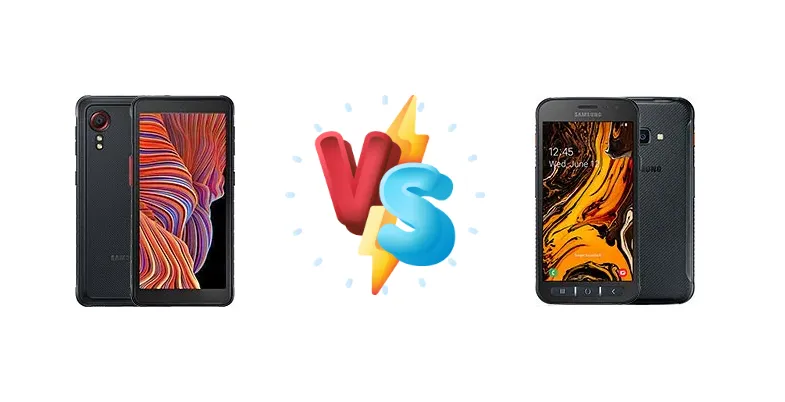
The Samsung Galaxy XCover line caters to a specific niche: users needing a durable, reliable smartphone for demanding environments. The XCover 4s has been a stalwart in this segment, but the XCover 5 introduces a newer chipset and refinements. This comparison dissects the key differences to determine which device offers the best value for professionals and outdoor enthusiasts.
🏆 Quick Verdict
For most users, the Samsung Galaxy XCover 5 is the superior choice. Its newer Exynos 850 chipset, built on an 8nm process, delivers a noticeable performance boost over the XCover 4s’s 14nm Exynos 7885, translating to smoother multitasking and app responsiveness. While charging remains slow on both, the XCover 5’s more efficient processor offers a slight edge in battery longevity.
| Network |
|---|
| 2G bands | GSM 850 / 900 / 1800 / 1900 | GSM 850 / 900 / 1800 / 1900 |
| 3G bands | HSDPA 850 / 900 / 1700(AWS) / 1900 / 2100 | HSDPA 850 / 900 / 1900 / 2100 |
| 4G bands | 1, 2, 3, 4, 5, 7, 8, 12, 17, 20, 26, 28, 38, 40, 41, 66 | 1, 3, 5, 7, 8, 20, 28, 38, 40 |
| Speed | HSPA, LTE | HSPA 42.2/5.76 Mbps, LTE (2CA) Cat6 300/50 Mbps |
| Technology | GSM / HSPA / LTE | GSM / HSPA / LTE |
| Launch |
|---|
| Announced | 2021, March 04 | 2019, June. Released 2019, July |
| Status | Available. Released 2021, March 12 | Discontinued |
| Body |
|---|
| Dimensions | 147.1 x 71.6 x 9.2 mm (5.79 x 2.82 x 0.36 in) | 146.2 x 73.3 x 9.7 mm (5.76 x 2.89 x 0.38 in) |
| SIM | · Nano-SIM· Nano-SIM + Nano-SIM | Single SIM (Micro-SIM) or Dual SIM (Micro-SIM, dual stand-by) |
| Weight | 172 g (6.07 oz) | 172 g (6.07 oz) |
| | IP68 dust/water resistant (up to 1.5m for 30 min)
MIL-STD-810H compliant | IP68 dust/water resistant (up to 1.5m for 30 min)
MIL-STD-810G compliant |
| Display |
|---|
| Resolution | 720 x 1480 pixels, 18.5:9 ratio (~311 ppi density) | 720 x 1280 pixels, 16:9 ratio (~294 ppi density) |
| Size | 5.3 inches, 71.3 cm2 (~67.7% screen-to-body ratio) | 5.0 inches, 68.9 cm2 (~64.3% screen-to-body ratio) |
| Type | PLS LCD | PLS LCD |
| Platform |
|---|
| CPU | Octa-core (4x2.0 GHz Cortex-A55 & 4x2.0 GHz Cortex-A55) | Octa-core (2x1.6 GHz Cortex-A73 & 6x1.6 GHz Cortex-A53) |
| Chipset | Exynos 850 (8 nm) | Exynos 7885 (14 nm) |
| GPU | Mali-G52 | Mali-G71 MP2 |
| OS | Android 11, upgradable to Android 14, One UI 6.1 | Android 9.0 (Pie), upgradable to Android 11, One UI 3.1 |
| Memory |
|---|
| Card slot | microSDXC (dedicated slot) | microSDXC (dedicated slot) |
| Internal | 64GB 4GB RAM | 32GB 3GB RAM |
| | eMMC 5.1 | eMMC 5.1 |
| Main Camera |
|---|
| Features | Dual LED flash, HDR, panorama | LED flash, HDR, panorama |
| Single | 16 MP, f/1.8, PDAF | 16 MP, f/1.7, PDAF |
| Video | 1080p@30fps | 1080p@30fps |
| Selfie camera |
|---|
| Single | 5 MP, f/2.2 | 5 MP, f/2.2 |
| Sound |
|---|
| 3.5mm jack | Yes | Yes |
| 35mm jack | Yes | Yes |
| Loudspeaker | Yes | Yes |
| Comms |
|---|
| Bluetooth | 5.0, A2DP, LE | 5.0, A2DP, LE |
| NFC | Yes | Yes |
| Positioning | GPS, GLONASS, GALILEO, BDS | GPS, GLONASS, GALILEO, BDS |
| Radio | Unspecified | FM radio |
| USB | USB Type-C 2.0, charging connector pins | USB Type-C 2.0 |
| WLAN | Wi-Fi 802.11 a/b/g/n/ac, dual-band, Wi-Fi Direct | Wi-Fi 802.11 a/b/g/n/ac, dual-band, Wi-Fi Direct |
| Features |
|---|
| Sensors | Accelerometer, gyro, proximity, compass | Accelerometer, proximity, compass |
| Battery |
|---|
| Charging | 15W wired | - |
| Type | Li-Ion 3000 mAh, removable | Li-Ion 2800 mAh, removable |
| Misc |
|---|
| Colors | Black | Gray |
| Models | SM-G525F, SM-G525F/DS, SM-G525N | SM-G398F, SM-G398FN/DS, SM-G398FN |
| Price | £ 61.49 / € 74.89 | About 260 EUR |
| SAR EU | 0.70 W/kg (head) 1.27 W/kg (body) | 0.91 W/kg (head) 1.31 W/kg (body) |
Samsung Galaxy XCover 5
- More powerful and efficient Exynos 850 chipset
- Improved multitasking and app responsiveness
- Potentially longer battery life due to 8nm process
- Still limited to 15W charging
- Detailed display specs are unknown
Samsung Galaxy XCover 4s
- Lower price point (likely)
- Proven reliability in the XCover series
- Durable build quality
- Older and less efficient Exynos 7885 chipset
- Slower performance and less responsive UI
- Potentially shorter battery life
Display Comparison
Both the XCover 5 and 4s feature displays designed for visibility in bright sunlight, a crucial feature for outdoor work. However, detailed display specs are missing. Given the XCover line’s focus on practicality, we can assume both utilize LCD panels. The XCover 5’s newer processor *could* support a higher refresh rate, but this isn’t confirmed. The 4s likely has larger bezels due to its older design, impacting screen-to-body ratio. Color accuracy is likely similar, prioritizing readability over color fidelity.
Camera Comparison
Camera details are sparse, but both phones likely prioritize functionality over photographic excellence. The XCover line isn’t aimed at photography enthusiasts. We can assume both feature basic rear and front cameras suitable for documentation and video calls. The absence of detailed sensor information suggests neither phone boasts impressive low-light performance. Any 2MP macro or depth sensors on either device are likely of limited practical use. The XCover 5 *may* benefit from improved image processing capabilities due to its newer ISP within the Exynos 850.
Performance
The core difference lies in the chipsets. The XCover 5’s Exynos 850 (8nm) represents a significant architectural leap over the XCover 4s’s Exynos 7885 (14nm). The 8nm process allows for greater transistor density and improved power efficiency. While both are octa-core CPUs, the XCover 5 utilizes Cortex-A55 cores across the board, offering consistent performance. The XCover 4s employs a mix of Cortex-A73 and A53 cores; the A73 provides a performance boost but consumes more power. This translates to faster app loading times and smoother multitasking on the XCover 5, particularly noticeable with demanding work applications. The XCover 5 will also benefit from better sustained performance due to improved thermal management.
Battery Life
Battery capacity is not specified, but both phones are designed for all-day use. The XCover 5’s Exynos 850, built on a more efficient 8nm process, will consume less power than the XCover 4s’s 14nm Exynos 7885. Both devices are limited to 15W wired charging, meaning neither offers particularly fast charging speeds. Expect approximately 2-3 hours to fully charge from 0-100% on both devices. The XCover 5’s efficiency advantage will likely result in slightly longer battery life under similar usage conditions.
Buying Guide
Buy the Samsung Galaxy XCover 5 if you prioritize performance for running modern work applications, require slightly better battery life during long shifts, and want a device with a more future-proof chipset. Buy the Samsung Galaxy XCover 4s if you are on a very tight budget and only need basic smartphone functionality for calls, texts, and light app usage, and value proven reliability over raw power.
Frequently Asked Questions
❓ Does the Exynos 850 in the XCover 5 generate excessive heat during prolonged use, like GPS navigation or video recording?
The Exynos 850’s 8nm process is designed for improved thermal efficiency compared to the XCover 4s’s 14nm Exynos 7885. While it will still generate heat under heavy load, it’s less likely to throttle performance as quickly, providing more consistent performance during extended tasks like GPS navigation or video recording.
❓ Is the 15W charging speed on both phones a significant drawback in 2024, and will it impact usability for users accustomed to faster charging?
Yes, 15W charging is relatively slow by modern standards. Users accustomed to 25W or faster charging will find the XCover 5 and 4s noticeably slower to charge. Expect approximately 2-3 hours for a full charge. This is a trade-off for the ruggedized design and focus on durability, prioritizing longevity over convenience.
❓ Given the lack of detailed camera specs, is the camera on either phone suitable for documenting work site conditions or taking detailed photos of equipment?
While both phones have cameras, they are likely best suited for basic documentation. Expect adequate image quality in good lighting conditions, but don't anticipate exceptional detail or low-light performance. For critical documentation, a dedicated camera is still recommended.