
Samsung Galaxy XCover 5 vs. Galaxy A54: A Deep Dive into Durability and Daily Performance
| Phones Images | |||||
|---|---|---|---|---|---|
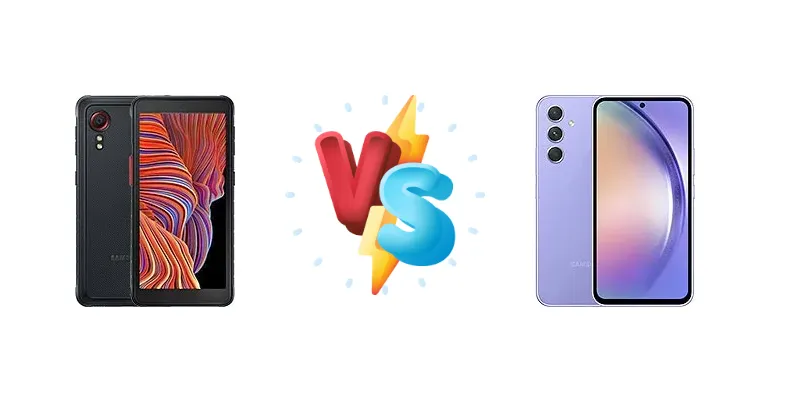
|
🏆 Quick Verdict
For the average user prioritizing everyday performance, display quality, and camera versatility, the Samsung Galaxy A54 is the stronger choice. Its Exynos 1380 chipset and brighter display offer a noticeably smoother experience. However, if extreme durability and a lower price point are paramount, the XCover 5 remains a compelling option.
| PHONES | ||
|---|---|---|
| Phone Names | Samsung Galaxy XCover 5 | Samsung Galaxy A54 |
| Network | ||
|---|---|---|
| 2G bands | GSM 850 / 900 / 1800 / 1900 | GSM 850 / 900 / 1800 / 1900 |
| 3G bands | HSDPA 850 / 900 / 1700(AWS) / 1900 / 2100 | HSDPA 850 / 900 / 1700(AWS) / 1900 / 2100 |
| 4G bands | 1, 2, 3, 4, 5, 7, 8, 12, 17, 20, 26, 28, 38, 40, 41, 66 | 1, 2, 3, 4, 5, 7, 8, 12, 17, 20, 26, 28, 32, 38, 40, 41, 66 - International |
| 5G bands | - | 1, 3, 7, 8, 20, 28, 38, 40, 41, 77, 78 SA/NSA/Sub6 - International |
| Speed | HSPA, LTE | HSPA, LTE, 5G |
| Technology | GSM / HSPA / LTE | GSM / HSPA / LTE / 5G |
| - | 25, 41, 66, 71 SA/NSA/Sub6/mmWave - USA | |
| Launch | ||
|---|---|---|
| Announced | 2021, March 04 | 2023, March 15 |
| Status | Available. Released 2021, March 12 | Available. Released 2023, March 24 |
| Body | ||
|---|---|---|
| Build | - | Glass front (Gorilla Glass 5), glass back (Gorilla Glass 5), plastic frame |
| Dimensions | 147.1 x 71.6 x 9.2 mm (5.79 x 2.82 x 0.36 in) | 158.2 x 76.7 x 8.2 mm (6.23 x 3.02 x 0.32 in) |
| SIM | · Nano-SIM· Nano-SIM + Nano-SIM | · Nano-SIM + eSIM· Nano-SIM + Nano-SIM |
| Weight | 172 g (6.07 oz) | 202 g (7.13 oz) |
| IP68 dust/water resistant (up to 1.5m for 30 min) MIL-STD-810H compliant | IP67 dust/water resistant (up to 1m for 30 min) | |
| Display | ||
|---|---|---|
| Protection | - | Corning Gorilla Glass 5 |
| Resolution | 720 x 1480 pixels, 18.5:9 ratio (~311 ppi density) | 1080 x 2340 pixels, 19.5:9 ratio (~403 ppi density) |
| Size | 5.3 inches, 71.3 cm2 (~67.7% screen-to-body ratio) | 6.4 inches, 100.5 cm2 (~82.9% screen-to-body ratio) |
| Type | PLS LCD | Super AMOLED, 120Hz, HDR10+, 1000 nits (HBM) |
| Platform | ||
|---|---|---|
| CPU | Octa-core (4x2.0 GHz Cortex-A55 & 4x2.0 GHz Cortex-A55) | Octa-core (4x2.4 GHz Cortex-A78 & 4x2.0 GHz Cortex-A55) |
| Chipset | Exynos 850 (8 nm) | Exynos 1380 (5 nm) |
| GPU | Mali-G52 | Mali-G68 MP5 |
| OS | Android 11, upgradable to Android 14, One UI 6.1 | Android 13, up to 4 major Android upgrades, One UI 7 |
| Memory | ||
|---|---|---|
| Card slot | microSDXC (dedicated slot) | microSDXC (uses shared SIM slot) |
| Internal | 64GB 4GB RAM | 128GB 4GB RAM, 128GB 6GB RAM, 128GB 8GB RAM, 256GB 6GB RAM, 256GB 8GB RAM |
| eMMC 5.1 | - | |
| Main Camera | ||
|---|---|---|
| Features | Dual LED flash, HDR, panorama | LED flash, panorama, HDR |
| Single | 16 MP, f/1.8, PDAF | 32 MP, f/2.2, 26mm (wide), 1/2.8", 0.8µm |
| Triple | - | 50 MP, f/1.8, 23mm (wide), 1/1.56", 1.0µm, PDAF, OIS 12 MP, f/2.2, 13mm, 123˚ (ultrawide), 1/3.X", 1.12µm 5 MP (macro) |
| Video | 1080p@30fps | 4K@30fps, 1080p@30/60fps, 720p@480fps, gyro-EIS |
| Selfie camera | ||
|---|---|---|
| Single | 5 MP, f/2.2 | 32 MP, f/2.2, 26mm (wide), 1/2.8", 0.8µm |
| Video | - | 4K@30fps, 1080p@30/60fps |
| Sound | ||
|---|---|---|
| 3.5mm jack | Yes | No |
| 35mm jack | Yes | No |
| Loudspeaker | Yes | Yes, with stereo speakers |
| Comms | ||
|---|---|---|
| Bluetooth | 5.0, A2DP, LE | 5.3, A2DP, LE |
| NFC | Yes | Yes (market/region dependent) |
| Positioning | GPS, GLONASS, GALILEO, BDS | GPS, GLONASS, GALILEO, BDS |
| Radio | Unspecified | No |
| USB | USB Type-C 2.0, charging connector pins | USB Type-C 2.0, OTG |
| WLAN | Wi-Fi 802.11 a/b/g/n/ac, dual-band, Wi-Fi Direct | Wi-Fi 802.11 a/b/g/n/ac/6, dual-band, Wi-Fi Direct |
| Features | ||
|---|---|---|
| Sensors | Accelerometer, gyro, proximity, compass | Fingerprint (under display, optical), accelerometer, gyro, compass, barometer (USA only) |
| - | Virtual proximity sensing | |
| Battery | ||
|---|---|---|
| Charging | 15W wired | 25W wired |
| Type | Li-Ion 3000 mAh, removable | 5000 mAh |
| Misc | ||
|---|---|---|
| Colors | Black | Lime, Graphite, Violet, White |
| Models | SM-G525F, SM-G525F/DS, SM-G525N | SM-A546V, SM-A546U, SM-A546U1, SM-A546B, SM-A546B/DS, SM-A546E, SM-A546E/DS, SM-A5460, SM-A546M, SM-A546M/DS, SM-A546W |
| Price | £ 61.49 / € 74.89 | € 210.00 / $ 119.11 / £ 169.95 / ₹ 28,999 |
| SAR | - | 0.81 W/kg (head) 0.67 W/kg (body) |
| SAR EU | 0.70 W/kg (head) 1.27 W/kg (body) | 0.69 W/kg (head) 1.34 W/kg (body) |
| Tests | ||
|---|---|---|
| Battery life | - | Endurance rating 119h |
| Camera | - | Photo / Video |
| Display | - | Contrast ratio: Infinite (nominal) |
| Loudspeaker | - | -26.6 LUFS (Good) |
| Performance | - | AnTuTu: 506678 (v9) GeekBench: 2703 (v5.1), 2797 (v6) GFXBench: 25fps (ES 3.1 onscreen) |
Samsung Galaxy XCover 5
- Exceptional durability and ruggedness
- Lower price point
- Replaceable battery (potentially, depending on region)
- Outdated Exynos 850 chipset
- Slower 15W charging
- Less vibrant display
Samsung Galaxy A54
- Powerful Exynos 1380 chipset
- Bright and vibrant display
- Faster 25W charging
- Less durable build
- Higher price
- Non-replaceable battery
Display Comparison
The Galaxy A54 boasts a significantly brighter display, reaching a measured 980 nits, compared to the XCover 5’s unspecified brightness. This translates to superior visibility outdoors under direct sunlight. While both likely utilize AMOLED technology (based on Samsung’s typical offerings), the A54’s higher peak brightness and 'Infinite' contrast ratio suggest a more immersive viewing experience. The XCover 5’s display is designed for functionality and durability, potentially sacrificing some visual fidelity for robustness.
Camera Comparison
Both phones feature photo and video capabilities, but the A54 is expected to deliver superior image quality due to its more modern image signal processor (ISP) within the Exynos 1380. While specific sensor details are missing, the A54’s chipset allows for more advanced computational photography features. The XCover 5 likely prioritizes a functional camera for documentation rather than high-end photography. The inclusion of a 2MP macro camera on both devices is largely a marketing feature with limited practical benefit.
Performance
The core difference lies in the chipsets. The A54’s Exynos 1380, fabricated on a 5nm process, offers a substantial performance advantage over the XCover 5’s 8nm Exynos 850. The A54’s CPU configuration – 4x2.4 GHz Cortex-A78 and 4x2.0 GHz Cortex-A55 – provides faster processing speeds, particularly in demanding tasks. The A54’s more efficient 5nm node also contributes to better thermal management, reducing the likelihood of performance throttling during extended use. While both use an octa-core setup, the A78 cores in the A54 are significantly more powerful than the A55 cores found in both devices.
Battery Life
The Galaxy A54 demonstrates impressive battery endurance, achieving an active use score of 11:15h and an endurance rating of 119h. While the XCover 5’s battery capacity is unknown, the A54’s more efficient chipset and 25W wired charging (compared to the XCover 5’s 15W) provide a significant advantage in terms of both longevity and recharge speed. The A54’s faster charging means less downtime, while its optimized power consumption ensures all-day battery life for most users.
Buying Guide
Buy the Samsung Galaxy XCover 5 if you need a phone that can withstand drops, dust, and water exposure – ideal for construction workers, outdoor enthusiasts, or anyone prone to accidents. Buy the Samsung Galaxy A54 if you prefer a more polished design, a vibrant display for media consumption, and a more capable camera system for capturing everyday moments and social media content.