
Samsung Galaxy XCover 5 vs. Galaxy A14 5G: A Deep Dive into Durability and Value
| Phones Images | |||||
|---|---|---|---|---|---|
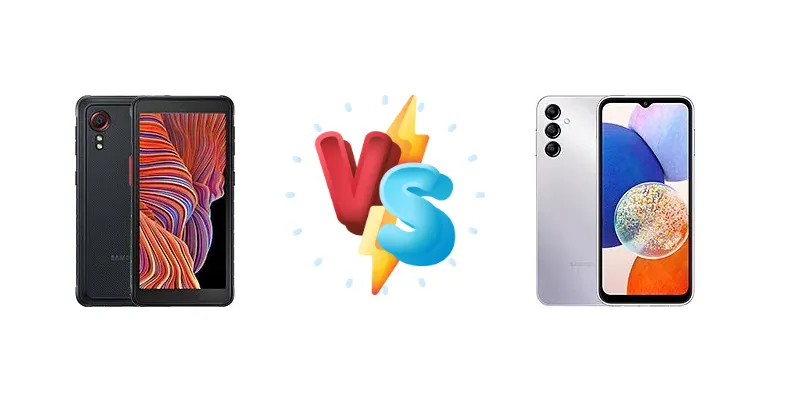
|
🏆 Quick Verdict
For users prioritizing durability and a guaranteed level of drop protection, the Galaxy XCover 5 is the clear winner. However, the Galaxy A14 5G offers significantly improved processing power with the Exynos 1330 (or Dimensity 700 depending on region) and a brighter display, making it the better choice for everyday users seeking a budget-friendly 5G experience.
| PHONES | ||
|---|---|---|
| Phone Names | Samsung Galaxy XCover 5 | Samsung Galaxy A14 5G |
| Network | ||
|---|---|---|
| 2G bands | GSM 850 / 900 / 1800 / 1900 | GSM 850 / 900 / 1800 / 1900 |
| 3G bands | HSDPA 850 / 900 / 1700(AWS) / 1900 / 2100 | HSDPA 850 / 900 / 1700(AWS) / 1900 / 2100 |
| 4G bands | 1, 2, 3, 4, 5, 7, 8, 12, 17, 20, 26, 28, 38, 40, 41, 66 | 1, 2, 3, 4, 5, 7, 8, 12, 17, 20, 26, 28, 38, 40, 41, 66 - International |
| 5G bands | - | 2, 5, 66, 77 Sub6/mmWave - USA |
| Speed | HSPA, LTE | HSPA, LTE, 5G |
| Technology | GSM / HSPA / LTE | GSM / HSPA / LTE / 5G |
| - | 1, 3, 5, 7, 8, 20, 28, 40, 41, 78 SA/NSA/Sub6 - India | |
| Launch | ||
|---|---|---|
| Announced | 2021, March 04 | 2023, January 04 |
| Status | Available. Released 2021, March 12 | Available. Released 2023, January 12 |
| Body | ||
|---|---|---|
| Build | - | Glass front, plastic back, plastic frame |
| Dimensions | 147.1 x 71.6 x 9.2 mm (5.79 x 2.82 x 0.36 in) | 167.7 x 78 x 9.1 mm (6.60 x 3.07 x 0.36 in) |
| SIM | · Nano-SIM· Nano-SIM + Nano-SIM | · Nano-SIM· Nano-SIM + Nano-SIM |
| Weight | 172 g (6.07 oz) | 202 g (7.13 oz) |
| IP68 dust/water resistant (up to 1.5m for 30 min) MIL-STD-810H compliant | - | |
| Display | ||
|---|---|---|
| Resolution | 720 x 1480 pixels, 18.5:9 ratio (~311 ppi density) | 1080 x 2408 pixels, 20:9 ratio (~400 ppi density) |
| Size | 5.3 inches, 71.3 cm2 (~67.7% screen-to-body ratio) | 6.6 inches, 104.9 cm2 (~80.2% screen-to-body ratio) |
| Type | PLS LCD | PLS LCD, 90Hz |
| Platform | ||
|---|---|---|
| CPU | Octa-core (4x2.0 GHz Cortex-A55 & 4x2.0 GHz Cortex-A55) | Octa-core (2x2.4 GHz Cortex-A78 & 6x2.0 GHz Cortex-A55) - SM-A146BOcta-core (2x2.2 GHz Cortex-A76 & 6x2.0 GHz Cortex-A55) - SM-A146P |
| Chipset | Exynos 850 (8 nm) | Exynos 1330 (5 nm) - SM-A146BMediatek Dimensity 700 (7 nm) - SM-A146P |
| GPU | Mali-G52 | Mali-G68 MP2 - SM-A146BMali-G57 MC2 - SM-A146P |
| OS | Android 11, upgradable to Android 14, One UI 6.1 | Android 13, upgradable to Android 15, One UI Core 7 |
| Memory | ||
|---|---|---|
| Card slot | microSDXC (dedicated slot) | microSDXC (uses shared SIM slot) - USA onlymicroSDXC (dedicated slot) - International |
| Internal | 64GB 4GB RAM | 64GB 4GB RAM, 128GB 4GB RAM, 128GB 6GB RAM, 128GB 8GB RAM |
| eMMC 5.1 | - | |
| Main Camera | ||
|---|---|---|
| Features | Dual LED flash, HDR, panorama | LED flash, panorama, HDR |
| Single | 16 MP, f/1.8, PDAF | 13 MP, f/2.0, (wide) |
| Triple | - | 50 MP, f/1.8, 26mm (wide), 1/2.76", 0.64µm, PDAF 2 MP (macro) Auxiliary lens |
| Video | 1080p@30fps | 1080p@30fps |
| Selfie camera | ||
|---|---|---|
| Single | 5 MP, f/2.2 | 13 MP, f/2.0, 26mm (wide), 1.12µm |
| Video | - | 1080p@30fps |
| Sound | ||
|---|---|---|
| 3.5mm jack | Yes | Yes |
| 35mm jack | Yes | Yes |
| Loudspeaker | Yes | Yes |
| Comms | ||
|---|---|---|
| Bluetooth | 5.0, A2DP, LE | 5.2, A2DP, LE |
| NFC | Yes | Yes |
| Positioning | GPS, GLONASS, GALILEO, BDS | GPS, GLONASS, GALILEO |
| Radio | Unspecified | FM radio (Exynos 1330 chipset only), recording |
| USB | USB Type-C 2.0, charging connector pins | USB Type-C 2.0 |
| WLAN | Wi-Fi 802.11 a/b/g/n/ac, dual-band, Wi-Fi Direct | Wi-Fi 802.11 a/b/g/n/ac, dual-band, Wi-Fi Direct |
| Features | ||
|---|---|---|
| Sensors | Accelerometer, gyro, proximity, compass | Fingerprint (side-mounted), accelerometer, gyro, proximity, compass, barometer (USA only) |
| Battery | ||
|---|---|---|
| Charging | 15W wired | 15W wired |
| Type | Li-Ion 3000 mAh, removable | Li-Po 5000 mAh |
| Misc | ||
|---|---|---|
| Colors | Black | Black, Light Green, Dark Red, Silver |
| Models | SM-G525F, SM-G525F/DS, SM-G525N | SM-A146B, SM-A146B/DS, SM-A146P, SM-A146P/DS, SM-A146U, SM-A146U1, SM-A146U1/DS, SM-A146W, SM-A146P/N, SM-A146P/DSN, SM-S146VL, SM-A146M |
| Price | £ 61.49 / € 74.89 | $ 77.63 / C$ 151.00 / £ 97.00 / € 159.79 / ₹ 14,990 |
| SAR | - | 1.00 W/kg (head) 1.00 W/kg (body) |
| SAR EU | 0.70 W/kg (head) 1.27 W/kg (body) | 0.56 W/kg (head) 1.28 W/kg (body) |
| Tests | ||
|---|---|---|
| Battery life | - | Endurance rating 130h |
| Camera | - | Photo / Video |
| Display | - | Contrast ratio: 1334:1 (nominal) |
| Loudspeaker | - | -26.8 LUFS (Good) |
| Performance | - | AnTuTu: 307886 (v9) GeekBench: 1727 (v5.1) GFXBench: 12fps (ES 3.1 onscreen) |
Samsung Galaxy XCover 5
- Exceptional durability and drop protection
- Designed for harsh environments
- Replaceable battery (potentially, depending on region)
- Outdated Exynos 850 processor
- Likely lower display quality
- Limited camera capabilities
Samsung Galaxy A14 5G
- More powerful Exynos 1330 or Dimensity 700 processor
- Brighter and more vibrant display
- 5G connectivity at an affordable price
- Less durable build quality
- Standard plastic construction
- 15W charging is relatively slow
Display Comparison
The Galaxy A14 5G boasts a brighter display, measured at 519 nits, compared to the XCover 5’s unspecified brightness. Both share a 1334:1 contrast ratio, suggesting similar color reproduction quality. However, the A14 5G’s higher peak brightness translates to better visibility under direct sunlight. The XCover 5’s display, while likely durable, lacks the vibrancy and clarity of the A14 5G’s panel, impacting media consumption and outdoor usability.
Camera Comparison
Both phones offer a 'Photo / Video' camera experience, but details are sparse. Without specific sensor information, it’s difficult to make a definitive judgment. However, the A14 5G’s newer chipset likely incorporates improved image signal processing (ISP) capabilities, potentially leading to better image quality, especially in low-light conditions. The XCover 5’s camera is likely geared towards functional image capture rather than high-end photography. We can assume both phones will have a basic macro camera, but its 2MP resolution on both devices suggests limited utility.
Performance
The performance gap is significant. The Galaxy A14 5G, depending on the region, utilizes either the Exynos 1330 (5nm) or the MediaTek Dimensity 700 (7nm). Both represent a substantial leap over the XCover 5’s Exynos 850 (8nm). The A14 5G’s CPU configuration – featuring Cortex-A78 cores – provides faster processing speeds for demanding tasks. The 5nm or 7nm process node used in the A14 5G’s chipsets also contributes to improved power efficiency and reduced thermal throttling compared to the XCover 5’s 8nm Exynos 850. This means smoother multitasking, faster app loading times, and a more responsive user experience on the A14 5G.
Battery Life
Both the XCover 5 and A14 5G share a 15W wired charging capability, indicating similar charging speeds. The A14 5G’s endurance rating of 130 hours suggests comparable battery life to what we’d expect from the XCover 5, despite the A14 5G’s more powerful processor. The A14 5G’s more efficient chipset may offset the power draw, resulting in similar real-world battery performance. However, the XCover 5 may offer slightly longer battery life in standby mode due to its less demanding processor.
Buying Guide
Buy the Samsung Galaxy XCover 5 if you need a phone that can withstand drops, dust, and extreme temperatures – ideal for construction workers, outdoor enthusiasts, or anyone in a harsh work environment. Buy the Samsung Galaxy A14 5G if you prefer a more modern processor for smoother multitasking and gaming, a brighter display for outdoor visibility, and are looking for the best possible value in a 5G-enabled smartphone.