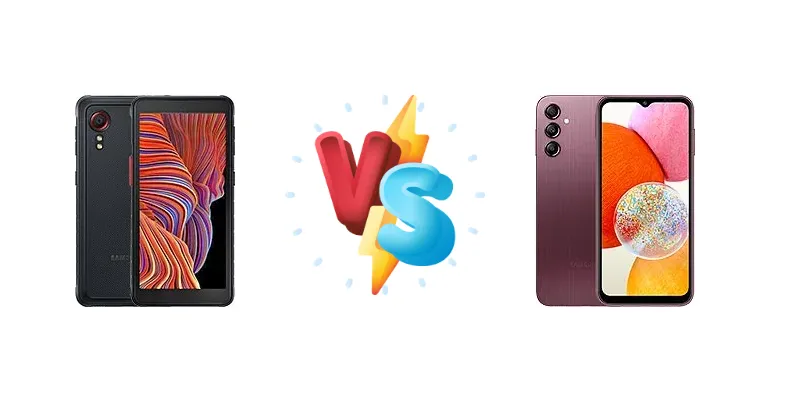
Samsung caters to diverse needs with its smartphone lineup. The Galaxy XCover 5 prioritizes ruggedness and reliability for demanding environments, while the Galaxy A14 focuses on delivering essential features at an accessible price point. This comparison dissects their core components to determine which device best suits your priorities.
🏆 Quick Verdict
For users prioritizing durability and a guaranteed level of performance, the Samsung Galaxy XCover 5 is the better choice. Its Exynos 850 chipset, while older, offers a more consistent experience than the potentially variable performance of the A14’s Mediatek Helio G80, and its ruggedized design is unmatched.
| Network |
|---|
| 2G bands | GSM 850 / 900 / 1800 / 1900 | GSM 850 / 900 / 1800 / 1900 |
| 3G bands | HSDPA 850 / 900 / 1700(AWS) / 1900 / 2100 | HSDPA 850 / 900 / 2100 |
| 4G bands | 1, 2, 3, 4, 5, 7, 8, 12, 17, 20, 26, 28, 38, 40, 41, 66 | 1, 3, 5, 7, 8, 20, 28, 38, 40, 41 |
| Speed | HSPA, LTE | HSPA, LTE |
| Technology | GSM / HSPA / LTE | GSM / HSPA / LTE |
| Launch |
|---|
| Announced | 2021, March 04 | 2023, February 28 |
| Status | Available. Released 2021, March 12 | Available. Released 2023, March 27 |
| Body |
|---|
| Build | - | Glass front, plastic back, plastic frame |
| Dimensions | 147.1 x 71.6 x 9.2 mm (5.79 x 2.82 x 0.36 in) | 167.7 x 78 x 9.1 mm (6.60 x 3.07 x 0.36 in) |
| SIM | · Nano-SIM· Nano-SIM + Nano-SIM | · Nano-SIM· Nano-SIM + Nano-SIM |
| Weight | 172 g (6.07 oz) | 201 g (7.09 oz) |
| | IP68 dust/water resistant (up to 1.5m for 30 min)
MIL-STD-810H compliant | - |
| Display |
|---|
| Resolution | 720 x 1480 pixels, 18.5:9 ratio (~311 ppi density) | 1080 x 2408 pixels, 20:9 ratio (~400 ppi density) |
| Size | 5.3 inches, 71.3 cm2 (~67.7% screen-to-body ratio) | 6.6 inches, 104.9 cm2 (~80.2% screen-to-body ratio) |
| Type | PLS LCD | PLS LCD |
| Platform |
|---|
| CPU | Octa-core (4x2.0 GHz Cortex-A55 & 4x2.0 GHz Cortex-A55) | Octa-core (2x2.0 GHz Cortex-A75 & 6x1.8 GHz Cortex-A55) - Version AOcta-core (4x2.0 GHz Cortex-A55 & 4x2.0 GHz Cortex-A55) - Version B |
| Chipset | Exynos 850 (8 nm) | Mediatek MT6769 Helio G80 (12 nm) - Version AExynos 850 (8 nm) - Version B |
| GPU | Mali-G52 | Mali-G52 MC2 |
| OS | Android 11, upgradable to Android 14, One UI 6.1 | Android 13, upgradable to Android 15, One UI 7 |
| Memory |
|---|
| Card slot | microSDXC (dedicated slot) | microSDXC (dedicated slot) |
| Internal | 64GB 4GB RAM | 64GB 4GB RAM, 128GB 4GB RAM, 128GB 6GB RAM |
| | eMMC 5.1 | - |
| Main Camera |
|---|
| Features | Dual LED flash, HDR, panorama | LED flash, panorama, HDR |
| Single | 16 MP, f/1.8, PDAF | 13 MP, f/2.0, (wide) |
| Triple | - | 50 MP, f/1.8, 26mm (wide), 1/2.75", 0.64µm, PDAF
5 MP, f/2.2, 17mm (ultrawide), 1/5.0", 1.12µm
2 MP (macro) |
| Video | 1080p@30fps | 1080p@30fps |
| Selfie camera |
|---|
| Single | 5 MP, f/2.2 | 13 MP, f/2.0, 26mm (wide), 1/3.1", 1.12µm |
| Video | - | 1080p@30fps |
| Sound |
|---|
| 3.5mm jack | Yes | Yes |
| 35mm jack | Yes | Yes |
| Loudspeaker | Yes | Yes |
| Comms |
|---|
| Bluetooth | 5.0, A2DP, LE | 5.1 or 5.3, A2DP, LE |
| NFC | Yes | Yes (market/region dependent) |
| Positioning | GPS, GLONASS, GALILEO, BDS | GPS, GALILEO, GLONASS, BDS, QZSS |
| Radio | Unspecified | Unspecified |
| USB | USB Type-C 2.0, charging connector pins | USB Type-C 2.0 |
| WLAN | Wi-Fi 802.11 a/b/g/n/ac, dual-band, Wi-Fi Direct | Wi-Fi 802.11 a/b/g/n/ac, dual-band, Wi-Fi Direct |
| Features |
|---|
| Sensors | Accelerometer, gyro, proximity, compass | Fingerprint (side-mounted), accelerometer, proximity, compass |
| Battery |
|---|
| Charging | 15W wired | 15W wired |
| Type | Li-Ion 3000 mAh, removable | Li-Po 5000 mAh |
| Misc |
|---|
| Colors | Black | Black, Dark Red, Silver, Green |
| Models | SM-G525F, SM-G525F/DS, SM-G525N | SM-A145F, SM-A145F/DSN, SM-A145M, SM-A145M/DS, SM-A145P, SM-A145R |
| Price | £ 61.49 / € 74.89 | € 85.76 / $ 147.60 / £ 79.95 |
| SAR EU | 0.70 W/kg (head) 1.27 W/kg (body) | 0.46 W/kg (head) 1.37 W/kg (body) |
Samsung Galaxy XCover 5
- Exceptional durability and ruggedness
- Reliable performance from the Exynos 850
- Potentially better build quality and longevity
- Potentially less vibrant display
- May have a smaller battery capacity
Samsung Galaxy A14
- More affordable price point
- Potentially larger display
- May offer a larger battery capacity
- Performance variability depending on chipset version (Helio G80 vs. Exynos 850)
- Less durable build quality
Display Comparison
Both devices feature displays geared towards practicality rather than premium visuals. While specific display specs (resolution, panel type) are missing, the XCover 5’s rugged design likely necessitates a more durable, potentially less vibrant panel. The A14, being a more mainstream device, may offer a slightly more color-accurate display, but neither is expected to compete with flagship-level brightness or color gamut coverage. Bezels are likely to be more pronounced on the XCover 5 due to the reinforced casing.
Camera Comparison
Camera performance is likely to be similar, focusing on everyday photography rather than professional-grade results. Details on sensor sizes and lens apertures are absent, but both phones likely employ a multi-camera setup with a primary sensor and supporting lenses (potentially including a depth or macro sensor). The A14’s marketing may emphasize camera features more heavily, but the XCover 5’s image processing could be tuned for greater reliability in challenging conditions. The presence of a 2MP macro camera on either device is unlikely to significantly impact image quality.
Performance
The performance landscape is the most interesting divergence. The XCover 5’s Exynos 850 (8nm) is a mature chipset known for efficiency. The A14 presents a more complex picture, offering two versions: one with the Mediatek Helio G80 (12nm) and another with the same Exynos 850 as the XCover 5. The Helio G80, while featuring Cortex-A75 performance cores (vs. the A55 in the XCover 5), is built on a larger 12nm process, potentially leading to higher power consumption and thermal throttling under sustained load. The Exynos 850 version of the A14 effectively negates this performance difference, making the choice hinge on other factors. Both phones share the same CPU core configuration in their Exynos variants, but the A14’s RAM configuration (not specified) could impact multitasking performance.
Battery Life
Both the XCover 5 and A14 support 15W wired charging, indicating a similar charging experience. Battery capacity is not specified, but the XCover 5’s rugged design may necessitate a slightly smaller battery to accommodate the reinforced chassis. The A14, with its larger form factor, could potentially house a larger battery. However, the more efficient Exynos 850 in the XCover 5 could offset this capacity difference, resulting in comparable real-world battery life. Expect approximately 2-3 hours of screen-on time for typical usage on both devices.
Buying Guide
Buy the Samsung Galaxy XCover 5 if you need a phone that can withstand drops, dust, and water exposure – ideal for outdoor workers, adventurers, or anyone prone to accidents. Buy the Samsung Galaxy A14 if you prioritize a larger display, a lower upfront cost, and are comfortable with potentially less consistent performance in demanding tasks.
Frequently Asked Questions
❓ Does the Mediatek Helio G80 in the A14 overheat during extended gaming sessions?
The Helio G80, being built on a 12nm process, is more prone to thermal throttling than the 8nm Exynos 850. While it can handle casual gaming, prolonged, graphically intensive games may lead to noticeable performance drops as the chip heats up. The Exynos 850 version of the A14 will perform similarly to the XCover 5 in this regard.
❓ Is the XCover 5's ruggedness worth the trade-off in potentially less vibrant display quality?
For users who frequently work or spend time in challenging environments, the XCover 5’s ruggedness is a significant benefit. The trade-off in display quality is likely minimal and acceptable for those prioritizing durability and reliability over peak visual fidelity. The reinforced display is designed to withstand impacts that would shatter a standard smartphone screen.
❓ What real-world benefits does the IP68 rating of the XCover 5 provide?
The IP68 rating means the XCover 5 is dust-tight and can survive immersion in up to 1.5 meters of freshwater for up to 30 minutes. This is invaluable for construction workers, outdoor enthusiasts, or anyone who frequently exposes their phone to harsh conditions. It offers peace of mind against accidental spills, drops in water, and dusty environments.