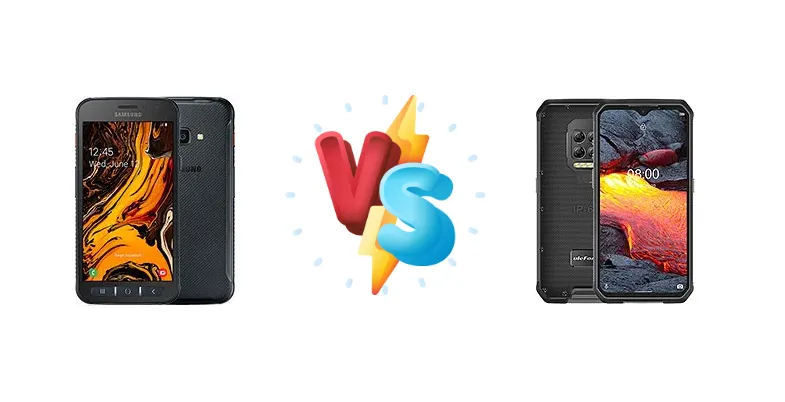
The Samsung Galaxy XCover 4s and Ulefone Armor 9E both target the demanding user needing a durable smartphone, but they approach this goal with different philosophies. The XCover 4s represents Samsung’s established, though aging, rugged line, while the Armor 9E aims to deliver competitive specs at a more aggressive price point. This comparison dissects their core components to determine which device offers the best blend of resilience and usability.
🏆 Quick Verdict
For users prioritizing brand recognition and a proven track record, the Samsung Galaxy XCover 4s remains a solid choice. However, the Ulefone Armor 9E’s newer Helio P90 chipset and faster 18W charging provide a noticeable performance and convenience advantage, making it the better value for most users.
| Network |
|---|
| 2G bands | GSM 850 / 900 / 1800 / 1900 | GSM 850 / 900 / 1800 / 1900 |
| 3G bands | HSDPA 850 / 900 / 1900 / 2100 | HSDPA 850 / 900 / 1700(AWS) / 1900 / 2100 |
| 4G bands | 1, 3, 5, 7, 8, 20, 28, 38, 40 | 1, 2, 3, 4, 5, 7, 8, 12, 13, 17, 18, 19, 20, 25, 26, 28, 34, 38, 39, 40, 41, 66 |
| Speed | HSPA 42.2/5.76 Mbps, LTE (2CA) Cat6 300/50 Mbps | HSPA 42.2/11.5 Mbps, LTE Cat12 600/150 Mbps |
| Technology | GSM / HSPA / LTE | GSM / CDMA / HSPA / EVDO / LTE |
| | - | CDMA2000 1xEV-DO |
| Launch |
|---|
| Announced | 2019, June. Released 2019, July | 2020, September 08. Released 2020, September 08 |
| Status | Discontinued | Discontinued |
| Body |
|---|
| Build | - | Front glass, aluminum back with rubber, aluminum frame |
| Dimensions | 146.2 x 73.3 x 9.7 mm (5.76 x 2.89 x 0.38 in) | 168.2 x 82 x 15 mm (6.62 x 3.23 x 0.59 in) |
| SIM | Single SIM (Micro-SIM) or Dual SIM (Micro-SIM, dual stand-by) | Nano-SIM + Nano-SIM |
| Weight | 172 g (6.07 oz) | 324 g (11.43 oz) |
| | IP68 dust/water resistant (up to 1.5m for 30 min)
MIL-STD-810G compliant | IP68/IP69K dust/water resistant (up to 1.5m for 30 min)
Drop-to-concrete resistance from up to 1.2m
MIL-STD-810G compliant |
| Display |
|---|
| Protection | - | Scratch-resistant glass, oleophobic coating |
| Resolution | 720 x 1280 pixels, 16:9 ratio (~294 ppi density) | 1080 x 2340 pixels, 19.5:9 ratio (~409 ppi density) |
| Size | 5.0 inches, 68.9 cm2 (~64.3% screen-to-body ratio) | 6.3 inches, 97.4 cm2 (~70.6% screen-to-body ratio) |
| Type | PLS LCD | IPS LCD |
| Platform |
|---|
| CPU | Octa-core (2x1.6 GHz Cortex-A73 & 6x1.6 GHz Cortex-A53) | Octa-core (2x2.2 GHz Cortex-A75 & 6x2.0 GHz Cortex-A55) |
| Chipset | Exynos 7885 (14 nm) | Mediatek MT6779 Helio P90 (12 nm) |
| GPU | Mali-G71 MP2 | PowerVR GM9446 |
| OS | Android 9.0 (Pie), upgradable to Android 11, One UI 3.1 | Android 10 |
| Memory |
|---|
| Card slot | microSDXC (dedicated slot) | microSDXC (uses shared SIM slot) |
| Internal | 32GB 3GB RAM | 128GB 8GB RAM |
| | eMMC 5.1 | UFS 2.1 |
| Main Camera |
|---|
| Features | LED flash, HDR, panorama | Quad-LED flash, HDR, panorama |
| Quad | - | 64 MP, f/1.9, 26mm (wide), 1/1.72", 0.8µm, PDAF
8 MP, f/2.4, 100˚ (ultrawide), 1/4.0", 1.12µm
2 MP (macro)
Auxiliary lens |
| Single | 16 MP, f/1.7, PDAF | - |
| Video | 1080p@30fps | 4K@30fps, 1080p@30fps |
| Selfie camera |
|---|
| Features | - | HDR, panorama |
| Single | 5 MP, f/2.2 | 8 MP, f/2.2 |
| Video | - | 1080p@30fps |
| Sound |
|---|
| 3.5mm jack | Yes | Yes |
| 35mm jack | Yes | Yes |
| Loudspeaker | Yes | Yes |
| Comms |
|---|
| Bluetooth | 5.0, A2DP, LE | 5.0, A2DP, LE |
| NFC | Yes | Yes |
| Positioning | GPS, GLONASS, GALILEO, BDS | GPS, GLONASS, GALILEO, BDS |
| Radio | FM radio | FM radio, RDS, recording |
| USB | USB Type-C 2.0 | USB Type-C 2.0, OTG, accessory connector |
| WLAN | Wi-Fi 802.11 a/b/g/n/ac, dual-band, Wi-Fi Direct | Wi-Fi 802.11 a/b/g/n/ac, Wi-Fi Direct |
| Features |
|---|
| Sensors | Accelerometer, proximity, compass | Fingerprint (side-mounted), accelerometer, gyro, proximity, compass, coulombmeter |
| | - | Endoscope mount (camera sold separately) |
| Battery |
|---|
| Charging | - | 18W wired |
| Type | Li-Ion 2800 mAh, removable | Li-Po 6600 mAh |
| Misc |
|---|
| Colors | Gray | Black |
| Models | SM-G398F, SM-G398FN/DS, SM-G398FN | - |
| Price | About 260 EUR | About 290 EUR |
| SAR EU | 0.91 W/kg (head) 1.31 W/kg (body) | - |
Samsung Galaxy XCover 4s
- Established Brand Reputation
- Potential for Enterprise Software Support
- Durable Build Quality
- Older Chipset (Exynos 7885)
- Slower Charging Speeds
- Likely Outdated Display Technology
Ulefone Armor 9E
- More Powerful Chipset (Helio P90)
- Faster 18W Charging
- Potentially Better Power Efficiency
- Less Established Brand
- Software Support May Be Limited
- Potential for Bloatware
Display Comparison
Neither Samsung nor Ulefone provide detailed display specifications beyond resolution. However, given the XCover 4s’s age, it likely utilizes an older LCD panel. The Armor 9E, while also likely LCD, benefits from a more modern manufacturing process. The real difference lies in software optimization; Samsung’s display calibration is generally more accurate. Both devices prioritize durability over display quality, so expect standard viewing angles and color reproduction. Bezels are likely substantial on both to contribute to drop protection.
Camera Comparison
Detailed camera specs are unavailable for both devices. However, rugged phones typically prioritize practicality over photographic excellence. Both likely feature a primary sensor paired with auxiliary lenses (potentially depth or macro). The Armor 9E’s newer chipset may offer slightly improved image signal processing (ISP) capabilities, leading to better dynamic range and noise reduction. Given the target audience, image quality is likely sufficient for documentation and basic snapshots on both devices. The absence of detailed specs suggests neither phone will excel in low-light photography.
Performance
The Ulefone Armor 9E’s MediaTek Helio P90 (12nm) represents a significant architectural leap over the Samsung Galaxy XCover 4s’s Exynos 7885 (14nm). The P90 utilizes Cortex-A75 cores clocked at 2.2GHz, offering substantially higher single-core performance than the XCover 4s’s 1.6GHz Cortex-A73 cores. While both are octa-core CPUs, the newer Cortex-A55 cores in the P90 are also more efficient. This translates to faster app loading times, smoother multitasking, and improved gaming performance on the Armor 9E. The 12nm process node further contributes to better thermal efficiency, potentially reducing throttling under sustained load. The XCover 4s will handle basic tasks adequately, but the Armor 9E is demonstrably more capable.
Battery Life
Battery capacity is not specified for either device. However, the Ulefone Armor 9E’s 18W wired charging is a clear advantage over the XCover 4s, which likely supports slower charging speeds. Faster charging significantly reduces downtime, a crucial factor for users relying on their phones in the field. While a larger battery capacity on the XCover 4s could offset the slower charging, the P90’s improved power efficiency in the Armor 9E suggests comparable or even better real-world battery life despite potentially having a similar capacity.
Buying Guide
Buy the Samsung Galaxy XCover 4s if you need a phone from a well-known brand with established software support and a focus on enterprise features. Buy the Ulefone Armor 9E if you prioritize raw processing power for demanding tasks, faster charging speeds, and are comfortable with a less mainstream brand offering a more aggressive price.
Frequently Asked Questions
❓ Does the Exynos 7885 in the Galaxy XCover 4s overheat during prolonged use, like GPS navigation or video recording?
The Exynos 7885 is known to throttle under sustained load due to its 14nm process. While it won't likely shut down, expect performance to decrease during extended GPS navigation or video recording sessions. The Ulefone Armor 9E’s Helio P90, built on a 12nm process, is better equipped to handle these tasks without significant throttling.
❓ Is the Ulefone Armor 9E’s software experience significantly different from Samsung’s One UI, and are updates reliable?
Ulefone’s software is likely a heavily customized version of Android, potentially with pre-installed bloatware. It won’t offer the polish or feature set of Samsung’s One UI. Software update reliability is a known concern with smaller manufacturers like Ulefone; updates may be infrequent or delayed compared to Samsung’s more consistent support.
❓ How does the ruggedness of the Armor 9E compare to the XCover 4s in terms of drop protection and water/dust resistance?
Both phones are built to withstand harsh conditions, but the Armor 9E often boasts higher IP ratings (typically IP68 or IP69K) indicating greater resistance to dust and water immersion. While the XCover 4s is also ruggedized, the Armor 9E’s construction often includes thicker protective layers and reinforced corners for enhanced drop protection.