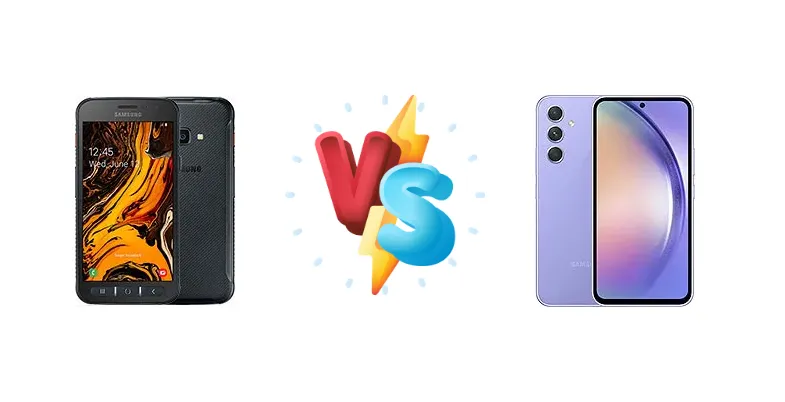
Choosing a new smartphone can be overwhelming. The Samsung Galaxy XCover 4s offers rugged durability, while the Galaxy A54 boasts a modern design and advanced features. This comparison breaks down the key differences to help you determine which device best suits your needs.
🏆 Quick Verdict
The Galaxy A54 is the clear winner for most users, offering a superior display, camera, and performance thanks to its newer chipset. However, the XCover 4s remains a compelling choice for those prioritizing ruggedness and a long-lasting battery in a durable package.
| Network |
|---|
| 2G bands | GSM 850 / 900 / 1800 / 1900 | GSM 850 / 900 / 1800 / 1900 |
| 3G bands | HSDPA 850 / 900 / 1900 / 2100 | HSDPA 850 / 900 / 1700(AWS) / 1900 / 2100 |
| 4G bands | 1, 3, 5, 7, 8, 20, 28, 38, 40 | 1, 2, 3, 4, 5, 7, 8, 12, 17, 20, 26, 28, 32, 38, 40, 41, 66 - International |
| 5G bands | - | 1, 3, 7, 8, 20, 28, 38, 40, 41, 77, 78 SA/NSA/Sub6 - International |
| Speed | HSPA 42.2/5.76 Mbps, LTE (2CA) Cat6 300/50 Mbps | HSPA, LTE, 5G |
| Technology | GSM / HSPA / LTE | GSM / HSPA / LTE / 5G |
| | - | 25, 41, 66, 71 SA/NSA/Sub6/mmWave - USA |
| Launch |
|---|
| Announced | 2019, June. Released 2019, July | 2023, March 15 |
| Status | Discontinued | Available. Released 2023, March 24 |
| Body |
|---|
| Build | - | Glass front (Gorilla Glass 5), glass back (Gorilla Glass 5), plastic frame |
| Dimensions | 146.2 x 73.3 x 9.7 mm (5.76 x 2.89 x 0.38 in) | 158.2 x 76.7 x 8.2 mm (6.23 x 3.02 x 0.32 in) |
| SIM | Single SIM (Micro-SIM) or Dual SIM (Micro-SIM, dual stand-by) | · Nano-SIM + eSIM· Nano-SIM + Nano-SIM |
| Weight | 172 g (6.07 oz) | 202 g (7.13 oz) |
| | IP68 dust/water resistant (up to 1.5m for 30 min)
MIL-STD-810G compliant | IP67 dust/water resistant (up to 1m for 30 min) |
| Display |
|---|
| Protection | - | Corning Gorilla Glass 5 |
| Resolution | 720 x 1280 pixels, 16:9 ratio (~294 ppi density) | 1080 x 2340 pixels, 19.5:9 ratio (~403 ppi density) |
| Size | 5.0 inches, 68.9 cm2 (~64.3% screen-to-body ratio) | 6.4 inches, 100.5 cm2 (~82.9% screen-to-body ratio) |
| Type | PLS LCD | Super AMOLED, 120Hz, HDR10+, 1000 nits (HBM) |
| Platform |
|---|
| CPU | Octa-core (2x1.6 GHz Cortex-A73 & 6x1.6 GHz Cortex-A53) | Octa-core (4x2.4 GHz Cortex-A78 & 4x2.0 GHz Cortex-A55) |
| Chipset | Exynos 7885 (14 nm) | Exynos 1380 (5 nm) |
| GPU | Mali-G71 MP2 | Mali-G68 MP5 |
| OS | Android 9.0 (Pie), upgradable to Android 11, One UI 3.1 | Android 13, up to 4 major Android upgrades, One UI 7 |
| Memory |
|---|
| Card slot | microSDXC (dedicated slot) | microSDXC (uses shared SIM slot) |
| Internal | 32GB 3GB RAM | 128GB 4GB RAM, 128GB 6GB RAM, 128GB 8GB RAM, 256GB 6GB RAM, 256GB 8GB RAM |
| | eMMC 5.1 | - |
| Main Camera |
|---|
| Features | LED flash, HDR, panorama | LED flash, panorama, HDR |
| Single | 16 MP, f/1.7, PDAF | 32 MP, f/2.2, 26mm (wide), 1/2.8", 0.8µm |
| Triple | - | 50 MP, f/1.8, 23mm (wide), 1/1.56", 1.0µm, PDAF, OIS
12 MP, f/2.2, 13mm, 123˚ (ultrawide), 1/3.X", 1.12µm
5 MP (macro) |
| Video | 1080p@30fps | 4K@30fps, 1080p@30/60fps, 720p@480fps, gyro-EIS |
| Selfie camera |
|---|
| Single | 5 MP, f/2.2 | 32 MP, f/2.2, 26mm (wide), 1/2.8", 0.8µm |
| Video | - | 4K@30fps, 1080p@30/60fps |
| Sound |
|---|
| 3.5mm jack | Yes | No |
| 35mm jack | Yes | No |
| Loudspeaker | Yes | Yes, with stereo speakers |
| Comms |
|---|
| Bluetooth | 5.0, A2DP, LE | 5.3, A2DP, LE |
| NFC | Yes | Yes (market/region dependent) |
| Positioning | GPS, GLONASS, GALILEO, BDS | GPS, GLONASS, GALILEO, BDS |
| Radio | FM radio | No |
| USB | USB Type-C 2.0 | USB Type-C 2.0, OTG |
| WLAN | Wi-Fi 802.11 a/b/g/n/ac, dual-band, Wi-Fi Direct | Wi-Fi 802.11 a/b/g/n/ac/6, dual-band, Wi-Fi Direct |
| Features |
|---|
| Sensors | Accelerometer, proximity, compass | Fingerprint (under display, optical), accelerometer, gyro, compass, barometer (USA only) |
| | - | Virtual proximity sensing |
| Battery |
|---|
| Charging | - | 25W wired |
| Type | Li-Ion 2800 mAh, removable | 5000 mAh |
| Misc |
|---|
| Colors | Gray | Lime, Graphite, Violet, White |
| Models | SM-G398F, SM-G398FN/DS, SM-G398FN | SM-A546V, SM-A546U, SM-A546U1, SM-A546B, SM-A546B/DS, SM-A546E, SM-A546E/DS, SM-A5460, SM-A546M, SM-A546M/DS, SM-A546W |
| Price | About 260 EUR | € 210.00 / $ 119.11 / £ 169.95 / ₹ 28,999 |
| SAR | - | 0.81 W/kg (head) 0.67 W/kg (body) |
| SAR EU | 0.91 W/kg (head) 1.31 W/kg (body) | 0.69 W/kg (head) 1.34 W/kg (body) |
| Tests |
|---|
| Battery life | - |
Endurance rating 119h
|
| Camera | - |
Photo / Video |
| Display | - |
Contrast ratio: Infinite (nominal) |
| Loudspeaker | - |
-26.6 LUFS (Good)
|
| Performance | - |
AnTuTu: 506678 (v9)
GeekBench: 2703 (v5.1), 2797 (v6)
GFXBench: 25fps (ES 3.1 onscreen) |
Samsung Galaxy XCover 4s
- Extremely durable and rugged
- Long battery life
- Removable battery (potentially)
- MIL-STD-810G certified
- Outdated chipset
- Basic display
- Lower camera quality
- Slower performance
Samsung Galaxy A54
- Excellent display (brightness, contrast)
- Powerful processor
- Superior camera system
- Modern design
- 5G connectivity
- Less rugged than XCover 4s
- Slower charging (25W)
- Non-removable battery
Display Comparison
The Galaxy A54's display is significantly better. Its 980 nits peak brightness and infinite contrast ratio provide a vibrant and easily viewable screen, even in direct sunlight. The XCover 4s has a more basic display, adequate for its intended use but lacking the A54's visual appeal.
Camera Comparison
The Galaxy A54's camera system is a major upgrade. It offers improved image quality, better low-light performance, and more versatile shooting options. The XCover 4s has a functional camera, but it's significantly behind the A54 in terms of resolution, detail, and features.
Performance
The A54's Exynos 1380 (5nm) chipset blows the XCover 4s' Exynos 7885 (14nm) out of the water. Expect noticeably faster app loading, smoother multitasking, and better gaming performance on the A54. The XCover 4s is sufficient for basic tasks but struggles with more demanding applications.
Battery Life
Both phones offer excellent battery life, with endurance ratings of 119h. The A54's active use score of 11:15h is impressive. The XCover 4s's battery is designed for longevity, and while it doesn't have fast charging, it provides reliable power for extended periods.
Buying Guide
Who should buy the Samsung Galaxy XCover 4s? Individuals working in demanding environments (construction, outdoor professions) or those needing a phone that can withstand drops and harsh conditions. Who should buy the Samsung Galaxy A54? Users seeking a stylish, feature-rich phone with a great camera, vibrant display, and solid performance for everyday use.
Frequently Asked Questions
❓ Is the XCover 4s waterproof?
The XCover 4s is IP68 rated for dust and water resistance, but it's not fully waterproof. Prolonged submersion is not recommended.
❓ Can I expand the storage on either phone?
The Samsung Galaxy A54 supports microSD card expansion up to 1TB. The XCover 4s also supports microSD cards, but the maximum capacity may vary.