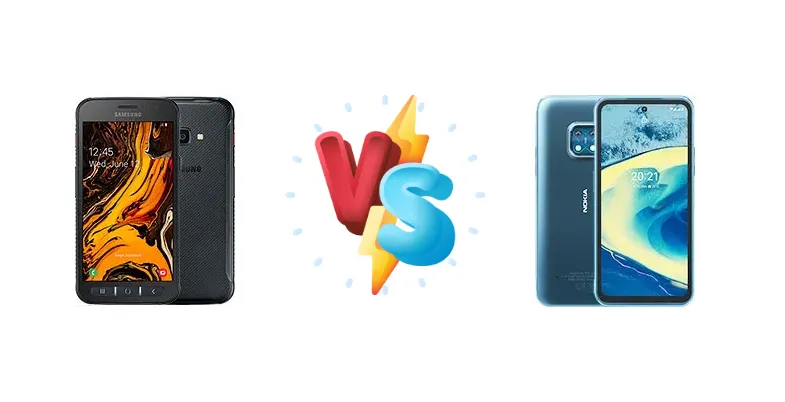
The Samsung Galaxy XCover 4s and Nokia XR20 both target a niche market: users needing a phone that can withstand drops, dust, and the elements. However, they approach this goal with different philosophies. The XCover 4s represents a more budget-conscious, older generation offering, while the XR20 aims for a more modern experience with 5G connectivity and wireless charging. This comparison dissects their core differences to determine which delivers the best value for demanding users.
🏆 Quick Verdict
For the average user prioritizing future-proofing and a smoother experience, the Nokia XR20 is the better choice. Its newer Snapdragon 480 chipset, built on an 8nm process, offers a noticeable performance advantage and 5G support. While the XCover 4s remains a viable option for basic use, the XR20’s added features and efficiency justify the price difference.
| Network |
|---|
| 2G bands | GSM 850 / 900 / 1800 / 1900 | GSM 850 / 900 / 1800 / 1900 |
| 3G bands | HSDPA 850 / 900 / 1900 / 2100 | HSDPA 850 / 900 / 1700(AWS) / 1900 / 2100 |
| 4G bands | 1, 3, 5, 7, 8, 20, 28, 38, 40 | 1, 2, 3, 4, 5, 7, 8, 12, 13, 14, 20, 25, 26, 28, 30, 38, 40, 41, 48, 66, 71 |
| 5G bands | - | 2, 5, 25, 38, 41, 48, 66, 77, 78 SA/NSA |
| Speed | HSPA 42.2/5.76 Mbps, LTE (2CA) Cat6 300/50 Mbps | HSPA, LTE, 5G |
| Technology | GSM / HSPA / LTE | GSM / CDMA / HSPA / EVDO / LTE / 5G |
| | - | CDMA2000 1xEV-DO |
| Launch |
|---|
| Announced | 2019, June. Released 2019, July | 2021, July 27 |
| Status | Discontinued | Available. Released 2021, August 04 |
| Body |
|---|
| Dimensions | 146.2 x 73.3 x 9.7 mm (5.76 x 2.89 x 0.38 in) | 171.6 x 81.5 x 10.6 mm (6.76 x 3.21 x 0.42 in) |
| SIM | Single SIM (Micro-SIM) or Dual SIM (Micro-SIM, dual stand-by) | · Nano-SIM· Nano-SIM + Nano-SIM |
| Weight | 172 g (6.07 oz) | 248 g (8.75 oz) |
| | IP68 dust/water resistant (up to 1.5m for 30 min)
MIL-STD-810G compliant | IP68 dust/water resistant (up to 1.5m for 60 min)
Drop-to-concrete resistance from up to 1.8m
MIL-STD-810H compliant |
| Display |
|---|
| Protection | - | Corning Gorilla Glass Victus |
| Resolution | 720 x 1280 pixels, 16:9 ratio (~294 ppi density) | 1080 x 2400 pixels, 20:9 ratio (~395 ppi density) |
| Size | 5.0 inches, 68.9 cm2 (~64.3% screen-to-body ratio) | 6.67 inches, 107.4 cm2 (~76.8% screen-to-body ratio) |
| Type | PLS LCD | IPS LCD, 550 nits |
| Platform |
|---|
| CPU | Octa-core (2x1.6 GHz Cortex-A73 & 6x1.6 GHz Cortex-A53) | Octa-core (2x2.0 GHz Kryo 460 & 6x1.8 GHz Kryo 460) |
| Chipset | Exynos 7885 (14 nm) | Qualcomm SM4350 Snapdragon 480 5G (8 nm) |
| GPU | Mali-G71 MP2 | Adreno 619 |
| OS | Android 9.0 (Pie), upgradable to Android 11, One UI 3.1 | Android 11, upgradable to Android 13 |
| Memory |
|---|
| Card slot | microSDXC (dedicated slot) | microSDXC (uses shared SIM slot) |
| Internal | 32GB 3GB RAM | 64GB 4GB RAM, 128GB 6GB RAM |
| | eMMC 5.1 | - |
| Main Camera |
|---|
| Dual | - | 48 MP, f/1.8, (wide), 1/2.25", 0.8µm, PDAF
13 MP, f/2.4, 123˚ (ultrawide), 1/3.0", 1.12µm |
| Features | LED flash, HDR, panorama | Zeiss optics, Dual-LED dual-tone flash, second LED flash, HDR, panorama |
| Single | 16 MP, f/1.7, PDAF | 8 MP, f/2.0 (wide), 1/4.0", 1.12µm |
| Video | 1080p@30fps | 1080p@30fps |
| Selfie camera |
|---|
| Single | 5 MP, f/2.2 | 8 MP, f/2.0 (wide), 1/4.0", 1.12µm |
| Video | - | 1080p@30fps |
| Sound |
|---|
| 3.5mm jack | Yes | Yes |
| 35mm jack | Yes | Yes |
| Loudspeaker | Yes | Yes, with stereo speakers |
| Comms |
|---|
| Bluetooth | 5.0, A2DP, LE | 5.1, A2DP, LE, aptX Adaptive |
| NFC | Yes | Yes |
| Positioning | GPS, GLONASS, GALILEO, BDS | GPS (L1+L5), GLONASS, BDS, GALILEO, QZSS, NavIC |
| Radio | FM radio | Unspecified |
| USB | USB Type-C 2.0 | USB Type-C 3.0 |
| WLAN | Wi-Fi 802.11 a/b/g/n/ac, dual-band, Wi-Fi Direct | Wi-Fi 802.11 a/b/g/n/ac/6, dual-band, Wi-Fi Direct |
| Features |
|---|
| Sensors | Accelerometer, proximity, compass | Fingerprint (side-mounted), accelerometer, gyro, proximity, compass, barometer |
| Battery |
|---|
| Charging | - | 18W wired
15W wireless |
| Type | Li-Ion 2800 mAh, removable | Li-Po 4630 mAh |
| Misc |
|---|
| Colors | Gray | Ultra Blue, Granite Gray |
| Models | SM-G398F, SM-G398FN/DS, SM-G398FN | TA-1368, TA-1362 |
| Price | About 260 EUR | About 270 EUR |
| SAR EU | 0.91 W/kg (head) 1.31 W/kg (body) | 1.13 W/kg (head) 1.43 W/kg (body) |
Samsung Galaxy XCover 4s
- Potentially lower price point
- Rugged design for durability
- Dedicated programmable key
- Older, less efficient chipset
- Likely lacks 5G connectivity
- No wireless charging
Nokia XR20
- 5G connectivity for faster data speeds
- More powerful and efficient Snapdragon 480 chipset
- 18W wired and 15W wireless charging
- Generally higher price
- May be slightly bulkier due to larger battery/features
- Software update commitment may be limited
Display Comparison
Neither device boasts a cutting-edge display. Both likely utilize LCD panels, common in this price bracket. However, the lack of detailed display specs necessitates focusing on the chipset's impact on UI smoothness. The XR20’s Snapdragon 480, with its more powerful GPU, will likely deliver a more responsive experience when scrolling and navigating the interface, even if the resolution and pixel density are similar. The XCover 4s, with its older Exynos 7885, may exhibit slight lag during demanding tasks.
Camera Comparison
Detailed camera specs are unavailable, but we can infer some differences. Both phones likely feature a primary camera for general photography. The XR20’s newer chipset likely includes a more advanced image signal processor (ISP), resulting in better image processing, noise reduction, and dynamic range. The XCover 4s’ older ISP will likely produce less refined images, particularly in low-light conditions. The presence of a 2MP macro camera on either device is largely a marketing gimmick and shouldn’t be a deciding factor.
Performance
The core difference lies in the chipsets. The Nokia XR20’s Qualcomm SM4350 Snapdragon 480 5G (8nm) is a significant upgrade over the Samsung Galaxy XCover 4s’ Exynos 7885 (14nm). The 8nm process node translates to improved power efficiency and reduced thermal throttling. While both are octa-core CPUs, the Snapdragon 480’s Kryo 460 cores operate at a higher clock speed (2.0 GHz vs 1.6 GHz) and benefit from Qualcomm’s architectural optimizations. This means faster app loading times, smoother multitasking, and a more responsive overall experience on the XR20. The XCover 4s will suffice for basic tasks, but will struggle with more demanding applications.
Battery Life
Battery capacity isn’t specified for the XCover 4s, but rugged phones typically prioritize longevity. The XR20’s 18W wired and 15W wireless charging capabilities are a significant advantage. The XCover 4s likely lacks wireless charging, and its slower charging speed (if any) will require longer tethering to a power outlet. The Snapdragon 480’s 8nm process also contributes to better power efficiency, potentially offsetting any capacity difference between the two devices, resulting in comparable real-world battery life.
Buying Guide
Buy the Samsung Galaxy XCover 4s if you need a highly affordable, extremely basic rugged phone for essential communication and limited app usage, and are comfortable with an older chipset. Buy the Nokia XR20 if you prefer a more modern, 5G-enabled experience with wireless charging, better performance for multitasking and media consumption, and a longer software support lifespan. The XR20 is ideal for users who need a reliable workhorse that can keep up with their active lifestyle.
Frequently Asked Questions
❓ Does the Exynos 7885 in the Galaxy XCover 4s overheat during prolonged use, like video recording or gaming?
The Exynos 7885, being a 14nm chip, is more prone to thermal throttling than the XR20’s 8nm Snapdragon 480. While it won’t likely reach critical temperatures, expect performance to dip during extended, demanding tasks like video recording or gaming. The XR20 will maintain higher sustained performance.
❓ Is the 5G connectivity on the Nokia XR20 actually useful for a rugged phone, considering it's often used in remote locations?
While rugged phones are often used outdoors, 5G connectivity provides a significant benefit in areas with coverage. Faster download and upload speeds are crucial for tasks like map downloads, cloud backups, and real-time communication, even in remote work environments. It future-proofs the device as 5G networks expand.
❓ How does the software update policy differ between the Samsung Galaxy XCover 4s and the Nokia XR20?
Nokia generally offers a more consistent and longer software update commitment than Samsung for its lower-to-midrange devices. The XR20 is likely to receive more Android version updates and security patches than the XCover 4s, extending its usable lifespan.
❓ Is the wireless charging on the Nokia XR20 a practical feature for a rugged phone that's likely to be used in harsh environments?
Wireless charging adds convenience, especially for users who frequently work in dusty or wet conditions where plugging in a cable is undesirable. It also reduces wear and tear on the charging port, a common point of failure in rugged devices.