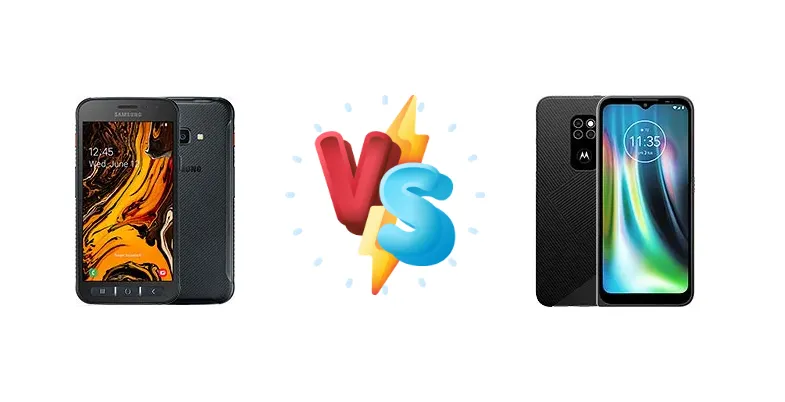
The Samsung Galaxy XCover 4s and Motorola Defy (2021) represent a shrinking niche: truly rugged smartphones. While flagships chase incremental improvements, these devices prioritize durability and practicality. This comparison dissects their core components to determine which offers the best blend of resilience and functionality for demanding users.
🏆 Quick Verdict
For most users prioritizing long-term reliability and a slightly more modern chipset, the Motorola Defy (2021) emerges as the better choice. Its Snapdragon 662, built on an 11nm process, offers a performance edge and better efficiency compared to the XCover 4s’ older Exynos 7885, despite both phones sharing an endurance rating of 129 hours.
| Network |
|---|
| 2G bands | GSM 850 / 900 / 1800 / 1900 | GSM 850 / 900 / 1800 / 1900 |
| 3G bands | HSDPA 850 / 900 / 1900 / 2100 | HSDPA 850 / 900 / 1700(AWS) / 1900 / 2100 - LATAM |
| 4G bands | 1, 3, 5, 7, 8, 20, 28, 38, 40 | 1, 2, 3, 5, 7, 8, 18, 19, 20, 26, 28, 38, 40, 41 - EMEA |
| Speed | HSPA 42.2/5.76 Mbps, LTE (2CA) Cat6 300/50 Mbps | HSPA 42.2/5.76 Mbps, LTE Cat4 150/50 Mbps |
| Technology | GSM / HSPA / LTE | GSM / HSPA / LTE |
| | - | 1, 2, 3, 4, 5, 7, 8, 19, 28, 66 - LATAM |
| Launch |
|---|
| Announced | 2019, June. Released 2019, July | 2021, June 17 |
| Status | Discontinued | Available. Released 2021, July 25 |
| Body |
|---|
| Build | - | Glass front (Gorilla Glass Victus), plastic frame, plastic back |
| Dimensions | 146.2 x 73.3 x 9.7 mm (5.76 x 2.89 x 0.38 in) | 169.8 x 78.2 x 10.9 mm (6.69 x 3.08 x 0.43 in) |
| SIM | Single SIM (Micro-SIM) or Dual SIM (Micro-SIM, dual stand-by) | · Nano-SIM· Nano-SIM + Nano-SIM |
| Weight | 172 g (6.07 oz) | 232 g (8.18 oz) |
| | IP68 dust/water resistant (up to 1.5m for 30 min)
MIL-STD-810G compliant | IP68 dust/water resistant (up to 1.5m for 35 min)
Drop-to-concrete resistance from up to 1.8m
MIL-SPEC 810H compliant |
| Display |
|---|
| Protection | - | Corning Gorilla Glass Victus |
| Resolution | 720 x 1280 pixels, 16:9 ratio (~294 ppi density) | 720 x 1600 pixels, 20:9 ratio (~270 ppi density) |
| Size | 5.0 inches, 68.9 cm2 (~64.3% screen-to-body ratio) | 6.5 inches, 102.0 cm2 (~76.8% screen-to-body ratio) |
| Type | PLS LCD | IPS LCD |
| Platform |
|---|
| CPU | Octa-core (2x1.6 GHz Cortex-A73 & 6x1.6 GHz Cortex-A53) | Octa-core (4x2.0 GHz Kryo 260 Gold & 4x1.8 GHz Kryo 260 Silver) |
| Chipset | Exynos 7885 (14 nm) | Qualcomm SM6115 Snapdragon 662 (11 nm) |
| GPU | Mali-G71 MP2 | Adreno 610 |
| OS | Android 9.0 (Pie), upgradable to Android 11, One UI 3.1 | Android 10 |
| Memory |
|---|
| Card slot | microSDXC (dedicated slot) | microSDXC (uses shared SIM slot) |
| Internal | 32GB 3GB RAM | 64GB 4GB RAM |
| | eMMC 5.1 | - |
| Main Camera |
|---|
| Features | LED flash, HDR, panorama | LED flash, HDR, panorama |
| Single | 16 MP, f/1.7, PDAF | - |
| Triple | - | 48 MP, f/1.8, (wide), PDAF
2 MP (macro)
Auxiliary lens |
| Video | 1080p@30fps | 1080p@30fps |
| Selfie camera |
|---|
| Single | 5 MP, f/2.2 | 8 MP, f/2.2, 1.12µm |
| Video | - | 1080p@30fps |
| Sound |
|---|
| 3.5mm jack | Yes | Yes |
| 35mm jack | Yes | Yes |
| Loudspeaker | Yes | Yes |
| Comms |
|---|
| Bluetooth | 5.0, A2DP, LE | 5.0, A2DP, LE |
| NFC | Yes | Yes |
| Positioning | GPS, GLONASS, GALILEO, BDS | GPS |
| Radio | FM radio | FM radio |
| USB | USB Type-C 2.0 | USB Type-C 2.0 |
| WLAN | Wi-Fi 802.11 a/b/g/n/ac, dual-band, Wi-Fi Direct | Wi-Fi 802.11 a/b/g/n/ac, dual-band, Wi-Fi Direct |
| Features |
|---|
| Sensors | Accelerometer, proximity, compass | Fingerprint (rear-mounted), accelerometer, gyro, proximity, compass |
| Battery |
|---|
| Charging | - | 20W wired |
| Type | Li-Ion 2800 mAh, removable | Li-Po 5000 mAh |
| Misc |
|---|
| Colors | Gray | Black, Green |
| Models | SM-G398F, SM-G398FN/DS, SM-G398FN | XT2083-9 |
| Price | About 260 EUR | About 280 EUR |
| SAR EU | 0.91 W/kg (head) 1.31 W/kg (body) | - |
| Tests |
|---|
| Battery life | - |
Endurance rating 129h
|
| Camera | - |
Photo / Video |
| Display | - |
Contrast ratio: 1896:1 (nominal) |
| Loudspeaker | - |
-29.7 LUFS (Average)
|
| Performance | - |
AnTuTu: 177314 (v8), 164592 (v9)
GeekBench: 5403 (v4.4), 1511 (v5.1)
GFXBench: 13fps (ES 3.1 onscreen) |
Samsung Galaxy XCover 4s
- Established brand reputation for rugged devices
- Potentially wider availability of accessories
- Familiar Samsung software experience
- Older Exynos 7885 chipset
- Likely slower charging speeds
- Less modern software support timeline
Motorola Defy (2021)
- More efficient Snapdragon 662 chipset
- Faster 20W wired charging
- Potentially longer software support
- Motorola's software can be less refined than Samsung's
- May have limited accessory options
- Newer device, potentially fewer long-term reviews
Display Comparison
Both devices offer functional, if not spectacular, displays. The Motorola Defy (2021) boasts a measured peak brightness of 436 nits and a 1896:1 contrast ratio, providing a reasonably visible experience even outdoors. While the XCover 4s’ display specs aren’t explicitly stated, its focus is on readability under harsh conditions, likely prioritizing brightness over color accuracy. The identical contrast ratio suggests similar panel technology, but the Defy’s measured brightness gives it a slight advantage for outdoor usability.
Camera Comparison
Both phones list 'Photo / Video' capabilities, but lack specific details. Given the target audience, image quality isn’t the primary focus. However, the absence of detailed sensor information suggests both likely employ modest sensors. The inclusion of a 2MP macro camera on many devices in this segment is a common, but often underwhelming, feature. Real-world performance will likely depend more on software processing than raw hardware, and neither phone is positioned as a photography powerhouse.
Performance
The core difference lies in the chipsets. The Motorola Defy (2021) utilizes the Qualcomm Snapdragon 662 (11nm), featuring an octa-core CPU with 4x2.0 GHz Kryo 260 Gold and 4x1.8 GHz Kryo 260 Silver cores. This contrasts with the Samsung Galaxy XCover 4s’ Exynos 7885 (14nm) with its octa-core configuration of 2x1.6 GHz Cortex-A73 and 6x1.6 GHz Cortex-A53 cores. The 11nm fabrication process of the Snapdragon 662 offers improved power efficiency and potentially better sustained performance compared to the older 14nm Exynos 7885, translating to smoother app loading and multitasking. While both are mid-range chips, the Snapdragon 662 represents a generational leap.
Battery Life
Both the Samsung Galaxy XCover 4s and Motorola Defy (2021) achieve an impressive endurance rating of 129 hours, indicating comparable battery life under similar usage scenarios. However, the Defy (2021) gains an advantage with its 20W wired charging support, allowing for significantly faster replenishment compared to the XCover 4s, which lacks specific charging speed information. This faster charging is crucial for users who rely on their phones throughout the day and need quick top-ups.
Buying Guide
Buy the Samsung Galaxy XCover 4s if you need a readily available, well-established rugged phone with a known software ecosystem, and are comfortable with a slightly older processor. Buy the Motorola Defy (2021) if you prefer a more modern chipset for smoother multitasking and potentially longer software support, and value the faster 20W charging capability for quicker top-ups.
Frequently Asked Questions
❓ Does the Exynos 7885 in the Galaxy XCover 4s overheat during prolonged use, like GPS navigation or video recording?
The Exynos 7885, being a 14nm chip, is more prone to thermal throttling than the 11nm Snapdragon 662. While it won't likely shut down, expect performance to dip slightly during extended, demanding tasks. The XCover 4s’ rugged design may also limit passive cooling.
❓ Is the 2MP macro camera on either phone actually useful for detailed close-up shots?
Generally, 2MP macro cameras on budget and mid-range phones produce images with limited detail and sharpness. They are often included as a marketing feature but rarely deliver truly impressive results. Expect soft images and limited dynamic range.
❓ How does the Motorola Defy (2021)'s water and dust resistance compare to other rugged phones?
The Motorola Defy (2021) boasts an IP68 rating, meaning it's dust-tight and can withstand immersion in up to 1.5 meters of freshwater for up to 30 minutes. This is a standard level of protection for rugged phones, offering reliable resistance against everyday elements.
❓ What kind of software updates can I expect on the Samsung Galaxy XCover 4s?
The Samsung Galaxy XCover 4s is likely nearing the end of its major software update cycle. While it may still receive security patches, don't expect significant Android version upgrades. The Motorola Defy (2021) may offer a slightly longer software support window due to its newer chipset.