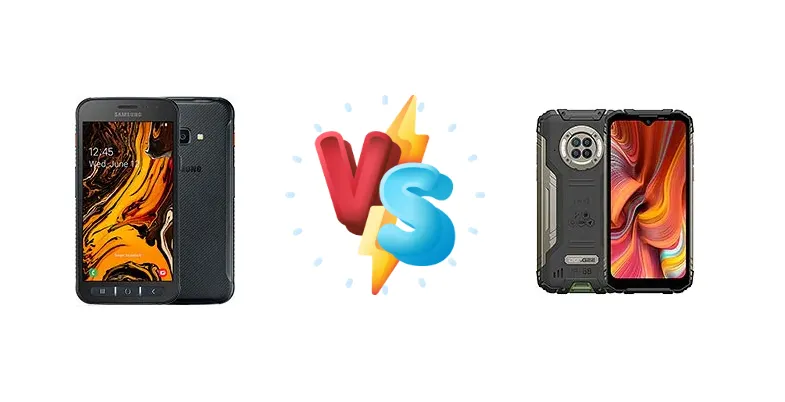
The rugged smartphone market caters to a specific need: durability. Both the Samsung Galaxy XCover 4s and the Doogee S96 Pro aim to deliver that, but they take different approaches to performance and features. The XCover 4s, a more established offering, relies on Samsung’s Exynos chipset, while the S96 Pro leverages MediaTek’s Helio G90, promising a more modern processing experience. This comparison will dissect the key differences to determine which device best suits demanding users.
🏆 Quick Verdict
For the average user prioritizing sustained performance and faster charging, the Doogee S96 Pro emerges as the winner. Its Helio G90 chipset, built on a more efficient 12nm process, offers a noticeable performance uplift over the XCover 4s’s Exynos 7885. While the XCover 4s benefits from Samsung’s software ecosystem, the S96 Pro’s faster charging and more modern CPU architecture provide a better overall experience.
| Network |
|---|
| 2G bands | GSM 850 / 900 / 1800 / 1900 | GSM 850 / 900 / 1800 / 1900 |
| 3G bands | HSDPA 850 / 900 / 1900 / 2100 | HSDPA 800 / 850 / 900 / 1700(AWS) / 1900 / 2100 |
| 4G bands | 1, 3, 5, 7, 8, 20, 28, 38, 40 | 1, 2, 3, 4, 5, 7, 8, 12, 13, 17, 18, 19, 20, 25, 26, 28, 38, 40, 66 |
| Speed | HSPA 42.2/5.76 Mbps, LTE (2CA) Cat6 300/50 Mbps | HSPA, LTE |
| Technology | GSM / HSPA / LTE | GSM / CDMA / HSPA / LTE |
| Launch |
|---|
| Announced | 2019, June. Released 2019, July | 2020, October 26. Released 2020, November |
| Status | Discontinued | Discontinued |
| Body |
|---|
| Dimensions | 146.2 x 73.3 x 9.7 mm (5.76 x 2.89 x 0.38 in) | 167 x 81.4 x 15.5 mm (6.57 x 3.20 x 0.61 in) |
| SIM | Single SIM (Micro-SIM) or Dual SIM (Micro-SIM, dual stand-by) | Nano-SIM + Nano-SIM |
| Weight | 172 g (6.07 oz) | 310 g (10.93 oz) |
| | IP68 dust/water resistant (up to 1.5m for 30 min)
MIL-STD-810G compliant | - |
| Display |
|---|
| Protection | - | Corning Gorilla Glass |
| Resolution | 720 x 1280 pixels, 16:9 ratio (~294 ppi density) | 720 x 1520 pixels, 19:9 ratio (~270 ppi density) |
| Size | 5.0 inches, 68.9 cm2 (~64.3% screen-to-body ratio) | 6.22 inches, 96.6 cm2 (~71.0% screen-to-body ratio) |
| Type | PLS LCD | IPS LCD |
| Platform |
|---|
| CPU | Octa-core (2x1.6 GHz Cortex-A73 & 6x1.6 GHz Cortex-A53) | Octa-core (2x2.0 GHz Cortex-A76 & 6x2.0 GHz Cortex-A55) |
| Chipset | Exynos 7885 (14 nm) | Mediatek MT6785 Helio G90 (12 nm) |
| GPU | Mali-G71 MP2 | Mali-G76 MC4 |
| OS | Android 9.0 (Pie), upgradable to Android 11, One UI 3.1 | Android 10 |
| Memory |
|---|
| Card slot | microSDXC (dedicated slot) | microSDXC (dedicated slot) |
| Internal | 32GB 3GB RAM | 128GB 8GB RAM |
| | eMMC 5.1 | - |
| Main Camera |
|---|
| Features | LED flash, HDR, panorama | Quad-LED flash, HDR, panorama |
| Quad | - | 48 MP, f/1.8, (wide), PDAF
8 MP, f/2.2, 130˚, (ultrawide)
20 MP, f/2.8, (night vision), 4 infrared night vision lights
2 MP (macro) |
| Single | 16 MP, f/1.7, PDAF | - |
| Video | 1080p@30fps | 1080p |
| Selfie camera |
|---|
| Single | 5 MP, f/2.2 | 16 MP, f/2.0, (wide) |
| Video | - | 1080p |
| Sound |
|---|
| 3.5mm jack | Yes | - |
| 35mm jack | Yes | Yes |
| Loudspeaker | Yes | Yes |
| Comms |
|---|
| Bluetooth | 5.0, A2DP, LE | 5.0, A2DP, LE |
| NFC | Yes | Yes |
| Positioning | GPS, GLONASS, GALILEO, BDS | GPS, GLONASS, BDS, GALILEO |
| Radio | FM radio | FM radio |
| USB | USB Type-C 2.0 | USB Type-C 2.0, OTG |
| WLAN | Wi-Fi 802.11 a/b/g/n/ac, dual-band, Wi-Fi Direct | Wi-Fi 802.11 a/b/g/n/ac, dual-band |
| Features |
|---|
| Sensors | Accelerometer, proximity, compass | Fingerprint (side-mounted), accelerometer, gyro, proximity, compass |
| Battery |
|---|
| Charging | - | 24W wired
10W wireless |
| Type | Li-Ion 2800 mAh, removable | 6350 mAh |
| Misc |
|---|
| Colors | Gray | Black, Orange, Green |
| Models | SM-G398F, SM-G398FN/DS, SM-G398FN | - |
| Price | About 260 EUR | About 280 EUR |
| SAR EU | 0.91 W/kg (head) 1.31 W/kg (body) | - |
Samsung Galaxy XCover 4s
- Established Brand Reputation (Samsung)
- Compact Form Factor (Likely)
- Familiar Samsung Software
- Older Exynos 7885 Chipset
- Slower Charging Speeds (Likely)
- Less Powerful GPU
Doogee S96 Pro
- More Powerful Helio G90 Chipset
- Faster 24W Wired Charging
- 10W Wireless Charging
- Less Established Brand
- Potentially Larger Form Factor
- Software Updates May Be Slower
Display Comparison
Neither device is known for a standout display. Specifics like brightness nits and panel type are unavailable for the XCover 4s, but given its market positioning, it likely utilizes a standard LCD panel. The S96 Pro also likely uses an LCD. The key difference isn't display quality, but rather the overall user experience. The XCover 4s’s smaller screen size (assumed, based on its compact design) may appeal to those preferring one-handed use, while the S96 Pro likely offers a larger viewing area. Bezels are expected to be substantial on both, given their ruggedized nature.
Camera Comparison
Detailed camera specs are limited, but the focus should be on real-world performance rather than megapixel counts. Both devices likely feature a primary camera suitable for basic photography. The S96 Pro’s image processing capabilities, leveraging MediaTek’s ISP, may offer slightly better dynamic range and noise reduction. The presence of a 2MP macro camera on the S96 Pro is largely a marketing gimmick and unlikely to deliver significant value. The XCover 4s’s camera performance is likely adequate for its target audience, but the S96 Pro has the potential for slightly better image quality due to its more modern chipset.
Performance
The core of the difference lies in the chipsets. The Doogee S96 Pro’s MediaTek Helio G90 (12nm) significantly outperforms the Samsung Galaxy XCover 4s’s Exynos 7885 (14nm). The G90 features newer Cortex-A76 cores (2x2.0 GHz) compared to the XCover 4s’s Cortex-A73 cores (2x1.6 GHz), resulting in a substantial CPU performance advantage. The 12nm process node of the G90 also contributes to better power efficiency and thermal management. While both utilize a 6x Cortex-A55/A53 cluster at 2.0 GHz/1.6 GHz respectively, the G90’s superior architecture translates to smoother multitasking and a more responsive user experience, particularly for gaming. The S96 Pro is the clear winner for users needing processing power.
Battery Life
Battery capacity is not specified for either device, but the S96 Pro’s 24W wired and 10W wireless charging capabilities are a significant advantage. The XCover 4s likely supports slower charging speeds. The faster charging on the S96 Pro translates to less downtime and greater convenience. Even with a similar battery capacity, the Helio G90’s improved power efficiency could result in longer real-world battery life for the S96 Pro, especially during demanding tasks. The wireless charging option on the S96 Pro is a further convenience feature absent on the XCover 4s.
Buying Guide
Buy the Samsung Galaxy XCover 4s if you need a phone with a well-established brand reputation, a familiar Samsung software experience, and prioritize a more compact form factor. Buy the Doogee S96 Pro if you prefer a more powerful processor for gaming or demanding applications, faster charging speeds (including wireless), and aren't concerned about brand prestige.
Frequently Asked Questions
❓ Does the Exynos 7885 in the Galaxy XCover 4s overheat during prolonged gaming sessions?
The Exynos 7885, being a 14nm chip, is more prone to thermal throttling than the 12nm Helio G90. While it can handle casual gaming, extended sessions with graphically demanding titles may lead to noticeable performance drops as the chip heats up. The S96 Pro is better equipped to handle sustained gaming loads.
❓ Is the 2MP macro camera on the Doogee S96 Pro actually useful for detailed close-up shots?
Generally, 2MP macro cameras on budget and mid-range phones offer limited detail and image quality. The small sensor size and lack of optical image stabilization result in soft, noisy images. It's more of a marketing feature than a genuinely useful tool for serious macro photography.
❓ Can the Doogee S96 Pro handle demanding games like PUBG Mobile at high frame rates?
The Helio G90 chipset in the S96 Pro is capable of running PUBG Mobile at high settings and frame rates (likely 60fps). However, achieving consistently smooth performance will depend on the specific game settings and the phone's thermal management. It's likely to outperform the XCover 4s in this scenario.
❓ How does the software support compare between Samsung and Doogee?
Samsung provides a more consistent and longer-term software support commitment for its devices. Doogee, as a smaller manufacturer, typically offers fewer software updates and a shorter support lifecycle. Users prioritizing timely security patches and OS upgrades should consider the XCover 4s, but the S96 Pro's software is still functional.