
Samsung Galaxy XCover 4s vs. Blackview BV9800 Pro: A Head-to-Head Rugged Phone Showdown
| Phones Images | |||||
|---|---|---|---|---|---|
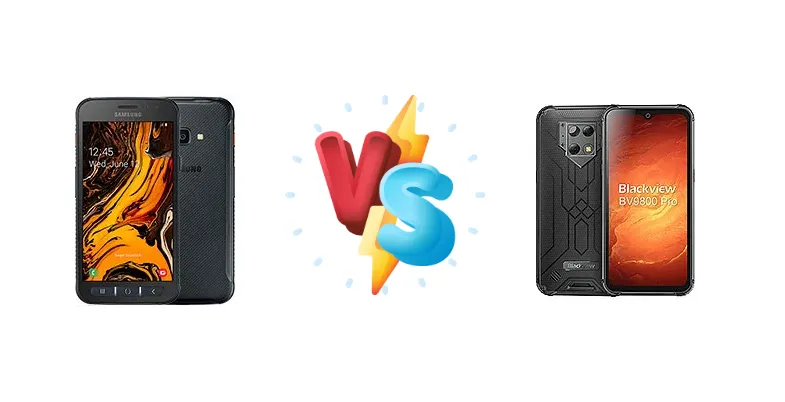
|
🏆 Quick Verdict
For the average user prioritizing long-term software support and a familiar interface, the Samsung Galaxy XCover 4s is the safer bet. However, the Blackview BV9800 Pro offers a noticeable performance boost thanks to its newer Helio P70 chipset and faster charging, making it ideal for users who need more processing power in the field.
| PHONES | ||
|---|---|---|
| Phone Names | Samsung Galaxy XCover 4s | Blackview BV9800 Pro |
| Network | ||
|---|---|---|
| 2G bands | GSM 850 / 900 / 1800 / 1900 | GSM 850 / 900 / 1800 / 1900 |
| 3G bands | HSDPA 850 / 900 / 1900 / 2100 | HSDPA 800 / 850 / 900 / 1700(AWS) / 1900 / 2100 |
| 4G bands | 1, 3, 5, 7, 8, 20, 28, 38, 40 | 1, 2, 3, 4, 5, 6, 7, 8, 12, 13, 17, 18, 19, 20, 25, 26, 28, 34, 38, 39, 40, 41, 66 |
| Speed | HSPA 42.2/5.76 Mbps, LTE (2CA) Cat6 300/50 Mbps | HSPA, LTE |
| Technology | GSM / HSPA / LTE | GSM / CDMA / HSPA / CDMA2000 / LTE |
| Launch | ||
|---|---|---|
| Announced | 2019, June. Released 2019, July | 2019, October 28. Released 2019, November |
| Status | Discontinued | Discontinued |
| Body | ||
|---|---|---|
| Dimensions | 146.2 x 73.3 x 9.7 mm (5.76 x 2.89 x 0.38 in) | 168.5 x 81 x 14.8 mm (6.63 x 3.19 x 0.58 in) |
| SIM | Single SIM (Micro-SIM) or Dual SIM (Micro-SIM, dual stand-by) | Nano-SIM + Nano-SIM |
| Weight | 172 g (6.07 oz) | 322 g (11.36 oz) |
| IP68 dust/water resistant (up to 1.5m for 30 min) MIL-STD-810G compliant | - | |
| Display | ||
|---|---|---|
| Resolution | 720 x 1280 pixels, 16:9 ratio (~294 ppi density) | 1080 x 2340 pixels, 19.5:9 ratio (~409 ppi density) |
| Size | 5.0 inches, 68.9 cm2 (~64.3% screen-to-body ratio) | 6.3 inches, 97.4 cm2 (~71.4% screen-to-body ratio) |
| Type | PLS LCD | IPS LCD |
| Platform | ||
|---|---|---|
| CPU | Octa-core (2x1.6 GHz Cortex-A73 & 6x1.6 GHz Cortex-A53) | Octa-core (4x2.1 GHz Cortex-A73 & 4x2.0 GHz Cortex-A53) |
| Chipset | Exynos 7885 (14 nm) | Mediatek MT6771V/CT Helio P70 (12 nm) |
| GPU | Mali-G71 MP2 | Mali-G72 MP3 |
| OS | Android 9.0 (Pie), upgradable to Android 11, One UI 3.1 | Android 9.0 (Pie) |
| Memory | ||
|---|---|---|
| Card slot | microSDXC (dedicated slot) | microSDXC |
| Internal | 32GB 3GB RAM | 128GB 6GB RAM |
| eMMC 5.1 | - | |
| Main Camera | ||
|---|---|---|
| Features | LED flash, HDR, panorama | Thermal imaging, LED flash |
| Single | 16 MP, f/1.7, PDAF | - |
| Triple | - | 48 MP, (wide), PDAF 5 MP, thermal assisted camera FLIR thermal camera (Lepton module) |
| Video | 1080p@30fps | 1080p@30fps |
| Selfie camera | ||
|---|---|---|
| Single | 5 MP, f/2.2 | 16 MP, f/2.0, (wide) |
| Video | - | 1080p@30fps |
| Sound | ||
|---|---|---|
| 3.5mm jack | Yes | - |
| 35mm jack | Yes | Yes |
| Loudspeaker | Yes | Yes |
| Comms | ||
|---|---|---|
| Bluetooth | 5.0, A2DP, LE | 4.1, A2DP |
| NFC | Yes | Yes |
| Positioning | GPS, GLONASS, GALILEO, BDS | GPS, GLONASS, GALILEO |
| Radio | FM radio | FM radio |
| USB | USB Type-C 2.0 | USB Type-C 2.0, OTG |
| WLAN | Wi-Fi 802.11 a/b/g/n/ac, dual-band, Wi-Fi Direct | Wi-Fi 802.11 a/b/g/n/ac |
| Features | ||
|---|---|---|
| Sensors | Accelerometer, proximity, compass | Fingerprint (side-mounted), accelerometer, gyro, proximity, compass, barometer |
| Battery | ||
|---|---|---|
| Charging | - | 18W wired |
| Type | Li-Ion 2800 mAh, removable | 6580 mAh |
| Misc | ||
|---|---|---|
| Colors | Gray | Black, Orange |
| Models | SM-G398F, SM-G398FN/DS, SM-G398FN | - |
| Price | About 260 EUR | About 340 EUR |
| SAR EU | 0.91 W/kg (head) 1.31 W/kg (body) | - |
Samsung Galaxy XCover 4s
- Established Brand Reputation
- Potential for Longer Software Support
- Samsung Ecosystem Integration
- Older Chipset (Exynos 7885)
- Slower Charging
- Likely Lower Performance
Blackview BV9800 Pro
- More Powerful Processor (Helio P70)
- Faster 18W Charging
- Competitive Price
- Less Established Brand
- Potentially Shorter Software Support
- Unknown Long-Term Reliability
Display Comparison
Neither device boasts a cutting-edge display. The XCover 4s’ display specifications are unavailable, but based on its market positioning, it likely features a standard LCD panel. The BV9800 Pro also utilizes an LCD, but the focus here is on durability rather than visual fidelity. Both prioritize visibility in direct sunlight, a crucial feature for outdoor use. The lack of high refresh rates or OLED technology on either device reflects their focus on battery life and ruggedness over premium visual experiences.
Camera Comparison
Camera performance is likely a secondary consideration for both phones, but the BV9800 Pro likely holds an edge. While detailed sensor information is missing for the XCover 4s, the BV9800 Pro’s camera setup, though not specified in detail, benefits from the more modern image signal processor (ISP) within the Helio P70 chipset. This allows for better noise reduction and dynamic range. The inclusion of a 2MP macro camera on the BV9800 Pro is largely a marketing gimmick, offering limited practical benefit. Both phones will likely excel in well-lit conditions, but the P70’s ISP should provide superior low-light performance.
Performance
The Blackview BV9800 Pro’s Mediatek Helio P70 (12nm) demonstrably outperforms the Samsung Galaxy XCover 4s’ Exynos 7885 (14nm). The P70’s newer architecture, featuring four Cortex-A73 cores clocked at 2.1 GHz versus the XCover 4s’ 1.6 GHz A73 cores, translates to faster app loading times and smoother multitasking. While both utilize a 6x Cortex-A53 cluster, the P70’s higher clock speed provides a consistent advantage. The 12nm process node of the P70 also contributes to improved thermal efficiency, potentially reducing throttling during sustained workloads. This difference is particularly noticeable for users running mapping applications, data logging software, or other processor-intensive tasks.
Battery Life
Battery life is a critical factor for rugged phones, and the BV9800 Pro offers a significant advantage with its 18W wired charging. While the battery capacity of both devices is not specified, the faster charging speed of the BV9800 Pro allows for quicker top-ups during breaks. The Exynos 7885 is known for being relatively power-efficient, but the Helio P70’s 12nm process and optimized power management features likely offset any potential gains. Users who spend extended periods away from power outlets will appreciate the BV9800 Pro’s ability to rapidly replenish its battery.
Buying Guide
Buy the Samsung Galaxy XCover 4s if you need a reliable, well-supported rugged phone from a major brand, prioritizing software updates and a proven track record. It’s ideal for professionals who rely on Samsung’s ecosystem and require a device that will receive security patches for years to come. Buy the Blackview BV9800 Pro if you prefer a more powerful processor for demanding tasks, faster charging, and don’t mind a less established brand. This phone is best suited for users who frequently use GPS, run resource-intensive apps, or need a quick power boost during long workdays.