
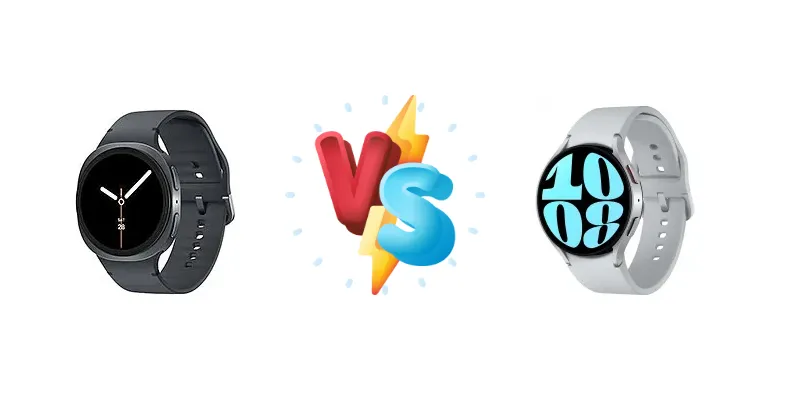
Samsung Galaxy Watch8 vs. Galaxy Watch6: A Detailed Comparison of Samsung's Smartwatch Lineup
| Phones Images | |||||
|---|---|---|---|---|---|
|
🏆 Quick Verdict
For most users, the Samsung Galaxy Watch8 represents a worthwhile upgrade, primarily due to its significantly more efficient Exynos W1000 chipset fabricated on a 3nm process. This translates to improved performance and potentially longer battery life. However, the Watch6 remains a compelling option for budget-conscious buyers.
| PHONES | ||
|---|---|---|
| Phone Names | Samsung Galaxy Watch8 | Samsung Galaxy Watch6 |
| Network | ||
|---|---|---|
| 2G bands | GSM 850 / 900 / 1800 / 1900 | GSM 850 / 900 / 1800 / 1900 |
| 3G bands | HSDPA 850 / 900 / 2100 | HSDPA 850 / 900 / 1700(AWS) / 1900 / 2100 |
| 4G bands | 1, 2, 3, 4, 5, 7, 8, 12, 13, 14, 18, 19, 20, 25, 26, 28, 40, 66, 71 | 1, 2, 3, 4, 5, 7, 8, 12, 13, 18, 19, 20, 25, 26, 28, 40, 66, 71 |
| Speed | HSPA, LTE | HSPA, LTE |
| Technology | GSM / HSPA / LTE | GSM / HSPA / LTE |
| Launch | ||
|---|---|---|
| Announced | 2025, July 09 | 2023, July 26 |
| Status | Available. Released 2025, July 25 | Available. Released 2023, August 11 |
| Body | ||
|---|---|---|
| Build | Glass front (Sapphire crystal), aluminum frame | Glass front (Sapphire crystal), aluminum frame |
| Dimensions | 46 x 43.7 x 8.6 mm (1.81 x 1.72 x 0.34 in) | 42.8 x 44.4 x 9 mm (1.69 x 1.75 x 0.35 in) |
| SIM | eSIM | eSIM |
| Weight | 34 g (44mm), 30 g (40mm) (1.06 oz) | 33.3 g (44mm), 28.7 g (40mm) (1.02 oz) |
| Display | ||
|---|---|---|
| Protection | Sapphire crystal | Sapphire crystal |
| Resolution | 480 x 480 pixels (~327 ppi density) | 480 x 480 pixels (~327 ppi density) |
| Size | 1.47 inches | 1.5 inches |
| Type | Super AMOLED, 3000 nits (peak) | Super AMOLED, 2000 nits (peak) |
| Platform | ||
|---|---|---|
| CPU | Penta-core | Dual-core 1.4GHz Cortex-A55 |
| Chipset | Exynos W1000 (3 nm) | Exynos W930 (5 nm) |
| GPU | Mali-G68 | Mali-G68 |
| OS | Android Wear OS 6, One UI 8 Watch | Android Wear OS 4, upgradable to 6.0, One UI Watch 8 |
| Memory | ||
|---|---|---|
| Card slot | No | No |
| Internal | 32GB 2GB RAM | 16GB 2GB RAM |
| Sound | ||
|---|---|---|
| 35mm jack | No | No |
| Loudspeaker | Yes | Yes |
| Comms | ||
|---|---|---|
| Bluetooth | 5.3, A2DP, LE | 5.3, A2DP, LE |
| NFC | Yes | Yes |
| Positioning | GPS (L1+L5), GLONASS, GALILEO, BDS | GPS, GLONASS, GALILEO, BDS |
| Radio | No | No |
| USB | No | No |
| WLAN | Wi-Fi 802.11 a/b/g/n, dual-band | Wi-Fi 802.11 a/b/g/n, dual-band |
| Features | ||
|---|---|---|
| Sensors | Accelerometer, gyro, heart rate, barometer, altimeter, compass, SpO2, temperature (skin), BioActive, antioxidant index | Accelerometer, gyro, heart rate, barometer, altimeter, compass, SpO2, temperature (skin) |
| Battery | ||
|---|---|---|
| Charging | 10W wireless | 10W wireless |
| Type | Li-Ion 435 mAh | Li-Ion 425 mAh |
| Misc | ||
|---|---|---|
| Colors | Graphite, Silver | Graphite, Silver, Gold |
| Models | SM-L320, SM-L325, SM-L330, SM-L335, SM-L325U, SM-L335U | - |
| Price | $ 229.98 / C$ 1,649.98 / € 237.69 | About 190 EUR |
| SAR EU | 0.15 W/kg (head) 0.78 W/kg (body) | - |
Samsung Galaxy Watch8
- Significantly more efficient Exynos W1000 (3nm)
- Potentially longer battery life
- Improved performance and responsiveness
- Likely higher price point
- May not offer a dramatically different experience for basic users
Samsung Galaxy Watch6
- More affordable price
- Capable performance for everyday tasks
- Proven Wear OS experience
- Less efficient Exynos W930 (5nm)
- Potentially shorter battery life
- May struggle with demanding applications
Display Comparison
Both watches share a similar form factor and display technology, but detailed specs are missing. Given Samsung's history, both likely utilize Super AMOLED panels with excellent color accuracy. The key difference will likely be in peak brightness and potentially a slightly refined LTPO implementation in the Watch8, allowing for more granular refresh rate control and improved power efficiency. Without specific nit ratings, it's difficult to definitively declare a winner, but the Watch8's newer chipset could enable more aggressive power management of the display.
Camera Comparison
Neither watch is particularly known for its camera capabilities, and detailed camera specs are unavailable. It's safe to assume both feature basic front-facing cameras for video calls. Any differences in image quality will likely be minimal and driven by software processing rather than hardware improvements. This isn't a key buying factor for either device.
Performance
The core differentiator lies in the chipsets. The Galaxy Watch8's Exynos W1000, built on a 3nm process, is a substantial leap forward compared to the Watch6's Exynos W930 (5nm). This smaller node allows for significantly higher transistor density and improved power efficiency. While the Watch6's dual-core 1.4GHz Cortex-A55 is adequate for everyday tasks, the Watch8's penta-core architecture promises smoother multitasking, faster app loading times, and improved responsiveness, particularly with Wear OS's increasingly complex features. The 3nm process also implies better thermal management, reducing the likelihood of performance throttling during extended use.
Battery Life
Both watches feature 10W wireless charging, indicating similar charging speeds. However, the Exynos W1000's 3nm process in the Watch8 is the critical factor here. A more efficient chipset translates directly to lower power consumption, potentially extending battery life even with a similar battery capacity (specs missing). While 0-100% charge times will likely be comparable, the Watch8 should offer more usable time between charges, especially for users who frequently utilize power-intensive features like GPS tracking or always-on display.
Buying Guide
Buy the Samsung Galaxy Watch8 if you prioritize peak performance, future-proofing with the latest chipset technology, and potentially longer battery life during demanding tasks. Buy the Samsung Galaxy Watch6 if you're seeking a capable smartwatch experience at a lower price point and don't require the absolute latest in processing power. The Watch6 is ideal for users focused on fitness tracking and basic notifications.