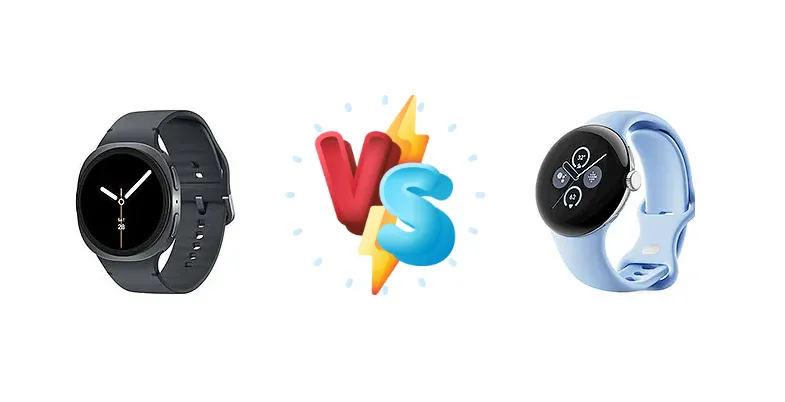
The smartwatch market is increasingly competitive, with Samsung and Google offering compelling options. The Galaxy Watch8, powered by Samsung’s new Exynos W1000, faces off against the Google Pixel Watch 2, utilizing the Qualcomm 5100. This comparison focuses on the core differences in their processing power and charging capabilities, crucial factors for daily usability.
🏆 Quick Verdict
For most users, the Google Pixel Watch 2 offers a more practical experience due to its significantly faster charging. While the Galaxy Watch8’s Exynos W1000 boasts a more advanced 3nm process, the Pixel Watch 2’s wired charging and 80% in 45-minute capability address a key smartwatch pain point.
| Network |
|---|
| 2G bands | GSM 850 / 900 / 1800 / 1900 | GSM 850 / 900 / 1800 / 1900 |
| 3G bands | HSDPA 850 / 900 / 2100 | HSDPA 850 / 900 / 1700(AWS) / 1900 / 2100 |
| 4G bands | 1, 2, 3, 4, 5, 7, 8, 12, 13, 14, 18, 19, 20, 25, 26, 28, 40, 66, 71 | LTE |
| Speed | HSPA, LTE | HSPA, LTE |
| Technology | GSM / HSPA / LTE | GSM / HSPA / LTE |
| Launch |
|---|
| Announced | 2025, July 09 | 2023, October 04 |
| Status | Available. Released 2025, July 25 | Available. Released 2023, October 12 |
| Body |
|---|
| Build | Glass front (Sapphire crystal), aluminum frame | Glass front (Gorilla Glass 5), aluminum frame |
| Dimensions | 46 x 43.7 x 8.6 mm (1.81 x 1.72 x 0.34 in) | 41 x 41 x 12.3 mm (1.61 x 1.61 x 0.48 in) |
| SIM | eSIM | eSIM |
| Weight | 34 g (44mm), 30 g (40mm) (1.06 oz) | 31 g (1.09 oz) |
| Display |
|---|
| Protection | Sapphire crystal | Corning Gorilla Glass 5 |
| Resolution | 480 x 480 pixels (~327 ppi density) | 450 x 450 pixels (~320 ppi density) |
| Size | 1.47 inches | 1.2 inches |
| Type | Super AMOLED, 3000 nits (peak) | AMOLED, 1000 nits (peak) |
| Platform |
|---|
| CPU | Penta-core | - |
| Chipset | Exynos W1000 (3 nm) | Qualcomm 5100 |
| GPU | Mali-G68 | - |
| OS | Android Wear OS 6, One UI 8 Watch | Android Wear OS 4 |
| Memory |
|---|
| Card slot | No | No |
| Internal | 32GB 2GB RAM | 32GB 2GB RAM |
| Sound |
|---|
| 35mm jack | No | No |
| Loudspeaker | Yes | Yes |
| Comms |
|---|
| Bluetooth | 5.3, A2DP, LE | 5.0, A2DP, LE |
| NFC | Yes | Yes |
| Positioning | GPS (L1+L5), GLONASS, GALILEO, BDS | GPS, GLONASS, GALILEO, BDS, QZSS |
| Radio | No | No |
| USB | No | No |
| WLAN | Wi-Fi 802.11 a/b/g/n, dual-band | Wi-Fi 802.11 b/g/n |
| Features |
|---|
| Sensors | Accelerometer, gyro, heart rate, barometer, altimeter, compass, SpO2, temperature (skin), BioActive, antioxidant index | Accelerometer, gyro, heart rate, altimeter, compass, SpO2, thermometer (skin temperature), skin conductance |
| Battery |
|---|
| Charging | 10W wireless | Wired, 80% in 45 min |
| Type | Li-Ion 435 mAh | Li-Ion 306 mAh |
| Misc |
|---|
| Colors | Graphite, Silver | Polished Silver, Matte Black, Champagne Gold |
| Models | SM-L320, SM-L325, SM-L330, SM-L335, SM-L325U, SM-L335U | G4TSL, GC3G8, GD2WG |
| Price | $ 229.98 / C$ 1,649.98 / € 237.69 | About 160 EUR |
| SAR EU | 0.15 W/kg (head) 0.78 W/kg (body) | - |
Samsung Galaxy Watch8
- Potentially more efficient 3nm Exynos W1000 chipset
- Seamless integration with Samsung ecosystem
- Likely vibrant AMOLED display (based on Samsung's history)
- Slow 10W wireless charging
- Battery capacity not specified
- Performance gains of 3nm may not be fully realized in smartwatch use cases
Google Pixel Watch 2
- Fast wired charging (80% in 45 minutes)
- Optimized Qualcomm 5100 chipset for Wear OS
- Streamlined Google Wear OS experience
- Chipset process node not specified
- Battery capacity not specified
- May lack the deep ecosystem integration of Samsung devices
Display Comparison
Display specifications are not provided, so a direct comparison is impossible. However, given Samsung’s history with AMOLED displays, the Galaxy Watch8 likely features a vibrant and color-accurate panel. The Pixel Watch 2, inheriting Google’s design philosophy, likely prioritizes a clean and minimalist aesthetic. The absence of display specs necessitates focusing on the core processing and charging differences.
Camera Comparison
Neither device is marketed for its camera capabilities, and no camera specifications are provided. Smartwatch cameras are generally limited in quality and usage scenarios, making this a non-factor in the comparison.
Performance
The Galaxy Watch8’s penta-core Exynos W1000, fabricated on a 3nm process, represents a significant leap in transistor density compared to typical smartwatch chipsets. This should translate to improved power efficiency and potentially higher sustained performance. However, the Google Pixel Watch 2 utilizes the Qualcomm 5100, a proven performer in the wearable space. While the process node isn’t specified, Qualcomm’s expertise in mobile chip design ensures optimized performance for Wear OS. The 3nm node of the Exynos *could* offer better thermal headroom, reducing throttling during intensive tasks, but real-world testing is needed to confirm this advantage.
Battery Life
Battery capacity isn’t specified for either device. However, the charging methods are drastically different. The Galaxy Watch8 relies on 10W wireless charging, which is convenient but relatively slow. The Pixel Watch 2, with its wired charging, can reach 80% charge in just 45 minutes. This faster charging speed is a substantial advantage, mitigating the anxiety of running out of battery during the day. The slower wireless charging of the Galaxy Watch8 may require overnight charging to ensure a full battery, potentially impacting daily usability.
Buying Guide
Buy the Samsung Galaxy Watch8 if you prioritize a potentially more efficient chipset architecture and are deeply embedded within the Samsung ecosystem, benefiting from seamless integration with Galaxy devices. Buy the Google Pixel Watch 2 if you value rapid charging and a streamlined Wear OS experience, particularly if you’re already invested in Google services and appreciate the convenience of a quick power boost.
Frequently Asked Questions
❓ Does the Exynos W1000 in the Galaxy Watch8 overheat during extended use, like GPS tracking or workout sessions?
While the 3nm process *should* improve thermal efficiency, the actual performance under sustained load is unknown without testing. The penta-core architecture suggests Samsung has prioritized multi-tasking, which could generate more heat. The Pixel Watch 2’s Qualcomm 5100 is a known quantity, but its thermal performance also depends on Google’s software optimization.
❓ Is the wired charging of the Pixel Watch 2 a significant inconvenience compared to the wireless charging of the Galaxy Watch8?
For many users, the speed advantage of wired charging (80% in 45 minutes) outweighs the convenience of wireless charging. The Galaxy Watch8’s 10W wireless charging is considerably slower, requiring significantly more time to reach a full charge. The Pixel Watch 2’s charging speed is a practical benefit for daily use.
❓ How does the Qualcomm 5100 chipset in the Pixel Watch 2 compare to the Exynos W1000 in terms of software optimization for Wear OS?
Qualcomm has a long-standing partnership with Google, specifically optimizing their chipsets for Wear OS. This collaboration likely results in smoother performance and better power management within the Wear OS environment. Samsung’s Exynos W1000, while powerful, may require more software optimization to achieve the same level of integration.