
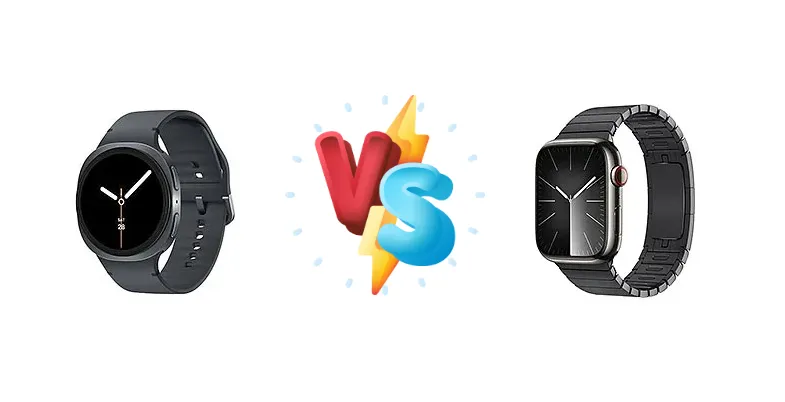
Samsung Galaxy Watch8 vs Apple Watch Series 9: A Detailed Comparison
| Phones Images | |||||
|---|---|---|---|---|---|
|
🏆 Quick Verdict
For the average user deeply embedded in the Apple ecosystem, the Apple Watch Series 9 remains the superior choice due to its seamless integration and optimized performance. However, the Samsung Galaxy Watch8 offers a compelling alternative, particularly for Android users, with its faster charging and potentially more efficient chipset.
| PHONES | ||
|---|---|---|
| Phone Names | Samsung Galaxy Watch8 | Apple Watch Series 9 |
| Network | ||
|---|---|---|
| 2G bands | GSM 850 / 900 / 1800 / 1900 | GSM 850 / 900 / 1800 / 1900 |
| 3G bands | HSDPA 850 / 900 / 2100 | HSDPA 850 / 900 / 1700(AWS) / 1900 / 2100 - International, China, HK |
| 4G bands | 1, 2, 3, 4, 5, 7, 8, 12, 13, 14, 18, 19, 20, 25, 26, 28, 40, 66, 71 | 1, 2, 3, 4, 5, 6, 7, 8, 18, 19, 20, 25, 26, 28, 39, 40, 41, 66 - International, China, HK |
| Speed | HSPA, LTE | HSPA, LTE |
| Technology | GSM / HSPA / LTE | GSM / HSPA / LTE |
| Launch | ||
|---|---|---|
| Announced | 2025, July 09 | 2023, September 12 |
| Status | Available. Released 2025, July 25 | Available. Released 2023, September 22 |
| Body | ||
|---|---|---|
| Build | Glass front (Sapphire crystal), aluminum frame | Sapphire crystal front, ceramic/sapphire crystal back, stainless steel frame |
| Dimensions | 46 x 43.7 x 8.6 mm (1.81 x 1.72 x 0.34 in) | 45 x 38 x 10.7 mm (1.77 x 1.50 x 0.42 in) |
| SIM | eSIM | eSIM |
| Weight | 34 g (44mm), 30 g (40mm) (1.06 oz) | 42.3 g (41mm), 51.5 g (45mm) (1.48 oz) |
| Display | ||
|---|---|---|
| Protection | Sapphire crystal | Sapphire crystal glass |
| Resolution | 480 x 480 pixels (~327 ppi density) | 484 x 396 pixels (~326 ppi density) |
| Size | 1.47 inches | 1.9 inches |
| Type | Super AMOLED, 3000 nits (peak) | Retina LTPO OLED, 2000 nits (peak) |
| Platform | ||
|---|---|---|
| CPU | Penta-core | Dual-core |
| Chipset | Exynos W1000 (3 nm) | Apple S9 |
| GPU | Mali-G68 | PowerVR |
| OS | Android Wear OS 6, One UI 8 Watch | watchOS 10, upgradable to watchOS 26.1 |
| Memory | ||
|---|---|---|
| Card slot | No | No |
| Internal | 32GB 2GB RAM | 64GB |
| Sound | ||
|---|---|---|
| 35mm jack | No | No |
| Loudspeaker | Yes | Yes |
| Comms | ||
|---|---|---|
| Bluetooth | 5.3, A2DP, LE | 5.3, A2DP, LE |
| NFC | Yes | Yes |
| Positioning | GPS (L1+L5), GLONASS, GALILEO, BDS | GPS, GLONASS, GALILEO, QZSS, BDS |
| Radio | No | No |
| USB | No | No |
| WLAN | Wi-Fi 802.11 a/b/g/n, dual-band | Wi-Fi 802.11 b/g/n, dual-band |
| Features | ||
|---|---|---|
| Sensors | Accelerometer, gyro, heart rate, barometer, altimeter, compass, SpO2, temperature (skin), BioActive, antioxidant index | Accelerometer, gyro, heart rate, barometer, always-on altimeter, compass, SpO2, VO2max, temperature (body) |
| Battery | ||
|---|---|---|
| Charging | 10W wireless | Wireless, 0-80% in 45 min |
| Type | Li-Ion 435 mAh | Li-Ion 308 mAh |
| Misc | ||
|---|---|---|
| Colors | Graphite, Silver | Graphite, Silver, Gold, Red |
| Models | SM-L320, SM-L325, SM-L330, SM-L335, SM-L325U, SM-L335U | A2982, A2984, A2983, A2985, Watch7,3, Watch7,4 |
| Price | $ 229.98 / C$ 1,649.98 / € 237.69 | About 630 EUR |
| SAR | - | 1.02 W/kg (head) |
| SAR EU | 0.15 W/kg (head) 0.78 W/kg (body) | 0.64 W/kg (head) |
Samsung Galaxy Watch8
- Faster wireless charging (10W)
- Potentially better battery efficiency due to 3nm Exynos W1000
- Open platform for app installation (Android ecosystem)
- Penta-core CPU may not match Apple's optimized dual-core performance
- Reliance on Samsung Health ecosystem
Apple Watch Series 9
- Optimized performance with Apple S9 chipset
- Seamless integration with Apple ecosystem
- Mature and extensive app ecosystem
- Slower charging speed (0-80% in 45 minutes)
- Limited to iOS/Apple devices
Display Comparison
While display specifications aren't provided, both watches likely utilize LTPO AMOLED panels for efficient refresh rate scaling. The key difference will be color calibration and peak brightness. Apple historically excels in color accuracy, while Samsung often pushes for higher peak brightness. The absence of detailed display specs makes a definitive statement difficult, but Samsung’s history suggests a brighter display, potentially at the cost of color fidelity. Bezels are also a factor; smaller bezels contribute to a more immersive experience, and Apple has consistently minimized these.
Camera Comparison
Neither device is heavily focused on camera capabilities, and detailed camera specs are absent. Smartwatches primarily use cameras for limited functions like video calls or potentially quick QR code scanning. Therefore, this section is less critical for this comparison.
Performance
The core of the performance difference lies in the chipsets. Samsung’s Galaxy Watch8 utilizes a Penta-core Exynos W1000 built on a 3nm process, while Apple employs the dual-core Apple S9. While core count isn’t everything, the 3nm fabrication of the Exynos W1000 *should* translate to improved power efficiency compared to Apple’s likely 4nm (based on previous generations) S9. However, Apple’s silicon is renowned for its architectural efficiency and software optimization. The dual-core S9 is likely to deliver smoother, more consistent performance in real-world tasks, despite the lower core count. The impact of RAM speed (likely LPDDR5x in both) is less significant than the chipset architecture.
Battery Life
Battery capacity isn’t specified, but the charging speeds are. The Galaxy Watch8 offers 10W wireless charging, while the Apple Watch Series 9 reaches 80% charge in 45 minutes. This suggests the Galaxy Watch8 will charge faster overall, potentially offsetting a smaller battery capacity. The 3nm Exynos W1000 *should* also contribute to improved battery life through increased efficiency. However, Apple’s software optimizations are known to aggressively manage background processes, potentially extending battery life despite a less efficient chipset.
Buying Guide
Buy the Samsung Galaxy Watch8 if you prioritize faster wireless charging, operate within the Android ecosystem, and appreciate a more open platform for app installation. Buy the Apple Watch Series 9 if you are an iPhone user seeking the most polished smartwatch experience, tight integration with Apple services, and a mature app ecosystem. The Series 9’s optimized performance within the Apple ecosystem is a significant advantage.