
Samsung Galaxy Watch8 Classic vs. Galaxy Watch6 Classic: A Detailed Comparison
| Phones Images | |||||
|---|---|---|---|---|---|
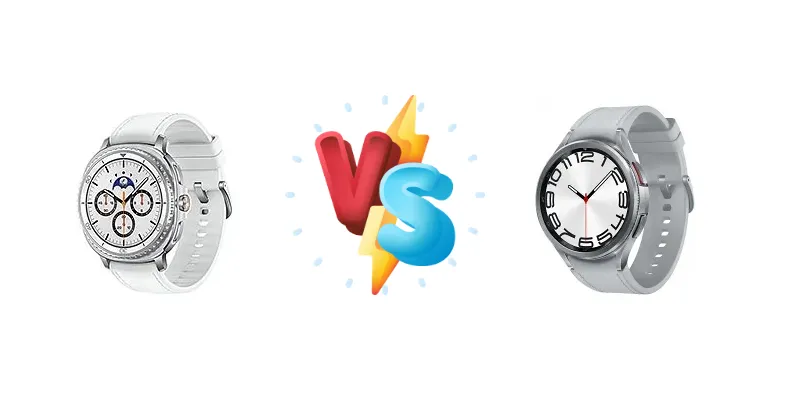
|
🏆 Quick Verdict
For most users, the Samsung Galaxy Watch8 Classic represents a worthwhile upgrade, primarily due to its more efficient 3nm Exynos W1000 chipset. This translates to potentially better battery life and sustained performance. However, the Watch6 Classic remains a strong contender, especially at potentially lower prices.
| PHONES | ||
|---|---|---|
| Phone Names | Samsung Galaxy Watch8 Classic | Samsung Galaxy Watch6 Classic |
| Network | ||
|---|---|---|
| 2G bands | GSM 850 / 900 / 1800 / 1900 | GSM 850 / 900 / 1800 / 1900 |
| 3G bands | HSDPA 850 / 900 / 2100 | HSDPA 850 / 900 / 1700(AWS) / 1900 / 2100 |
| 4G bands | 1, 2, 3, 4, 5, 7, 8, 12, 13, 14, 18, 19, 20, 25, 26, 28, 40, 66, 71 | 1, 2, 3, 4, 5, 7, 8, 12, 13, 18, 19, 20, 25, 26, 28, 40, 66, 71 |
| Speed | HSPA, LTE | HSPA, LTE |
| Technology | GSM / HSPA / LTE | GSM / HSPA / LTE |
| Launch | ||
|---|---|---|
| Announced | 2025, July 09 | 2023, July 26 |
| Status | Available. Released 2025, July 25 | Available. Released 2023, August 11 |
| Body | ||
|---|---|---|
| Build | Glass front (Sapphire crystal), stainless steel frame | Sapphire crystal front, stainless steel frame |
| Dimensions | 46.4 x 46 x 10.6 mm (1.83 x 1.81 x 0.42 in) | 46.5 x 46.5 x 10.9 mm (1.83 x 1.83 x 0.43 in) |
| SIM | eSIM | eSIM |
| Weight | 63.5 g (2.26 oz) | 59 g (47mm), 52 g (43mm) (2.08 oz) |
| Display | ||
|---|---|---|
| Protection | Sapphire crystal | Sapphire crystal |
| Resolution | 438 x 438 pixels (~327 ppi density) | 480 x 480 pixels (~453 ppi density) |
| Size | 1.34 inches | 1.5 inches |
| Type | Super AMOLED, 3000 nits (peak) | Super AMOLED, 2000 nits (peak) |
| Platform | ||
|---|---|---|
| CPU | Penta-core | Dual-core 1.4 GHz Cortex-A55 |
| Chipset | Exynos W1000 (3 nm) | Exynos W930 (5 nm) |
| GPU | Mali-G68 | Mali-G68 |
| OS | Android Wear OS 6, One UI 8 Watch | Android Wear OS 4, upgradable to 6.0, One UI Watch 8 |
| Memory | ||
|---|---|---|
| Card slot | No | No |
| Internal | 64GB 2GB RAM | 16GB 2GB RAM |
| Sound | ||
|---|---|---|
| 35mm jack | No | No |
| Loudspeaker | Yes | Yes |
| Comms | ||
|---|---|---|
| Bluetooth | 5.3, A2DP, LE | 5.3, A2DP, LE |
| NFC | Yes | Yes |
| Positioning | GPS (L1+L5), GLONASS, GALILEO, BDS | GPS, GLONASS, GALILEO, BDS |
| Radio | No | No |
| USB | No | No |
| WLAN | Wi-Fi 802.11 a/b/g/n, dual-band | Wi-Fi 802.11 a/b/g/n, dual-band |
| Features | ||
|---|---|---|
| Sensors | Accelerometer, gyro, heart rate, barometer, altimeter, compass, SpO2, temperature (skin), BioActive, antioxidant index | Accelerometer, gyro, heart rate, barometer, altimeter, compass, SpO2, temperature (skin) |
| Battery | ||
|---|---|---|
| Charging | 10W wireless | 10W wireless |
| Type | Li-Ion 445 mAh | Li-Ion 425 mAh |
| Misc | ||
|---|---|---|
| Colors | Black, White | Black, Silver |
| Models | SM-L500, SM-L505U | - |
| Price | € 279.90 / $ 299.99 | $ 149.99 / € 195.88 |
| SAR | 1.04 W/kg (head) 0.41 W/kg (body) | - |
| SAR EU | 0.03 W/kg (head) 0.67 W/kg (body) | - |
Samsung Galaxy Watch8 Classic
- More efficient 3nm Exynos W1000 chipset
- Potentially longer battery life
- Improved performance for demanding tasks
- Likely higher price point
- May not offer a dramatically different experience for basic users
Samsung Galaxy Watch6 Classic
- Potentially lower price point
- Still a capable performer for everyday tasks
- Classic design with rotating bezel
- Less efficient 5nm Exynos W930 chipset
- Potentially shorter battery life compared to Watch8 Classic
Display Comparison
Both watches feature Super AMOLED displays, but detailed specs like brightness and resolution are not provided. However, the focus on the Watch8 Classic's efficiency suggests potential improvements in power consumption related to the display. The rotating bezel, a hallmark of the Classic line, is present on both, offering a tactile and intuitive navigation experience. The absence of specific display data makes a direct comparison difficult, but the Watch8's overall efficiency gains likely extend to display power draw.
Camera Comparison
Neither watch is positioned as a photography powerhouse, and detailed camera specs are absent. This suggests the cameras are primarily for basic functionality like quick scans or remote camera control via a paired phone. Any differences in image quality are likely minimal and won't be a deciding factor for most buyers.
Performance
The core difference lies in the chipsets. The Galaxy Watch8 Classic boasts the Exynos W1000, fabricated on a 3nm process, while the Watch6 Classic utilizes the Exynos W930 on a 5nm process. This generational leap is significant; a smaller node generally equates to higher transistor density, improved power efficiency, and increased performance. The Watch8 Classic’s penta-core CPU contrasts with the Watch6 Classic’s dual-core 1.4 GHz Cortex-A55. While core count isn't everything, the W1000’s architecture, combined with the 3nm process, should deliver noticeably snappier performance in demanding applications and multitasking. The Watch6 Classic’s performance is still adequate, but the Watch8 Classic is geared towards a smoother, more responsive user experience.
Battery Life
Both watches offer 10W wireless charging, indicating similar charging speeds. However, the Exynos W1000’s 3nm process in the Watch8 Classic is the key differentiator here. Increased efficiency means less power consumption for the same tasks, potentially translating to longer battery life. While the mAh capacity isn't specified, the improved efficiency of the W1000 is likely to provide a more noticeable real-world benefit than a minor increase in battery capacity.
Buying Guide
Buy the Samsung Galaxy Watch8 Classic if you prioritize long-term performance and battery optimization, and are willing to pay a premium for the latest technology. Its 3nm Exynos W1000 offers a tangible advantage for demanding users. Buy the Samsung Galaxy Watch6 Classic if you're seeking a premium smartwatch experience at a potentially lower price point, and your usage is primarily focused on notifications, fitness tracking, and basic app functionality. The W930 chipset is still very capable for these tasks.