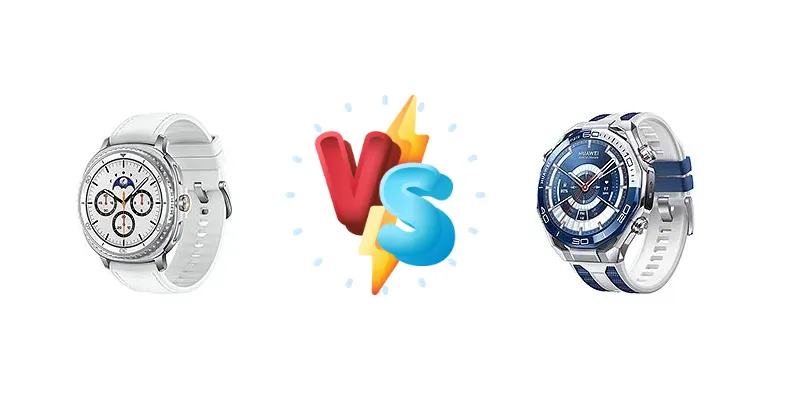
The smartwatch landscape is increasingly segmented, with Samsung continuing to refine its Wear OS experience and Huawei forging its own path with HarmonyOS. This comparison pits the Samsung Galaxy Watch8 Classic, a familiar and feature-rich option, against the Huawei Watch Ultimate 2, a premium device aiming for a more luxurious and robust experience. Both target users seeking a sophisticated wearable, but their approaches differ significantly.
🏆 Quick Verdict
For the average user deeply integrated into the Android ecosystem, the Samsung Galaxy Watch8 Classic offers a more seamless experience with its established app support and familiar interface. However, the Huawei Watch Ultimate 2 presents a compelling alternative for those prioritizing build quality and potentially longer battery life, despite the HarmonyOS limitations.
| Network |
|---|
| 2G bands | GSM 850 / 900 / 1800 / 1900 | GSM 850 / 900 / 1800 / 1900 |
| 3G bands | HSDPA 850 / 900 / 2100 | HSDPA 850 / 900 / 1900 / 2100 |
| 4G bands | 1, 2, 3, 4, 5, 7, 8, 12, 13, 14, 18, 19, 20, 25, 26, 28, 40, 66, 71 | LTE |
| Speed | HSPA, LTE | HSPA, LTE |
| Technology | GSM / HSPA / LTE | GSM / HSPA / LTE |
| Launch |
|---|
| Announced | 2025, July 09 | 2025, September 19 |
| Status | Available. Released 2025, July 25 | Available. Released 2025, September 29 |
| Body |
|---|
| Build | Glass front (Sapphire crystal), stainless steel frame | Sapphire crystal front, cerramic bezzel, zirconium front case, ceramic back |
| Dimensions | 46.4 x 46 x 10.6 mm (1.83 x 1.81 x 0.42 in) | 48.5 x 48.5 x 12.9 mm - Black47.8 x 47.8 x 12.9 mm - Blue |
| SIM | eSIM | eSIM |
| Weight | 63.5 g (2.26 oz) | 80.5 g (2.86 oz) |
| Display |
|---|
| Protection | Sapphire crystal | - |
| Resolution | 438 x 438 pixels (~327 ppi density) | 466 x 466 pixels (~310 ppi density) |
| Size | 1.34 inches | 1.5 inches |
| Type | Super AMOLED, 3000 nits (peak) | LTPO2 AMOLED, 3500 nits (peak) |
| Platform |
|---|
| CPU | Penta-core | - |
| Chipset | Exynos W1000 (3 nm) | - |
| GPU | Mali-G68 | - |
| OS | Android Wear OS 6, One UI 8 Watch | HarmonyOS 5.1 |
| Memory |
|---|
| Card slot | No | No |
| Internal | 64GB 2GB RAM | Unspecified |
| Sound |
|---|
| 35mm jack | No | No |
| Loudspeaker | Yes | Yes |
| Comms |
|---|
| Bluetooth | 5.3, A2DP, LE | 5.2, A2DP, LE |
| NFC | Yes | Yes |
| Positioning | GPS (L1+L5), GLONASS, GALILEO, BDS | GPS (L1+L5), BDS (B1I+B1c), GALILEO (E1+E5a), QZSS (L1+L5), GLONASS |
| Radio | No | No |
| USB | No | No |
| WLAN | Wi-Fi 802.11 a/b/g/n, dual-band | Wi-Fi 802.11 a/b/g/n/ac/6 |
| Features |
|---|
| Sensors | Accelerometer, gyro, heart rate, barometer, altimeter, compass, SpO2, temperature (skin), BioActive, antioxidant index | Accelerometer, gyro, heart rate, barometer, compass, SpO2, thermometer (body temperature), X-TAP |
| Battery |
|---|
| Charging | 10W wireless | 10W wireless |
| Type | Li-Ion 445 mAh | Li-Ion 867 mAh |
| Misc |
|---|
| Colors | Black, White | Black, Blue |
| Models | SM-L500, SM-L505U | MCH-AL00 |
| Price | € 279.90 / $ 299.99 | € 849.00 |
| SAR | 1.04 W/kg (head) 0.41 W/kg (body) | - |
| SAR EU | 0.03 W/kg (head) 0.67 W/kg (body) | - |
Samsung Galaxy Watch8 Classic
- Efficient 3nm Exynos W1000 chipset for smooth performance.
- Mature Wear OS ecosystem with broad app support.
- Seamless integration with Android devices.
- Battery life may be limited compared to competitors.
- Wear OS can sometimes feel bloated.
Huawei Watch Ultimate 2
- Premium build quality and materials.
- Potentially longer battery life due to unspecified chipset optimizations.
- Unique design and aesthetic.
- Limited third-party app availability on HarmonyOS.
- Uncertain chipset performance compared to the Exynos W1000.
Display Comparison
Both watches utilize wireless charging at 10W, but details regarding display technology are absent for the Huawei Watch Ultimate 2. The Samsung Galaxy Watch8 Classic benefits from the efficiency of the 3nm Exynos W1000 chipset, potentially allowing for a brighter and more responsive display experience. Without knowing the panel type (AMOLED, LCD) or resolution of the Huawei device, it's difficult to assess color accuracy or outdoor visibility. The Samsung's display is likely to benefit from Wear OS optimizations for smooth animations.
Camera Comparison
Neither device is marketed for its camera capabilities, and details are lacking. This suggests both are focused on core smartwatch functionality rather than photography. Any camera present on either device is likely to be limited in quality and intended for quick scans or remote control functionality.
Performance
The Samsung Galaxy Watch8 Classic's penta-core Exynos W1000 (3nm) chipset represents a significant leap in efficiency compared to previous generations. This smaller node size translates to improved performance per watt, reducing thermal throttling during demanding tasks. While the Huawei Watch Ultimate 2's chipset is unspecified, the focus on premium materials suggests a prioritization of efficiency over raw processing power. Users prioritizing smooth app transitions and responsive interactions will likely find the Samsung's chipset more advantageous. The 3nm process allows for more transistors in a smaller space, potentially enabling more complex features and AI processing.
Battery Life
Both the Samsung Galaxy Watch8 Classic and the Huawei Watch Ultimate 2 support 10W wireless charging. However, without knowing the battery capacity of the Huawei device, it's difficult to compare real-world battery life. The Exynos W1000's 3nm process in the Samsung watch should contribute to improved power efficiency, potentially offsetting a smaller battery capacity. Users who frequently use GPS or other power-intensive features will benefit from the Samsung's more efficient chipset.
Buying Guide
Buy the Samsung Galaxy Watch8 Classic if you need broad app compatibility, seamless integration with Android phones, and a mature smartwatch platform. Its established ecosystem and readily available support make it a safe and versatile choice. Buy the Huawei Watch Ultimate 2 if you prioritize a premium build, potentially longer battery life, and are comfortable operating within the HarmonyOS ecosystem, accepting limited third-party app availability.
Frequently Asked Questions
❓ Does the Exynos W1000 chipset in the Galaxy Watch8 Classic overheat during extended GPS use?
The 3nm process of the Exynos W1000 is designed to minimize heat generation. While some warmth is expected during prolonged GPS tracking, the chipset's efficiency should prevent significant overheating and performance throttling, offering a more consistent experience.
❓ How does HarmonyOS on the Huawei Watch Ultimate 2 impact app availability compared to Wear OS?
HarmonyOS has a significantly smaller app ecosystem than Wear OS. While Huawei is developing its own apps and encouraging developers, users should expect limited access to popular third-party apps available on the Google Play Store for Wear OS. This is a key consideration for users reliant on specific apps.
❓ What materials are used in the construction of the Huawei Watch Ultimate 2, and how does this affect its durability?
Huawei emphasizes the use of premium materials like liquid metal and sapphire glass in the Watch Ultimate 2. These materials contribute to exceptional durability and scratch resistance, making it a more robust option for users prone to accidental impacts or demanding activities.