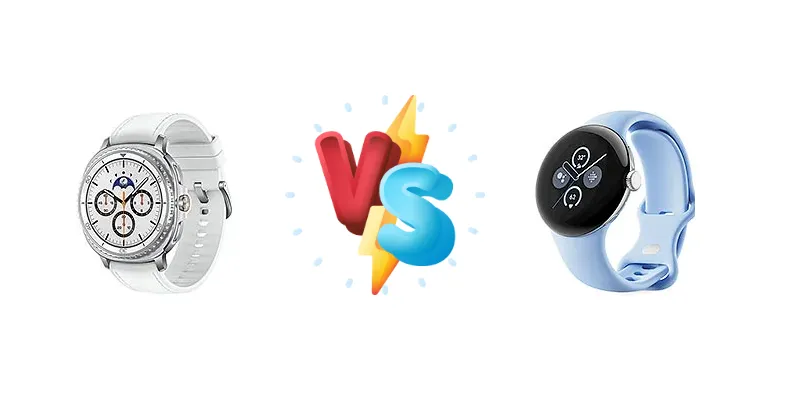
The smartwatch landscape is increasingly competitive, with Samsung and Google offering compelling options. This comparison focuses on the core hardware differences between the Samsung Galaxy Watch8 Classic, powered by Samsung’s new 3nm Exynos W1000, and the Google Pixel Watch 2, utilizing the Qualcomm 5100 platform. We’ll dissect how these chipset choices impact performance, battery life, and the overall user experience.
🏆 Quick Verdict
For the average user prioritizing consistent performance and a more established ecosystem, the Samsung Galaxy Watch8 Classic emerges as the winner. Its 3nm Exynos W1000 promises efficiency gains, while the Pixel Watch 2’s strength lies in its faster, albeit wired, charging solution.
| Network |
|---|
| 2G bands | GSM 850 / 900 / 1800 / 1900 | GSM 850 / 900 / 1800 / 1900 |
| 3G bands | HSDPA 850 / 900 / 2100 | HSDPA 850 / 900 / 1700(AWS) / 1900 / 2100 |
| 4G bands | 1, 2, 3, 4, 5, 7, 8, 12, 13, 14, 18, 19, 20, 25, 26, 28, 40, 66, 71 | LTE |
| Speed | HSPA, LTE | HSPA, LTE |
| Technology | GSM / HSPA / LTE | GSM / HSPA / LTE |
| Launch |
|---|
| Announced | 2025, July 09 | 2023, October 04 |
| Status | Available. Released 2025, July 25 | Available. Released 2023, October 12 |
| Body |
|---|
| Build | Glass front (Sapphire crystal), stainless steel frame | Glass front (Gorilla Glass 5), aluminum frame |
| Dimensions | 46.4 x 46 x 10.6 mm (1.83 x 1.81 x 0.42 in) | 41 x 41 x 12.3 mm (1.61 x 1.61 x 0.48 in) |
| SIM | eSIM | eSIM |
| Weight | 63.5 g (2.26 oz) | 31 g (1.09 oz) |
| Display |
|---|
| Protection | Sapphire crystal | Corning Gorilla Glass 5 |
| Resolution | 438 x 438 pixels (~327 ppi density) | 450 x 450 pixels (~320 ppi density) |
| Size | 1.34 inches | 1.2 inches |
| Type | Super AMOLED, 3000 nits (peak) | AMOLED, 1000 nits (peak) |
| Platform |
|---|
| CPU | Penta-core | - |
| Chipset | Exynos W1000 (3 nm) | Qualcomm 5100 |
| GPU | Mali-G68 | - |
| OS | Android Wear OS 6, One UI 8 Watch | Android Wear OS 4 |
| Memory |
|---|
| Card slot | No | No |
| Internal | 64GB 2GB RAM | 32GB 2GB RAM |
| Sound |
|---|
| 35mm jack | No | No |
| Loudspeaker | Yes | Yes |
| Comms |
|---|
| Bluetooth | 5.3, A2DP, LE | 5.0, A2DP, LE |
| NFC | Yes | Yes |
| Positioning | GPS (L1+L5), GLONASS, GALILEO, BDS | GPS, GLONASS, GALILEO, BDS, QZSS |
| Radio | No | No |
| USB | No | No |
| WLAN | Wi-Fi 802.11 a/b/g/n, dual-band | Wi-Fi 802.11 b/g/n |
| Features |
|---|
| Sensors | Accelerometer, gyro, heart rate, barometer, altimeter, compass, SpO2, temperature (skin), BioActive, antioxidant index | Accelerometer, gyro, heart rate, altimeter, compass, SpO2, thermometer (skin temperature), skin conductance |
| Battery |
|---|
| Charging | 10W wireless | Wired, 80% in 45 min |
| Type | Li-Ion 445 mAh | Li-Ion 306 mAh |
| Misc |
|---|
| Colors | Black, White | Polished Silver, Matte Black, Champagne Gold |
| Models | SM-L500, SM-L505U | G4TSL, GC3G8, GD2WG |
| Price | € 279.90 / $ 299.99 | About 160 EUR |
| SAR | 1.04 W/kg (head) 0.41 W/kg (body) | - |
| SAR EU | 0.03 W/kg (head) 0.67 W/kg (body) | - |
Samsung Galaxy Watch8 Classic
- Potentially superior power efficiency with the 3nm Exynos W1000.
- Established smartwatch ecosystem and feature set.
- Rotating bezel offers intuitive navigation.
- Slower wireless charging compared to the Pixel Watch 2.
- May be more expensive than the Pixel Watch 2.
Google Pixel Watch 2
- Faster charging with wired connection (80% in 45 minutes).
- Tight integration with Google services and Wear OS.
- Potentially more affordable price point.
- Qualcomm 5100 chipset may be less power efficient than the Exynos W1000.
- Requires a proprietary charger.
Display Comparison
While display specs aren't provided, the Galaxy Watch8 Classic traditionally features a Super AMOLED panel with excellent outdoor visibility. The Pixel Watch 2 also utilizes AMOLED, but its smaller size may impact readability for some. The key difference will likely be in color calibration and peak brightness, with Samsung historically leading in these areas. Both watches likely employ LTPO technology for variable refresh rates, conserving battery when static content is displayed.
Camera Comparison
Neither device is heavily focused on camera capabilities, and detailed camera specs are unavailable. Smartwatches primarily use cameras for limited functions like video calls or quick scans. Any differences in image quality will likely be minimal and less impactful than other features.
Performance
The core of this comparison lies in the chipsets. Samsung’s Exynos W1000, fabricated on a 3nm process, represents a significant leap in transistor density compared to the Qualcomm 5100. This smaller node generally translates to improved power efficiency and thermal performance, potentially allowing the Galaxy Watch8 Classic to sustain peak performance for longer periods. The Penta-core architecture of the Exynos suggests a heterogeneous design, likely balancing performance cores with efficiency cores. While the Qualcomm 5100 is a capable chipset, the 3nm advantage of the Exynos W1000 gives Samsung a theoretical edge in sustained performance and battery life.
Battery Life
Battery capacity isn't specified, but the charging methods differ significantly. The Galaxy Watch8 Classic relies on 10W wireless charging, which is convenient but slower. The Google Pixel Watch 2 offers wired charging, achieving 80% charge in 45 minutes. This faster charging speed is a clear advantage for users who frequently need to top up their watch. The Exynos W1000’s 3nm efficiency could offset a potentially smaller battery capacity in the Galaxy Watch8 Classic, but real-world testing is crucial to determine which watch delivers superior all-day battery life.
Buying Guide
Buy the Samsung Galaxy Watch8 Classic if you need a smartwatch with a potentially more efficient processor for all-day use and value the rotating bezel for intuitive navigation. Buy the Google Pixel Watch 2 if you prioritize faster charging times and a streamlined Wear OS experience tightly integrated with Google services, and don't mind a wired charging setup.
Frequently Asked Questions
❓ Does the Exynos W1000 chip in the Galaxy Watch8 Classic overheat during intensive tasks like GPS tracking or workout recording?
The 3nm fabrication process of the Exynos W1000 is designed to mitigate overheating. While demanding tasks will naturally generate heat, the improved efficiency should result in better thermal management compared to older chipsets. However, sustained use of power-hungry features will still impact battery life.
❓ Is the wired charging of the Pixel Watch 2 a significant inconvenience compared to the wireless charging of the Galaxy Watch8 Classic?
The convenience of wireless charging is undeniable, but the Pixel Watch 2’s faster wired charging (80% in 45 minutes) offers a compelling trade-off. For users who frequently need to quickly top up their watch, the speed advantage may outweigh the inconvenience of using a cable.
❓ How does the Qualcomm 5100 chipset in the Pixel Watch 2 compare to the Exynos W1000 in terms of app launch speeds and overall responsiveness?
The Exynos W1000's architecture and 3nm process should provide a performance advantage in app launch speeds and overall system responsiveness. However, software optimization plays a crucial role, and Google's tight integration of Wear OS with the Pixel Watch 2 could help minimize any performance gap.