
Samsung Galaxy Watch8 Classic vs Apple Watch Ultra 2: A Comprehensive Comparison
| Phones Images | |||||
|---|---|---|---|---|---|
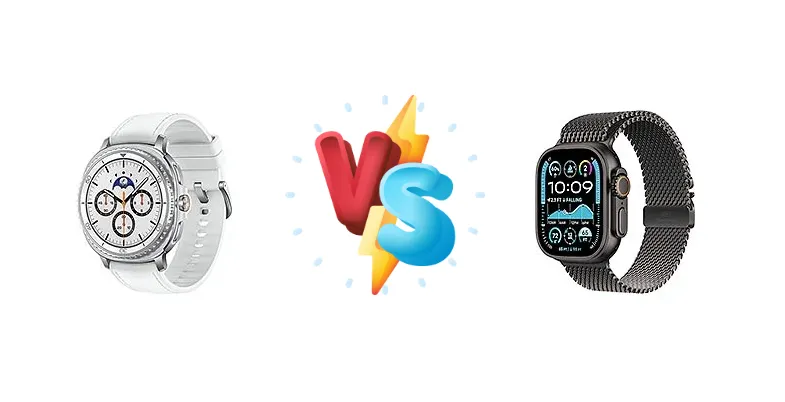
|
🏆 Quick Verdict
For iPhone users deeply embedded in the Apple ecosystem, the Apple Watch Ultra 2 is the clear winner, offering seamless integration and advanced features. However, Android users, or those prioritizing a more classic watch design and potentially faster charging, will find the Galaxy Watch8 Classic a compelling alternative.
| PHONES | ||
|---|---|---|
| Phone Names | Samsung Galaxy Watch8 Classic | Apple Watch Ultra 2 |
| Network | ||
|---|---|---|
| 2G bands | GSM 850 / 900 / 1800 / 1900 | GSM 850 / 900 / 1800 / 1900 |
| 3G bands | HSDPA 850 / 900 / 2100 | HSDPA 850 / 900 / 1700(AWS) / 1900 / 2100 - International, China, HK |
| 4G bands | 1, 2, 3, 4, 5, 7, 8, 12, 13, 14, 18, 19, 20, 25, 26, 28, 40, 66, 71 | 1, 2, 3, 4, 5, 6, 7, 8, 18, 19, 20, 25, 26, 28, 39, 40, 41, 66 - International, China, HK |
| Speed | HSPA, LTE | HSPA, LTE |
| Technology | GSM / HSPA / LTE | GSM / HSPA / LTE |
| Launch | ||
|---|---|---|
| Announced | 2025, July 09 | 2023, September 12 |
| Status | Available. Released 2025, July 25 | Available. Released 2023, September 22 |
| Body | ||
|---|---|---|
| Build | Glass front (Sapphire crystal), stainless steel frame | Sapphire crystal front, ceramic/sapphire crystal back, titanium frame |
| Dimensions | 46.4 x 46 x 10.6 mm (1.83 x 1.81 x 0.42 in) | 49 x 44 x 14.4 mm (1.93 x 1.73 x 0.57 in) |
| SIM | eSIM | eSIM |
| Weight | 63.5 g (2.26 oz) | 61.4 g or 61.8 g (black) (2.15 oz) |
| Display | ||
|---|---|---|
| Protection | Sapphire crystal | Sapphire crystal glass |
| Resolution | 438 x 438 pixels (~327 ppi density) | 502 x 410 pixels (~338 ppi density) |
| Size | 1.34 inches | 1.92 inches |
| Type | Super AMOLED, 3000 nits (peak) | Retina LTPO2 OLED, 3000 nits (peak) |
| Platform | ||
|---|---|---|
| CPU | Penta-core | Dual-core |
| Chipset | Exynos W1000 (3 nm) | Apple S9 |
| GPU | Mali-G68 | PowerVR |
| OS | Android Wear OS 6, One UI 8 Watch | watchOS 10, upgradable to watchOS 26.1 |
| Memory | ||
|---|---|---|
| Card slot | No | No |
| Internal | 64GB 2GB RAM | 64GB |
| Sound | ||
|---|---|---|
| 35mm jack | No | No |
| Loudspeaker | Yes | Yes, with dual speakers (86-decibel) |
| Comms | ||
|---|---|---|
| Bluetooth | 5.3, A2DP, LE | 5.3, A2DP, LE |
| NFC | Yes | Yes |
| Positioning | GPS (L1+L5), GLONASS, GALILEO, BDS | GPS (L1+L5), GLONASS, GALILEO, BDS |
| Radio | No | No |
| USB | No | No |
| WLAN | Wi-Fi 802.11 a/b/g/n, dual-band | Wi-Fi 802.11 b/g/n, dual-band |
| Features | ||
|---|---|---|
| Sensors | Accelerometer, gyro, heart rate, barometer, altimeter, compass, SpO2, temperature (skin), BioActive, antioxidant index | Accelerometer, gyro, heart rate, barometer, always-on altimeter (-500m to 9000m), compass, SpO2, VO2max, temperature (body), temperature (water) |
| Battery | ||
|---|---|---|
| Charging | 10W wireless | Wireless, 0-80% in 60 min |
| Type | Li-Ion 445 mAh | Li-Ion 564 mAh |
| Misc | ||
|---|---|---|
| Colors | Black, White | Titanium, Black |
| Models | SM-L500, SM-L505U | A2986, A2987, Watch7,5 |
| Price | € 279.90 / $ 299.99 | $ 469.99 / € 584.49 |
| SAR | 1.04 W/kg (head) 0.41 W/kg (body) | 0.88 W/kg (head) |
| SAR EU | 0.03 W/kg (head) 0.67 W/kg (body) | 0.22 W/kg (head) |
Samsung Galaxy Watch8 Classic
- Classic watch design appeals to traditionalists.
- Wear OS offers broader app compatibility.
- 3nm Exynos W1000 promises improved power efficiency.
- Slower 10W wireless charging.
- Potentially less optimized software compared to watchOS.
Apple Watch Ultra 2
- Faster charging (0-80% in 60 minutes).
- Tight integration with the Apple ecosystem.
- Optimized performance through Apple’s hardware-software synergy.
- Limited to the Apple ecosystem.
- Larger size may not appeal to all users.
Display Comparison
While specific display specs aren't provided, the Galaxy Watch8 Classic likely utilizes a Super AMOLED panel, known for vibrant colors. The Apple Watch Ultra 2 boasts a larger display optimized for outdoor visibility. The Ultra 2’s larger size is a key differentiator, catering to users who want more at-a-glance information. Both likely employ LTPO technology for variable refresh rates, conserving battery life. The Ultra 2’s focus on outdoor use suggests a higher peak brightness, crucial for readability in direct sunlight.
Camera Comparison
Neither device is primarily marketed for its camera capabilities, and detailed camera specs are absent. However, smartwatches are increasingly used for quick snapshots. The Ultra 2 likely benefits from Apple’s image processing algorithms, potentially delivering more refined images. The Galaxy Watch8 Classic’s camera performance will depend heavily on software optimization.
Performance
The core difference lies in the chipset architecture. Samsung’s Penta-core Exynos W1000, built on a cutting-edge 3nm process, promises significant power efficiency gains compared to older generations. However, Apple’s dual-core S9 chip, while potentially less core-intensive, benefits from Apple’s tight hardware-software integration and optimized neural engine for on-device processing. The 3nm node of the Exynos should translate to better thermal management under sustained load, potentially avoiding throttling during demanding tasks. The S9’s advantage lies in its optimized software, allowing it to extract maximum performance from its dual-core design.
Battery Life
Battery life is a critical factor. While mAh ratings are missing, the Exynos W1000’s 3nm process should contribute to improved efficiency. The Apple Watch Ultra 2 offers a 0-80% charge in 60 minutes, a significant advantage for users needing a quick top-up. The Galaxy Watch8 Classic’s 10W wireless charging is slower, potentially requiring longer charging times. The Ultra 2’s larger size may also accommodate a larger battery, further extending its runtime.
Buying Guide
Buy the Samsung Galaxy Watch8 Classic if you need a traditional watch aesthetic, prefer the Wear OS ecosystem with its broader app compatibility, and value the convenience of 10W wireless charging. Buy the Apple Watch Ultra 2 if you prioritize extreme durability, tight integration with the Apple ecosystem, and benefit from Apple’s optimized performance and health tracking features.