
Galaxy Watch8 Classic vs Apple Watch Series 9: A Detailed Comparison
| Phones Images | |||||
|---|---|---|---|---|---|
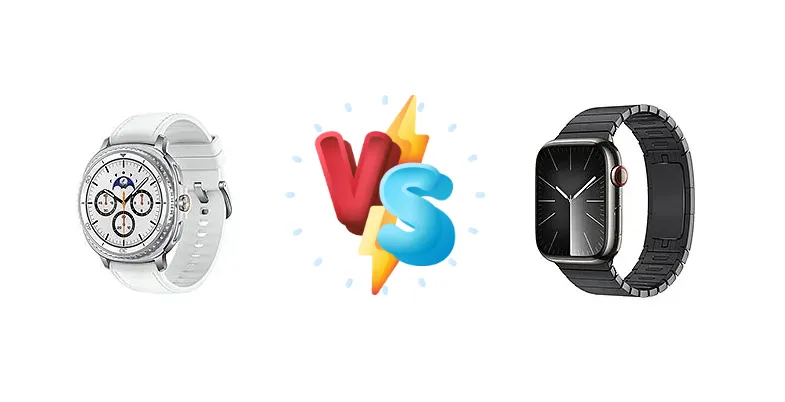
|
🏆 Quick Verdict
For users deeply embedded in the Apple ecosystem, the Apple Watch Series 9 remains the superior choice due to its seamless integration and optimized software. However, the Samsung Galaxy Watch8 Classic offers a compelling alternative with its potentially more efficient 3nm Exynos W1000 chipset and wider compatibility, making it the better option for Android users and those prioritizing open platform flexibility.
| PHONES | ||
|---|---|---|
| Phone Names | Samsung Galaxy Watch8 Classic | Apple Watch Series 9 |
| Network | ||
|---|---|---|
| 2G bands | GSM 850 / 900 / 1800 / 1900 | GSM 850 / 900 / 1800 / 1900 |
| 3G bands | HSDPA 850 / 900 / 2100 | HSDPA 850 / 900 / 1700(AWS) / 1900 / 2100 - International, China, HK |
| 4G bands | 1, 2, 3, 4, 5, 7, 8, 12, 13, 14, 18, 19, 20, 25, 26, 28, 40, 66, 71 | 1, 2, 3, 4, 5, 6, 7, 8, 18, 19, 20, 25, 26, 28, 39, 40, 41, 66 - International, China, HK |
| Speed | HSPA, LTE | HSPA, LTE |
| Technology | GSM / HSPA / LTE | GSM / HSPA / LTE |
| Launch | ||
|---|---|---|
| Announced | 2025, July 09 | 2023, September 12 |
| Status | Available. Released 2025, July 25 | Available. Released 2023, September 22 |
| Body | ||
|---|---|---|
| Build | Glass front (Sapphire crystal), stainless steel frame | Sapphire crystal front, ceramic/sapphire crystal back, stainless steel frame |
| Dimensions | 46.4 x 46 x 10.6 mm (1.83 x 1.81 x 0.42 in) | 45 x 38 x 10.7 mm (1.77 x 1.50 x 0.42 in) |
| SIM | eSIM | eSIM |
| Weight | 63.5 g (2.26 oz) | 42.3 g (41mm), 51.5 g (45mm) (1.48 oz) |
| Display | ||
|---|---|---|
| Protection | Sapphire crystal | Sapphire crystal glass |
| Resolution | 438 x 438 pixels (~327 ppi density) | 484 x 396 pixels (~326 ppi density) |
| Size | 1.34 inches | 1.9 inches |
| Type | Super AMOLED, 3000 nits (peak) | Retina LTPO OLED, 2000 nits (peak) |
| Platform | ||
|---|---|---|
| CPU | Penta-core | Dual-core |
| Chipset | Exynos W1000 (3 nm) | Apple S9 |
| GPU | Mali-G68 | PowerVR |
| OS | Android Wear OS 6, One UI 8 Watch | watchOS 10, upgradable to watchOS 26.1 |
| Memory | ||
|---|---|---|
| Card slot | No | No |
| Internal | 64GB 2GB RAM | 64GB |
| Sound | ||
|---|---|---|
| 35mm jack | No | No |
| Loudspeaker | Yes | Yes |
| Comms | ||
|---|---|---|
| Bluetooth | 5.3, A2DP, LE | 5.3, A2DP, LE |
| NFC | Yes | Yes |
| Positioning | GPS (L1+L5), GLONASS, GALILEO, BDS | GPS, GLONASS, GALILEO, QZSS, BDS |
| Radio | No | No |
| USB | No | No |
| WLAN | Wi-Fi 802.11 a/b/g/n, dual-band | Wi-Fi 802.11 b/g/n, dual-band |
| Features | ||
|---|---|---|
| Sensors | Accelerometer, gyro, heart rate, barometer, altimeter, compass, SpO2, temperature (skin), BioActive, antioxidant index | Accelerometer, gyro, heart rate, barometer, always-on altimeter, compass, SpO2, VO2max, temperature (body) |
| Battery | ||
|---|---|---|
| Charging | 10W wireless | Wireless, 0-80% in 45 min |
| Type | Li-Ion 445 mAh | Li-Ion 308 mAh |
| Misc | ||
|---|---|---|
| Colors | Black, White | Graphite, Silver, Gold, Red |
| Models | SM-L500, SM-L505U | A2982, A2984, A2983, A2985, Watch7,3, Watch7,4 |
| Price | € 279.90 / $ 299.99 | About 630 EUR |
| SAR | 1.04 W/kg (head) 0.41 W/kg (body) | 1.02 W/kg (head) |
| SAR EU | 0.03 W/kg (head) 0.67 W/kg (body) | 0.64 W/kg (head) |
Samsung Galaxy Watch8 Classic
- Potentially better power efficiency with the 3nm Exynos W1000 chipset.
- Rotating bezel provides a unique and intuitive navigation experience.
- Wider smartphone compatibility (Android and iOS).
- 10W wireless charging is slower than the Apple Watch Series 9.
- Wear OS ecosystem, while improving, is still less mature than watchOS.
Apple Watch Series 9
- Faster charging (0-80% in 45 minutes).
- Seamless integration with the Apple ecosystem.
- Mature and refined watchOS operating system.
- Limited to Apple device compatibility.
- Dual-core processor may struggle with demanding multitasking compared to the penta-core Exynos.
Display Comparison
While specific display specs aren't provided, both watches utilize advanced AMOLED panels. The Galaxy Watch8 Classic likely benefits from Samsung’s display expertise, potentially offering vibrant colors and high peak brightness. However, Apple’s consistently excellent color accuracy and LTPO technology for adaptive refresh rates are strong contenders. The Classic’s rotating bezel offers a unique interaction method absent on the Series 9, potentially enhancing usability for some users.
Camera Comparison
Neither watch is focused on photography, and detailed camera specs are absent. Both likely feature basic front-facing cameras for video calls, but image quality is not a primary selling point. The focus is on health tracking and notifications, not capturing high-resolution photos.
Performance
The core difference lies in the chipsets: Samsung’s penta-core Exynos W1000, fabricated on a 3nm process, versus Apple’s dual-core S9. While core count isn’t everything, the 3nm node of the Exynos suggests superior power efficiency and potentially better sustained performance compared to Apple’s S9. The Exynos’ architecture is likely optimized for Wear OS, while the S9 is tailored for watchOS. The impact of the dual-core vs. penta-core design will be most noticeable in complex tasks and multitasking, where the Exynos may have an advantage. However, Apple’s tight software-hardware integration often mitigates the raw power difference.
Battery Life
Samsung specifies 10W wireless charging for the Galaxy Watch8 Classic, while Apple claims 0-80% charge in 45 minutes for the Series 9. The faster charging speed of the Apple Watch is a clear advantage for users who frequently need to top up their device. However, the Exynos W1000’s 3nm process could translate to improved battery efficiency, potentially offsetting the slower charging speed with longer real-world usage. Actual battery life will depend heavily on usage patterns and enabled features.
Buying Guide
Buy the Samsung Galaxy Watch8 Classic if you need broader smartphone compatibility (Android and iOS), prefer a rotating bezel for intuitive navigation, and value the flexibility of the Wear OS platform. Buy the Apple Watch Series 9 if you prioritize seamless integration with other Apple devices, a mature and refined operating system (watchOS), and access to Apple’s extensive app ecosystem. The choice hinges on your existing tech investments and preferred operating system.