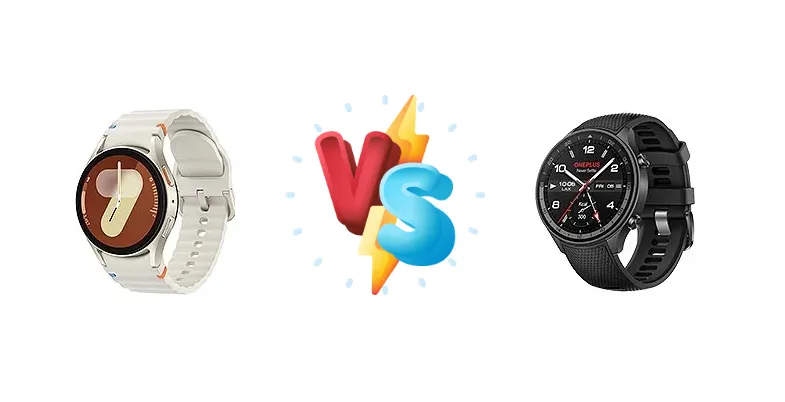
The smartwatch market is heating up, with Samsung and OnePlus offering compelling options at different price points. The Samsung Galaxy Watch7, powered by the new Exynos W1000, aims for premium performance. Meanwhile, the OnePlus Watch 2R leverages the Qualcomm Snapdragon W5 Gen 1 to deliver a balance of features and efficiency. This comparison dissects the core differences between these two wearables, focusing on chipset architecture, charging capabilities, and real-world user experience.
🏆 Quick Verdict
For users prioritizing raw processing power and a potentially smoother software experience, the Samsung Galaxy Watch7 takes a slight edge thanks to its 3nm Exynos W1000. However, the OnePlus Watch 2R offers excellent value with the Snapdragon W5 Gen 1, and its wired charging may be preferable for some, making it the better choice for budget-conscious buyers.
| Network |
|---|
| 2G bands | GSM 850 / 900 / 1800 / 1900 | N/A |
| 3G bands | HSDPA 850 / 900 / 2100 | N/A |
| 4G bands | 1, 2, 3, 4, 5, 7, 8, 12, 13, 14, 18, 19, 20, 25, 26, 28, 40, 66, 71 | N/A |
| EDGE | - | No |
| GPRS | - | No |
| Speed | HSPA, LTE | - |
| Technology | GSM / HSPA / LTE | No cellular connectivity |
| Launch |
|---|
| Announced | 2024, July 10 | 2024, July 16 |
| Status | Available. Released 2024, July 24 | Available. Released 2024, July 16 |
| Body |
|---|
| Build | Glass front (Sapphire crystal), aluminum frame | Glass front (Panda Glass), aluminum frame |
| Dimensions | 44.4 x 44.4 x 9.7 mm (1.75 x 1.75 x 0.38 in) | 47 x 46.6 x 12.1 mm (1.85 x 1.83 x 0.48 in) |
| SIM | eSIM | No |
| Weight | 33.8 g (44mm), 28.8 g (40mm) (1.02 oz) | 37 g (1.31 oz) |
| Display |
|---|
| Protection | Sapphire crystal | Panda Glass |
| Resolution | 480 x 480 pixels (~327 ppi density) | 466 x 466 pixels (~326 ppi density) |
| Size | 1.5 inches | 1.43 inches |
| Type | Super AMOLED, 2000 nits (peak) | AMOLED, 1000 nits (HBM) |
| Platform |
|---|
| CPU | Penta-core | Quad-core 1.7 GHz Cortex-A53 |
| Chipset | Exynos W1000 (3 nm) | Qualcomm Snapdragon W5 Gen 1 (4 nm) |
| GPU | Mali-G68 | Adreno 702 |
| OS | Android Wear OS 5, up to 6.0, One UI Watch 8 | Android Wear OS, ColorOS Watch 6.0 |
| Memory |
|---|
| Card slot | No | No |
| Internal | 32GB 2GB RAM | 32GB 2GB RAM |
| Sound |
|---|
| 35mm jack | No | No |
| Loudspeaker | Yes | Yes |
| Comms |
|---|
| Bluetooth | 5.3, A2DP, LE | 5.0, A2DP, LE |
| NFC | Yes | Yes |
| Positioning | GPS (L1+L5), GLONASS, GALILEO, BDS | GPS (L1+L5), GLONASS, GALILEO, BDS, QZSS |
| Radio | No | No |
| USB | No | No |
| WLAN | Wi-Fi 802.11 a/b/g/n, dual-band | Wi-Fi 802.11 a/b/g/n, dual-band |
| Features |
|---|
| Sensors | Accelerometer, gyro, heart rate, barometer, altimeter, compass, SpO2, temperature (skin), BioActive | Accelerometer, gyro, barometer, compass, heart rate, SpO2 |
| Battery |
|---|
| Charging | 10W wireless | 7.5W wired |
| Type | Li-Ion 425 mAh | 500 mAh |
| Misc |
|---|
| Colors | Cream, Silver, Green | Forest Green, Gunmetal Gray |
| Models | SM-L310F, SM-L315F | - |
| Price | $ 199.99 / € 136.55 | About 150 EUR |
| SAR EU | 0.73 W/kg (head) 1.85 W/kg (body) | - |
Samsung Galaxy Watch7
- Potentially faster processing with the 3nm Exynos W1000
- Likely superior display quality based on Samsung's history
- Seamless integration with Samsung ecosystem
- Slower wireless charging
- Potential for higher price point
- Battery life may be impacted by the more powerful processor
OnePlus Watch 2R
- Efficient Snapdragon W5 Gen 1 chipset
- Faster wired charging
- Potentially better value for money
- May not match the Galaxy Watch7's processing power
- Display quality may be slightly lower
- Less brand recognition in the smartwatch space
Display Comparison
Display specifications are not provided, so a direct comparison is limited. However, given Samsung's history, the Watch7 likely features a vibrant AMOLED panel with excellent color accuracy and potentially higher peak brightness. The OnePlus Watch 2R will likely offer a solid AMOLED experience, but may not reach the same level of visual fidelity. Bezels and LTPO technology (for variable refresh rates) will be key differentiators, but are unknown at this time.
Camera Comparison
Camera specifications are not provided for either device. Smartwatches generally feature limited camera functionality, and image quality is rarely a primary purchasing factor. Any camera present on either device will likely be for basic video calls or quick snapshots, and image processing will be crucial for acceptable results.
Performance
The core of this comparison lies in the chipsets. Samsung's Exynos W1000, fabricated on a 3nm process, theoretically offers superior transistor density and power efficiency compared to the OnePlus Watch 2R’s Qualcomm Snapdragon W5 Gen 1, built on a 4nm node. While the Snapdragon W5 Gen 1 utilizes a quad-core Cortex-A53 configuration clocked at 1.7 GHz, the penta-core Exynos W1000’s architecture is unknown, but the 3nm process suggests a performance advantage. This translates to potentially faster app loading times and smoother animations on the Galaxy Watch7. However, Qualcomm’s Snapdragon is known for its optimized power management, potentially offsetting some of the Exynos’s theoretical gains. The impact of these differences will be most noticeable in demanding tasks like voice assistant interactions and complex watch face rendering.
Battery Life
Battery capacity is not specified, but the charging methods differ significantly. The Samsung Galaxy Watch7 utilizes 10W wireless charging, which is convenient but generally slower than wired charging. The OnePlus Watch 2R employs 7.5W wired charging, offering a potentially faster 0-100% charge time. The Snapdragon W5 Gen 1’s efficiency could contribute to longer battery life on the OnePlus Watch 2R, even with a smaller battery capacity, offsetting the slower wireless charging of the Samsung device. Real-world battery life will depend heavily on usage patterns and feature utilization.
Buying Guide
Buy the Samsung Galaxy Watch7 if you demand the latest in wearable processing technology and are deeply integrated into the Samsung ecosystem, benefiting from seamless connectivity and feature compatibility. Buy the OnePlus Watch 2R if you prioritize battery life, value for money, and a reliable, efficient chipset, and aren't necessarily seeking the absolute peak performance available in a smartwatch.
Frequently Asked Questions
❓ Does the Exynos W1000 chip in the Galaxy Watch7 overheat during extended use, such as GPS tracking or long phone calls?
While the 3nm process should improve thermal efficiency, the Exynos W1000's performance potential could generate more heat than the Snapdragon W5 Gen 1. Real-world testing is needed to determine if throttling occurs during sustained workloads. Samsung's software optimization will play a crucial role in managing heat dissipation.
❓ Is the 7.5W wired charging on the OnePlus Watch 2R significantly faster than the 10W wireless charging on the Galaxy Watch7 in practical terms?
Yes, wired charging generally provides a faster and more consistent charging rate than wireless charging. While the wattage difference isn't massive, the OnePlus Watch 2R will likely achieve a full charge in a shorter timeframe, especially when starting from a low battery level. Wireless charging is more convenient, but sacrifices speed.
❓ How does the software experience differ between the Galaxy Watch7 and the OnePlus Watch 2R, and which is more customizable?
The Galaxy Watch7 runs Wear OS with Samsung's One UI Watch, offering a feature-rich and polished experience tightly integrated with the Samsung ecosystem. The OnePlus Watch 2R likely uses a proprietary operating system, which may offer less customization and app availability compared to Wear OS. Samsung's software is generally more refined, but OnePlus may prioritize simplicity and battery life.