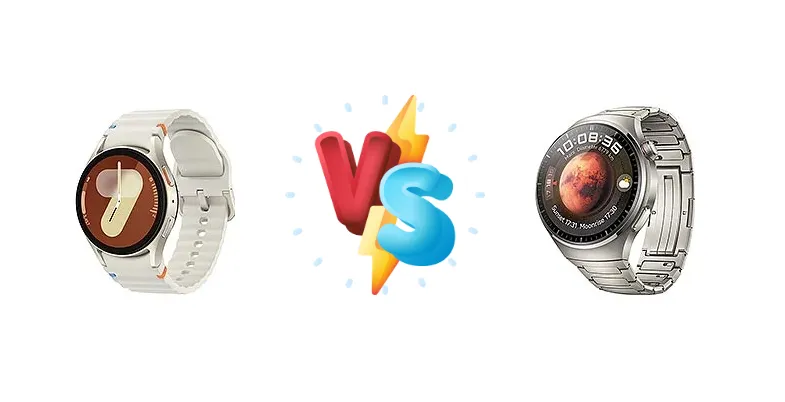
The smartwatch market is heating up, with Samsung and Huawei consistently pushing boundaries. We're pitting the newly released Samsung Galaxy Watch7, powered by the cutting-edge Exynos W1000, against the established Huawei Watch 4 Pro to determine which wearable reigns supreme. This comparison focuses on the core hardware differences and their impact on the user experience.
🏆 Quick Verdict
For the average user prioritizing raw performance and a mature software ecosystem, the Samsung Galaxy Watch7 emerges as the winner. Its 3nm Exynos W1000 chipset promises significant efficiency gains, though real-world testing is needed to confirm. However, the Huawei Watch 4 Pro remains a strong contender, particularly for those invested in the Huawei ecosystem.
| Network |
|---|
| 2G bands | GSM 850 / 900 / 1800 / 1900 | N/A |
| 3G bands | HSDPA 850 / 900 / 2100 | HSDPA 850 / 900 / 1800 / 1900 / 2100 / 800 |
| 4G bands | 1, 2, 3, 4, 5, 7, 8, 12, 13, 14, 18, 19, 20, 25, 26, 28, 40, 66, 71 | LTE |
| Speed | HSPA, LTE | HSPA, LTE |
| Technology | GSM / HSPA / LTE | HSPA / LTE |
| Launch |
|---|
| Announced | 2024, July 10 | 2023, May 10 |
| Status | Available. Released 2024, July 24 | Available. Released 2023, June 22 |
| Body |
|---|
| Build | Glass front (Sapphire crystal), aluminum frame | Glass front, ceramic back, TC4 titanium frame |
| Dimensions | 44.4 x 44.4 x 9.7 mm (1.75 x 1.75 x 0.38 in) | 47.6 x 47.6 x 12.9 mm (1.87 x 1.87 x 0.51 in) |
| SIM | eSIM | eSIM |
| Weight | 33.8 g (44mm), 28.8 g (40mm) (1.02 oz) | 65 g (2.29 oz) |
| | - | 50m water resistant
5 ATM
Compatible with standard 22mm straps |
| Display |
|---|
| Protection | Sapphire crystal | Sapphire crystal glass |
| Resolution | 480 x 480 pixels (~327 ppi density) | 466 x 466 pixels (~310 ppi density) |
| Size | 1.5 inches | 1.5 inches |
| Type | Super AMOLED, 2000 nits (peak) | LTPO AMOLED |
| | - | * the display resolution is unconfirmed
Always-on display |
| Platform |
|---|
| CPU | Penta-core | - |
| Chipset | Exynos W1000 (3 nm) | - |
| GPU | Mali-G68 | - |
| OS | Android Wear OS 5, up to 6.0, One UI Watch 8 | HarmonyOS 3.0 |
| Memory |
|---|
| Card slot | No | No |
| Internal | 32GB 2GB RAM | 32GB 2GB RAM |
| Sound |
|---|
| 3.5mm jack | - | No |
| 35mm jack | No | No |
| Loudspeaker | Yes | Yes |
| Comms |
|---|
| Bluetooth | 5.3, A2DP, LE | 5.2, A2DP, LE |
| NFC | Yes | Yes |
| Positioning | GPS (L1+L5), GLONASS, GALILEO, BDS | GPS (L1+L5), GLONASS, BDS, GALILEO, QZSS |
| Radio | No | No |
| USB | No | No |
| WLAN | Wi-Fi 802.11 a/b/g/n, dual-band | Wi-Fi 802.11 b/g/n (market/region dependent) |
| Features |
|---|
| Sensors | Accelerometer, gyro, heart rate, barometer, altimeter, compass, SpO2, temperature (skin), BioActive | Accelerometer, gyro, heart rate, barometer, compass, SpO2, thermometer (body temperature) |
| Battery |
|---|
| Charging | 10W wireless | Wireless |
| Type | Li-Ion 425 mAh | Li-Ion |
| Misc |
|---|
| Colors | Cream, Silver, Green | Titanium |
| Models | SM-L310F, SM-L315F | MDS-AL00, MDS-AL10 |
| Price | $ 199.99 / € 136.55 | About 550 EUR |
| SAR EU | 0.73 W/kg (head) 1.85 W/kg (body) | - |
Samsung Galaxy Watch7
- Cutting-edge 3nm Exynos W1000 processor for improved performance and efficiency
- Wear OS ecosystem provides a wide range of apps and customization options
- 10W wireless charging offers a convenient charging experience
- Battery life remains to be fully tested in real-world scenarios
- Wear OS can sometimes feel resource-intensive
Huawei Watch 4 Pro
- Potentially longer battery life due to unspecified optimizations
- HarmonyOS offers a unique user experience
- Strong integration with the Huawei ecosystem
- Chipset details are missing, making performance comparisons difficult
- Limited app selection compared to Wear OS
Display Comparison
Display specifications are currently unavailable for the Huawei Watch 4 Pro, making a direct comparison difficult. However, given Huawei’s history with premium smartwatches, we anticipate a high-quality AMOLED panel. The Galaxy Watch7’s display benefits from the efficiency of the Exynos W1000, potentially allowing for a brighter, more vibrant display without significant battery drain. The absence of detailed display specs for the Huawei Watch 4 Pro means we cannot assess its peak brightness, color accuracy, or outdoor visibility relative to the Galaxy Watch7.
Camera Comparison
Neither device’s camera specifications are provided in the context data. This suggests that camera functionality is not a primary selling point for either smartwatch. Historically, smartwatch cameras are limited in quality and utility, primarily used for quick notes or remote control of a phone’s camera. Without further information, it’s impossible to assess the camera capabilities of either device.
Performance
The Samsung Galaxy Watch7’s Exynos W1000, fabricated on a 3nm process, represents a substantial leap in efficiency compared to previous generations. This smaller node size allows for increased transistor density, translating to higher performance at lower power consumption. While the Huawei Watch 4 Pro’s chipset remains unspecified, it’s likely built on a larger node, potentially leading to higher power draw under sustained loads. The penta-core CPU in the Galaxy Watch7 suggests a focus on multi-tasking and responsiveness, crucial for running Wear OS and its associated apps. Users who frequently use demanding apps or features like voice assistants will likely benefit from the Galaxy Watch7’s more advanced processor.
Battery Life
Both the Samsung Galaxy Watch7 and Huawei Watch 4 Pro offer wireless charging, but detailed battery capacity and charging speeds are limited. The Galaxy Watch7’s 10W wireless charging is a known quantity, providing a baseline for comparison. The Huawei Watch 4 Pro’s charging speed is unspecified, but a larger battery capacity (if present) could offset a slower charging rate. The Exynos W1000’s 3nm architecture in the Galaxy Watch7 is designed to improve battery efficiency, potentially extending usage time between charges, even with a similar battery capacity to the Huawei Watch 4 Pro.
Buying Guide
Buy the Samsung Galaxy Watch7 if you need a smartwatch with the latest processor technology, a wider app selection through Wear OS, and seamless integration with the Android ecosystem. Buy the Huawei Watch 4 Pro if you prioritize a potentially longer battery life (given the lack of detailed specs), prefer the HarmonyOS interface, and are already heavily invested in Huawei's suite of devices and services.
Frequently Asked Questions
❓ Does the Exynos W1000 in the Galaxy Watch7 generate excessive heat during prolonged use?
The 3nm fabrication process of the Exynos W1000 is specifically designed to minimize heat generation. While demanding tasks will inevitably produce some heat, the improved efficiency should result in significantly better thermal management compared to older chipsets. However, real-world testing is crucial to confirm this.
❓ How does the HarmonyOS on the Huawei Watch 4 Pro differ from Wear OS on the Galaxy Watch7 in terms of user experience?
HarmonyOS prioritizes a streamlined and efficient user interface, with a focus on connectivity within the Huawei ecosystem. Wear OS, on the other hand, offers greater customization options and a wider range of third-party apps. Users accustomed to the Android ecosystem will likely find Wear OS more familiar, while those seeking a simpler, more integrated experience may prefer HarmonyOS.
❓ What impact does the 3nm process have on the Galaxy Watch7's battery life compared to a smartwatch with a larger node chipset?
A 3nm process allows for significantly more transistors to be packed into the same area, leading to increased performance and reduced power consumption. This translates to potentially longer battery life for the Galaxy Watch7, even if the battery capacity is similar to that of the Huawei Watch 4 Pro. The efficiency gains are particularly noticeable during demanding tasks.