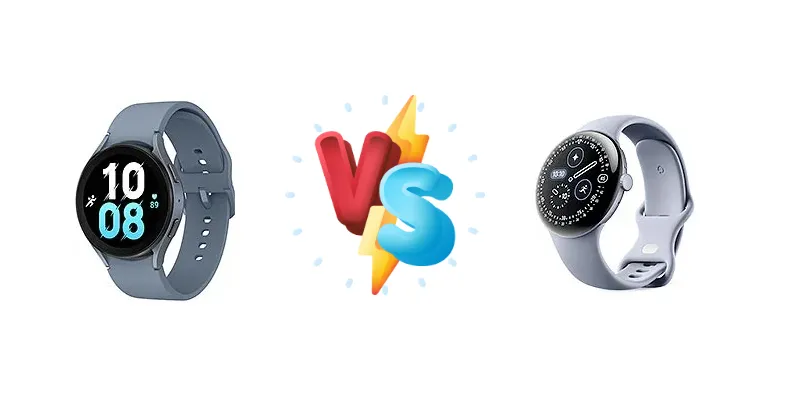
The smartwatch landscape is heating up. Samsung’s Galaxy Watch5, a refined iteration of a popular line, faces a strong challenge from Google’s Pixel Watch 4, which boasts a newer chipset and a focus on streamlined Wear OS. This comparison dissects the core differences, moving beyond marketing hype to reveal which watch delivers the best experience for your needs.
🏆 Quick Verdict
For most users, the Google Pixel Watch 4 emerges as the superior choice. Its Qualcomm Snapdragon W5 Gen 2 chipset provides a noticeable performance boost over the Galaxy Watch5’s Exynos W920, and the faster charging is a significant convenience. However, Samsung’s established ecosystem and wider app support remain compelling advantages.
| Network |
|---|
| 2G bands | GSM 850 / 900 / 1800 / 1900 | GSM 850 / 900 / 1800 / 1900 |
| 3G bands | HSDPA 850 / 900 / 2100 | HSDPA 850 / 900 / 1700(AWS) / 1900 / 2100 |
| 4G bands | 1, 3, 5, 7, 8, 20, 28 | LTE |
| Speed | HSPA, LTE | HSPA, LTE |
| Technology | GSM / HSPA / LTE | GSM / HSPA / LTE |
| Launch |
|---|
| Announced | 2022, August 10 | 2025, August 20 |
| Status | Available. Released 2022, August 26 | Available. Released 2025, October 09 |
| Body |
|---|
| Build | Glass front (Sapphire crystal), aluminum frame | Glass front (Gorilla Glass 5), aluminum frame |
| Dimensions | 44.4 x 43.3 x 9.8 mm (1.75 x 1.70 x 0.39 in) | 45 x 45 x 12.3 mm (1.77 x 1.77 x 0.48 in) |
| SIM | eSIM | eSIM |
| Weight | 33.5 g (44mm), 28.7 g (40mm) (1.02 oz) | 31 g or 37 g (1.09 oz) |
| | MIL-STD-810H compliant*
50m water resistant (IP68)
Compatible with standard 20mm straps
ECG certified
Blood pressure monitor
Armor aluminum frame with tougher drop and scratch resistance (advertised)
*does not guarantee ruggedness or use in extreme conditions | - |
| Display |
|---|
| Protection | Sapphire crystal | Corning Gorilla Glass 5 |
| Resolution | 450 x 450 pixels (~321 ppi density) | 456 x 456 pixels (~320 ppi density) |
| Size | 1.4 inches | 1.4 inches |
| Type | Super AMOLED | LTPO AMOLED, 3000 nits (peak) |
| | Always-on display | - |
| Platform |
|---|
| CPU | Dual-core 1.18 GHz Cortex-A55 | Quad-core (4x1.7 GHz Cortex-A53) |
| Chipset | Exynos W920 (5 nm) | Qualcomm Snapdragon W5 Gen 2 (4 nm) |
| GPU | Mali-G68 | Adreno A702 |
| OS | Android Wear OS 4, One UI Watch 5 | Android Wear OS 6 |
| Memory |
|---|
| Card slot | No | No |
| Internal | 16GB 1.5GB RAM | 32GB 2GB RAM |
| Sound |
|---|
| 3.5mm jack | No | - |
| 35mm jack | No | No |
| Loudspeaker | Yes | Yes |
| Comms |
|---|
| Bluetooth | 5.2, A2DP, LE | 6.0, A2DP |
| NFC | Yes | Yes |
| Positioning | GPS, GLONASS, GALILEO, BDS | GPS (L1+L5), GLONASS, GALILEO (E1+E5a) |
| Radio | No | No |
| USB | No | No |
| WLAN | Wi-Fi 802.11 a/b/g/n, dual-band | Wi-Fi 802.11 a/b/g/n/ac/6, dual-band |
| Features |
|---|
| Sensors | Accelerometer, gyro, heart rate, barometer, thermometer (skin temperature) | Accelerometer, gyro, heart rate, altimeter, compass, SpO2, thermometer (skin temperature), skin conductance |
| | Natural language commands and dictation
Samsung Pay | - |
| Battery |
|---|
| Charging | 10W wireless | Wired, 50% in 15 min, 80% in 30 min, 100% in 60 min - 45mm model
Wired, 50% in 15 min, 80% in 25 min, 100% in 45 min - 41mm model |
| Type | Li-Ion 410 mAh | Li-Ion 455 mAh |
| Misc |
|---|
| Colors | Graphite, Silver, Pink Gold, Sapphire | Matte Black, Polished Silver, Champagne Gold, Satin Moonstone |
| Models | SM-R915F, SM-R905F | - |
| Price | About 170 EUR | € 353.94 |
Samsung Galaxy Watch5
- Established Samsung ecosystem integration
- Mature One UI Watch software experience
- Wide range of available watch bands and accessories
- Older Exynos W920 chipset
- Slower wireless charging
- Potentially more thermal throttling under load
Google Pixel Watch 4
- Powerful Qualcomm Snapdragon W5 Gen 2 chipset
- Faster wired charging (50% in 15 minutes)
- Clean and streamlined Wear OS experience
- Less mature app ecosystem compared to One UI Watch
- Reliance on Google’s software updates
- Potentially less extensive accessory options
Display Comparison
While both watches likely employ AMOLED panels (data not provided), the core difference lies in the processing power driving them. The display quality will be largely similar, but the Snapdragon W5 Gen 2 in the Pixel Watch 4 will ensure smoother animations and faster response times when interacting with the interface. We anticipate both watches will offer excellent outdoor visibility, but detailed brightness nits and color accuracy data are needed for a definitive assessment.
Camera Comparison
Neither watch is positioned as a photography powerhouse, and detailed camera specs are unavailable. Smartwatches generally feature limited camera capabilities, primarily for quick scans or video calls. Any camera differences will likely be minimal and not a deciding factor for most buyers.
Performance
The Pixel Watch 4’s Qualcomm Snapdragon W5 Gen 2 (4nm) represents a significant architectural leap over the Galaxy Watch5’s Exynos W920 (5nm). The 4nm process node inherently offers better power efficiency and thermal characteristics, translating to less throttling during demanding tasks. Furthermore, the quad-core 1.7 GHz Cortex-A53 CPU in the Pixel Watch 4 is clocked considerably higher than the dual-core 1.18 GHz Cortex-A55 in the Galaxy Watch5, promising a snappier user experience. This difference will be most noticeable when launching apps, navigating complex menus, and utilizing third-party applications.
Battery Life
Battery life is a complex equation. While mAh capacity isn’t provided for either watch, the Pixel Watch 4’s Snapdragon W5 Gen 2’s superior efficiency could offset a potentially smaller battery. However, the Pixel Watch 4’s charging speed is a clear win. Achieving 50% charge in 15 minutes (45mm model) and a full charge in 60 minutes is significantly faster than the Galaxy Watch5’s 10W wireless charging, which lacks specific timing data. This faster charging mitigates any potential battery life concerns and provides greater convenience for users on the go.
Buying Guide
Buy the Samsung Galaxy Watch5 if you prioritize seamless integration with the Samsung ecosystem, rely heavily on Samsung Health features, or prefer the established maturity of One UI Watch. Buy the Google Pixel Watch 4 if you value raw performance, a cleaner Wear OS experience, and faster charging speeds, and are comfortable with a slightly less mature app ecosystem.
Frequently Asked Questions
❓ Does the Exynos W920 chip in the Galaxy Watch5 overheat during extended use, like GPS tracking or video recording?
The 5nm process of the Exynos W920 is relatively efficient, but it's less so than the 4nm Snapdragon W5 Gen 2. Users engaging in prolonged, demanding tasks like GPS tracking or video recording may experience some thermal throttling, leading to reduced performance. The Pixel Watch 4 is less likely to exhibit this issue.
❓ How does the Wear OS experience on the Pixel Watch 4 differ from One UI Watch on the Galaxy Watch5 in terms of customization and third-party app availability?
One UI Watch offers a more feature-rich and customizable experience out of the box, with a wider selection of pre-installed apps and watch faces. However, Wear OS is rapidly improving, and the Pixel Watch 4 benefits from Google’s direct integration and access to the Google Play Store. While the app ecosystem is still maturing, Wear OS is gaining ground in terms of third-party app support.
❓ Is the wired charging of the Pixel Watch 4 a significant inconvenience compared to the wireless charging of the Galaxy Watch5?
While wireless charging is convenient, the Pixel Watch 4’s significantly faster wired charging (full charge in 60 minutes for the 45mm model) largely mitigates this inconvenience. The time saved during charging outweighs the need for a cable for many users.