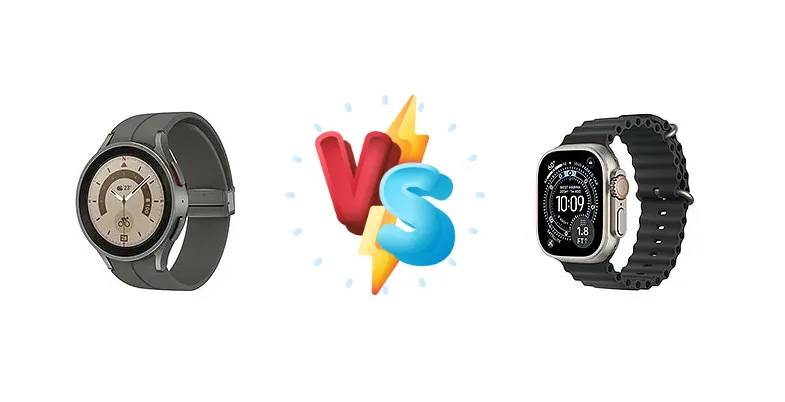
Both the Samsung Galaxy Watch5 Pro and the Apple Watch Ultra 3 represent the pinnacle of smartwatch engineering, targeting users who demand durability, advanced health tracking, and extended battery life. However, they approach these goals with fundamentally different philosophies – Samsung leveraging Wear OS and a focus on customization, while Apple maintains its walled-garden approach with watchOS and a streamlined experience. This comparison dissects the core differences to determine which reigns supreme.
🏆 Quick Verdict
For the average user prioritizing seamless integration within the Apple ecosystem and a more refined user experience, the Apple Watch Ultra 3 is the superior choice. Its faster charging and optimized software outweigh the Galaxy Watch5 Pro’s slightly more flexible Wear OS platform. However, Android users will find the Watch5 Pro a more natural fit.
| Network |
|---|
| 2G bands | GSM 850 / 900 / 1800 / 1900 | GSM 850 / 900 / 1800 / 1900 |
| 3G bands | HSDPA 850 / 900 / 2100 | HSDPA 850 / 900 / 1700(AWS) / 1900 / 2100 - International, China, HK |
| 4G bands | 1, 3, 5, 7, 8, 20, 28 | 1, 2, 3, 4, 5, 6, 7, 8, 18, 19, 20, 25, 26, 28, 39, 40, 41, 66 - International, China, HK |
| 5G bands | - | SA/NSA |
| Speed | HSPA, LTE | HSPA, LTE, 5G |
| Technology | GSM / HSPA / LTE | GSM / HSPA / LTE / 5G |
| Launch |
|---|
| Announced | 2022, August 10 | 2025, September 09 |
| Status | Available. Released 2022, August 26 | Available. Released 2025, September 19 |
| Body |
|---|
| Build | Glass front (Sapphire crystal), titanium frame | Sapphire crystal front, ceramic/sapphire crystal back, titanium frame (grade 5) |
| Dimensions | 45.4 x 45.4 x 10.5 mm (1.79 x 1.79 x 0.41 in) | 49 x 44 x 12 mm (1.93 x 1.73 x 0.47 in) |
| SIM | eSIM | eSIM |
| Weight | 46.5 g (1.66 oz) | 61.6 g or 61.8 g (black) (2.15 oz) |
| | MIL-STD-810H compliant*
50m water resistant (IP68)
Compatible with standard 20mm straps
ECG certified
Blood pressure monitor
*does not guarantee ruggedness or use in extreme conditions | - |
| Display |
|---|
| Protection | Sapphire crystal | Sapphire crystal glass |
| Resolution | 450 x 450 pixels (~321 ppi density) | 514 x 422 pixels (~326 ppi density) |
| Size | 1.4 inches | 1.98 inches |
| Type | Super AMOLED | Retina LTPO3 OLED, 3000 nits (peak) |
| | Always-on display | - |
| Platform |
|---|
| CPU | Dual-core 1.18 GHz Cortex-A55 | Dual-core |
| Chipset | Exynos W920 (5 nm) | Apple S10 |
| GPU | Mali-G68 | PowerVR |
| OS | Android Wear OS 4, One UI Watch 5 | watchOS 26, upgradable to watchOS 26.1 |
| Memory |
|---|
| Card slot | No | No |
| Internal | 16GB 1.5GB RAM | 64GB |
| Sound |
|---|
| 3.5mm jack | No | - |
| 35mm jack | No | No |
| Loudspeaker | Yes | Yes, with dual speakers (86-decibel) |
| Comms |
|---|
| Bluetooth | 5.2, A2DP, LE | 5.3, A2DP, LE |
| NFC | Yes | Yes |
| Positioning | GPS, GLONASS, GALILEO, BDS | GPS (L1+L5), GLONASS, GALILEO, BDS, QZSS |
| Radio | No | No |
| USB | No | No |
| WLAN | Wi-Fi 802.11 a/b/g/n, dual-band | Wi-Fi 802.11 b/g/n, dual-band |
| Features |
|---|
| Sensors | Accelerometer, gyro, heart rate, barometer, thermometer (body temperature) | Accelerometer, gyro, heart rate, barometer, always-on altimeter (-500m to 9000m), compass, SpO2, VO2max, temperature (body), temperature (water) |
| | Natural language commands and dictation
Samsung Pay | - |
| Battery |
|---|
| Charging | 10W wireless | Wireless, 0-80% in 45 min |
| Type | Li-Ion 590 mAh | Li-Ion 599 mAh |
| Misc |
|---|
| Colors | Black Titanium, Gray Titanium | Natural, Black |
| Models | SM-R925F | A3281, A3282 |
| Price | About 110 EUR | € 828.00 |
| SAR | - | 1.16 W/kg (head) |
| SAR EU | - | 1.19 W/kg (head) |
Samsung Galaxy Watch5 Pro
- Wear OS offers greater customization options.
- Broader smartphone compatibility (Android).
- Sapphire crystal glass provides excellent scratch resistance.
- Slower charging speed (10W wireless).
- Exynos W920 may exhibit more throttling under sustained load.
- Less optimized software experience compared to watchOS.
Apple Watch Ultra 3
- Faster charging (0-80% in 45 minutes).
- Apple S10 offers superior performance and efficiency.
- Seamless integration with the Apple ecosystem.
- Limited to Apple ecosystem.
- Less customizable than Wear OS.
- Potentially higher price point.
Display Comparison
While both watches feature robust displays designed for outdoor visibility, specifics are limited. The Apple Watch Ultra 3 likely benefits from Apple’s industry-leading display calibration and potentially higher peak brightness, though exact nits aren’t provided. Both utilize LTPO technology for adaptive refresh rates, conserving battery. The Watch5 Pro’s sapphire crystal glass offers excellent scratch resistance, but the Ultra 3’s larger display area and potentially superior brightness give it an edge for readability in direct sunlight. Bezels are likely comparable, given both prioritize a rugged aesthetic.
Camera Comparison
Neither watch is designed for serious photography. Both lack detailed camera specifications in the provided data. The focus is on functionality like walkie-talkie and emergency SOS, not image quality. Any camera features are likely secondary and of limited utility.
Performance
The core of the performance difference lies in the chipsets. The Apple Watch Ultra 3’s Apple S10 is a custom-designed SoC, optimized for watchOS and known for its efficient performance. The Samsung Galaxy Watch5 Pro utilizes the Exynos W920 (5nm). While both are dual-core processors, Apple’s vertical integration allows for tighter hardware-software optimization, likely resulting in smoother animations and faster app loading times. The 5nm process node of the Exynos W920 is respectable, but Apple’s S10 likely benefits from architectural advantages and potentially a more advanced manufacturing process. RAM specifications are not provided, but Apple typically optimizes memory management more aggressively.
Battery Life
Battery life is a critical consideration for rugged smartwatches. The Apple Watch Ultra 3 boasts a 0-80% charge in 45 minutes, a significant advantage over the Samsung Galaxy Watch5 Pro’s 10W wireless charging. While the Watch5 Pro’s battery capacity isn’t specified, the faster charging of the Ultra 3 allows for quicker replenishment during extended use. The efficiency of the Apple S10 chip likely contributes to competitive battery endurance, despite the Ultra 3’s larger, brighter display. Real-world usage will dictate the ultimate winner, but the Ultra 3’s charging speed is a clear benefit.
Buying Guide
Buy the Samsung Galaxy Watch5 Pro if you need broader smartphone compatibility (Android), prefer a more customizable Wear OS experience, and value the flexibility of third-party apps. Buy the Apple Watch Ultra 3 if you are deeply invested in the Apple ecosystem, prioritize a polished and intuitive user interface, and require the fastest possible charging speeds for quick top-ups during demanding activities.
Frequently Asked Questions
❓ Does the Exynos W920 chip in the Galaxy Watch5 Pro overheat during prolonged GPS tracking or workout sessions?
The 5nm process of the Exynos W920 helps mitigate overheating, but it's still possible under sustained load. Users engaging in long-duration activities may experience some performance throttling to manage thermal output. Apple’s S10 is likely more efficient in this regard due to its custom design and tighter software integration.
❓ How does the charging speed difference impact real-world usability for the Apple Watch Ultra 3 versus the Samsung Galaxy Watch5 Pro?
The Apple Watch Ultra 3’s 0-80% charge in 45 minutes is a significant advantage for users who frequently engage in demanding activities. A quick 15-20 minute charge can provide hours of additional use, whereas the Galaxy Watch5 Pro’s 10W wireless charging will require considerably longer to achieve a similar level of charge.
❓ Is the lack of detailed camera specs a significant drawback for either smartwatch?
No. Neither the Apple Watch Ultra 3 nor the Samsung Galaxy Watch5 Pro are positioned as photography devices. Camera functionality is primarily intended for quick snapshots or video calls, and image quality is not a primary focus.