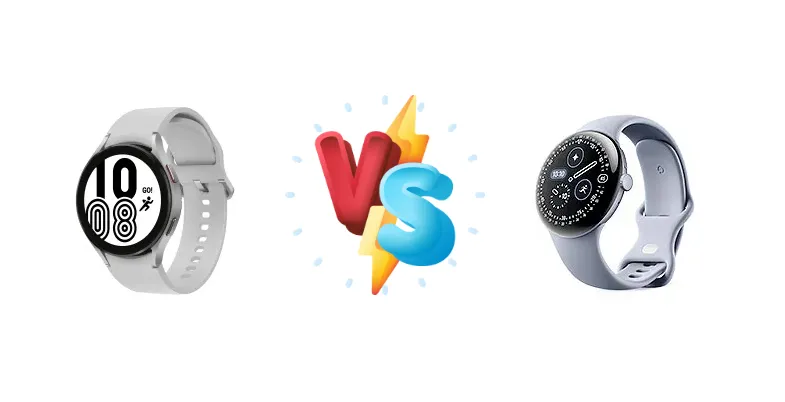
The smartwatch landscape is heating up, with Google's Pixel Watch 4 aiming to challenge Samsung's established Galaxy Watch4. While both devices offer a premium wearable experience, they diverge significantly in their core hardware. This comparison dives deep into the architectural differences between the Snapdragon W5 Gen 2 and Exynos W920 chipsets, analyzing their impact on performance, battery life, and overall user experience.
🏆 Quick Verdict
For most users, the Google Pixel Watch 4 emerges as the superior choice. Its newer Snapdragon W5 Gen 2 chipset, fabricated on a 4nm process, delivers demonstrably better performance and efficiency compared to the Galaxy Watch4’s 5nm Exynos W920. The faster charging speeds further solidify its advantage, despite the Galaxy Watch4’s established ecosystem.
| Network |
|---|
| 2G bands | GSM 850 / 900 / 1800 / 1900 | GSM 850 / 900 / 1800 / 1900 |
| 3G bands | HSDPA 850 / 900 / 2100 | HSDPA 850 / 900 / 1700(AWS) / 1900 / 2100 |
| 4G bands | 1, 3, 5, 7, 8, 20 | LTE |
| Speed | HSPA, LTE | HSPA, LTE |
| Technology | GSM / HSPA / LTE | GSM / HSPA / LTE |
| Launch |
|---|
| Announced | 2021, August 11 | 2025, August 20 |
| Status | Available. Released 2021, August 27 | Available. Released 2025, October 09 |
| Body |
|---|
| Build | Glass front (Gorilla Glass DX+), aluminum frame | Glass front (Gorilla Glass 5), aluminum frame |
| Dimensions | 44.4 x 43.3 x 9.8 mm (1.75 x 1.70 x 0.39 in) | 45 x 45 x 12.3 mm (1.77 x 1.77 x 0.48 in) |
| SIM | eSIM | eSIM |
| Weight | 30.3 g (44mm), 25.9 g (40mm) (1.06 oz) | 31 g or 37 g (1.09 oz) |
| | MIL-STD-810G compliant*
50m water resistant (IP68)
Compatible with standard 20mm straps
ECG certified
Blood pressure monitor
*does not guarantee ruggedness or use in extreme conditions | - |
| Display |
|---|
| Protection | Corning Gorilla Glass DX+ | Corning Gorilla Glass 5 |
| Resolution | 450 x 450 pixels (~321 ppi density) | 456 x 456 pixels (~320 ppi density) |
| Size | 1.4 inches | 1.4 inches |
| Type | Super AMOLED | LTPO AMOLED, 3000 nits (peak) |
| | Always-on display | - |
| Platform |
|---|
| CPU | Dual-core 1.18 GHz Cortex-A55 | Quad-core (4x1.7 GHz Cortex-A53) |
| Chipset | Exynos W920 (5 nm) | Qualcomm Snapdragon W5 Gen 2 (4 nm) |
| GPU | Mali-G68 | Adreno A702 |
| OS | Android Wear OS 4, One UI Watch 5 | Android Wear OS 6 |
| Memory |
|---|
| Card slot | No | No |
| Internal | 16GB 1.5GB RAM | 32GB 2GB RAM |
| Sound |
|---|
| 3.5mm jack | No | - |
| 35mm jack | No | No |
| Loudspeaker | Yes | Yes |
| Comms |
|---|
| Bluetooth | 5.0, A2DP, LE | 6.0, A2DP |
| NFC | Yes | Yes |
| Positioning | GPS, GLONASS, GALILEO, BDS | GPS (L1+L5), GLONASS, GALILEO (E1+E5a) |
| Radio | No | No |
| USB | No | No |
| WLAN | Wi-Fi 802.11 a/b/g/n, dual-band | Wi-Fi 802.11 a/b/g/n/ac/6, dual-band |
| Features |
|---|
| Sensors | Accelerometer, gyro, compass, barometer, heart rate, SpO2 | Accelerometer, gyro, heart rate, altimeter, compass, SpO2, thermometer (skin temperature), skin conductance |
| | Natural language commands and dictation
Samsung Pay | - |
| Battery |
|---|
| Charging | Wireless | Wired, 50% in 15 min, 80% in 30 min, 100% in 60 min - 45mm model
Wired, 50% in 15 min, 80% in 25 min, 100% in 45 min - 41mm model |
| Type | Li-Ion 361 mAh | Li-Ion 455 mAh |
| Misc |
|---|
| Colors | Black, Pink Gold, Silver, Green, Thom Browne Edition, Bespoke Edition, PXG Golf Edition | Matte Black, Polished Silver, Champagne Gold, Satin Moonstone |
| Models | SM-R860, SM-R870 | - |
| Price | About 110 EUR | € 353.94 |
Samsung Galaxy Watch4
- Established Samsung ecosystem integration
- Potentially lower price point (depending on sales)
- Mature app ecosystem
- Older Exynos W920 chipset
- Slower wireless charging
- Potential for thermal throttling under heavy load
Google Pixel Watch 4
- Faster and more efficient Snapdragon W5 Gen 2 chipset
- Significantly faster wired charging
- Cleaner Wear OS experience
- Potentially less mature app ecosystem
- Reliance on Google’s software updates
- May be more expensive
Display Comparison
Both watches utilize AMOLED displays, but detailed display specs (resolution, brightness) are missing. However, the core difference lies in the processing power driving them. The Pixel Watch 4’s Snapdragon W5 Gen 2 will likely handle complex animations and UI transitions more smoothly. The Galaxy Watch4’s display, while likely excellent, is constrained by the older Exynos chipset. The absence of LTPO information prevents a full power efficiency comparison.
Camera Comparison
Neither device is particularly known for its camera capabilities, and detailed camera specs are unavailable. Smartwatches generally prioritize functionality over photographic excellence. Any camera features are likely to be secondary to core smartwatch functions.
Performance
The Google Pixel Watch 4’s Qualcomm Snapdragon W5 Gen 2, with its quad-core 1.7 GHz Cortex-A53 CPUs, represents a significant architectural leap over the Galaxy Watch4’s dual-core 1.18 GHz Cortex-A55 Exynos W920. The move to a 4nm process for the Snapdragon chip provides superior transistor density and thermal efficiency. This translates to sustained performance under load, reducing the likelihood of throttling during demanding tasks like GPS tracking or voice assistant interactions. The higher clock speeds and core count of the Snapdragon W5 Gen 2 will be noticeable in app launch times and overall system responsiveness.
Battery Life
While battery capacity (mAh) is not provided, the Pixel Watch 4’s Snapdragon W5 Gen 2’s improved efficiency should result in comparable or better battery life despite potentially having a similar capacity to the Galaxy Watch4. Crucially, the Pixel Watch 4 boasts significantly faster charging: 50% in 15 minutes, 80% in 25/30 minutes (depending on model), and 100% in 45/60 minutes. This is a substantial advantage over the Galaxy Watch4’s wireless charging, which lacks specific timing data but is generally slower.
Buying Guide
Buy the Samsung Galaxy Watch4 if you are deeply embedded in the Samsung ecosystem and prioritize seamless integration with Galaxy devices, or if you find a significantly discounted price. Buy the Google Pixel Watch 4 if you value raw performance, faster charging, and a cleaner Wear OS experience, and are comfortable with a potentially less mature app ecosystem.
Frequently Asked Questions
❓ Does the Exynos W920 in the Galaxy Watch4 overheat during extended GPS use?
The Exynos W920, being a 5nm chip, is susceptible to thermal throttling during prolonged, demanding tasks like GPS tracking for outdoor activities. While it won't necessarily 'overheat' to a dangerous degree, performance may be reduced to manage temperature, impacting GPS accuracy and responsiveness.
❓ How does the Snapdragon W5 Gen 2's 4nm process impact real-world battery life on the Pixel Watch 4?
The 4nm process allows for a higher transistor density and lower power consumption compared to the 5nm Exynos W920. This translates to improved battery efficiency, meaning the Pixel Watch 4 can potentially achieve similar or better battery life with a comparable battery capacity, and will likely maintain performance for longer under load.
❓ Is the wired charging on the Pixel Watch 4 a significant inconvenience compared to the Galaxy Watch4's wireless charging?
While wireless charging is convenient, the Pixel Watch 4’s significantly faster wired charging (50% in 15 minutes) largely mitigates this inconvenience. The time saved during charging outweighs the slight hassle of using a cable for most users.