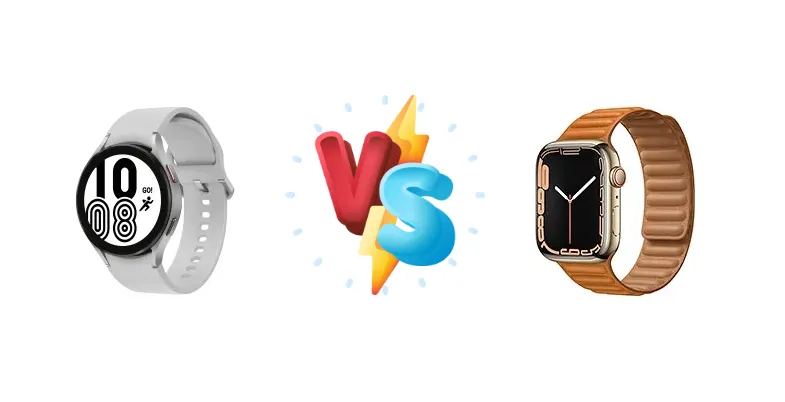
The smartwatch market is largely a duopoly, with Samsung and Apple consistently leading the charge. The Samsung Galaxy Watch4, powered by Wear OS, represents a significant shift for Samsung’s wearable line, while the Apple Watch Series 7 continues to refine Apple’s established watchOS ecosystem. This comparison dives deep into the hardware and software differences to determine which smartwatch delivers the best experience.
🏆 Quick Verdict
For Android users, the Samsung Galaxy Watch4 is the clear winner, offering a feature-rich experience and seamless integration. However, for iPhone users, the Apple Watch Series 7 remains the superior choice due to its tight ecosystem integration and optimized performance, despite the Galaxy Watch4's competitive hardware.
| Network |
|---|
| 2G bands | GSM 850 / 900 / 1800 / 1900 | GSM 850 / 900 / 1800 / 1900 |
| 3G bands | HSDPA 850 / 900 / 2100 | HSDPA 850 / 900 / 1700(AWS) / 1900 / 2100 - International |
| 4G bands | 1, 3, 5, 7, 8, 20 | 1, 2, 3, 4, 5, 7, 8, 18, 19, 20, 25, 26, 28, 39, 40, 41, 66 - International |
| Speed | HSPA, LTE | HSPA, LTE |
| Technology | GSM / HSPA / LTE | GSM / HSPA / LTE |
| | - | 1, 2, 3, 4, 5, 7, 12, 13, 14, 17, 18, 19, 25, 26, 39, 40, 41, 66 - USA, LATAM, Canada |
| Launch |
|---|
| Announced | 2021, August 11 | 2021, September 14 |
| Status | Available. Released 2021, August 27 | Available. Released 2021, October 15 |
| Body |
|---|
| Build | Glass front (Gorilla Glass DX+), aluminum frame | Sapphire crystal front, ceramic/sapphire crystal back, stainless steel frame |
| Dimensions | 44.4 x 43.3 x 9.8 mm (1.75 x 1.70 x 0.39 in) | 45 x 38 x 10.7 mm (1.77 x 1.50 x 0.42 in) |
| SIM | eSIM | eSIM |
| Weight | 30.3 g (44mm), 25.9 g (40mm) (1.06 oz) | 42.3 g (41mm), 51.5 g (45mm) (1.48 oz) |
| | MIL-STD-810G compliant*
50m water resistant (IP68)
Compatible with standard 20mm straps
ECG certified
Blood pressure monitor
*does not guarantee ruggedness or use in extreme conditions | IP6X certified
50m water resistant
ECG certified (region dependent SW application; HW available on all models) |
| Display |
|---|
| Protection | Corning Gorilla Glass DX+ | Sapphire crystal glass |
| Resolution | 450 x 450 pixels (~321 ppi density) | 484 x 396 pixels (~326 ppi density) |
| Size | 1.4 inches | 1.9 inches |
| Type | Super AMOLED | Retina LTPO OLED, 1000 nits (peak) |
| | Always-on display | Always-on display |
| Platform |
|---|
| CPU | Dual-core 1.18 GHz Cortex-A55 | Dual-core |
| Chipset | Exynos W920 (5 nm) | Apple S7 |
| GPU | Mali-G68 | PowerVR |
| OS | Android Wear OS 4, One UI Watch 5 | watchOS 8.0, upgradable to watchOS 26.1 |
| Memory |
|---|
| Card slot | No | No |
| Internal | 16GB 1.5GB RAM | 32GB 1GB RAM |
| Sound |
|---|
| 3.5mm jack | No | No |
| 35mm jack | No | No |
| Loudspeaker | Yes | Yes |
| Comms |
|---|
| Bluetooth | 5.0, A2DP, LE | 5.0, A2DP, LE |
| NFC | Yes | Yes |
| Positioning | GPS, GLONASS, GALILEO, BDS | GPS, GLONASS, GALILEO, QZSS, BDS |
| Radio | No | No |
| USB | No | No |
| WLAN | Wi-Fi 802.11 a/b/g/n, dual-band | Wi-Fi 802.11 b/g/n, dual-band |
| Features |
|---|
| Sensors | Accelerometer, gyro, compass, barometer, heart rate, SpO2 | Accelerometer, gyro, heart rate, barometer, always-on altimeter, compass, SpO2, VO2max |
| | Natural language commands and dictation
Samsung Pay | Natural language commands and dictation (talking mode)
Ultra Wideband (UWB) support |
| Battery |
|---|
| Charging | Wireless | Wireless, 0-80% in 45 min |
| Type | Li-Ion 361 mAh | Li-Ion 309 mAh (1.19 Wh) |
| Misc |
|---|
| Colors | Black, Pink Gold, Silver, Green, Thom Browne Edition, Bespoke Edition, PXG Golf Edition | Graphite, Gold, Silver |
| Models | SM-R860, SM-R870 | A2475, A2476, A2477, A2478, watch6,8, watch6,9 |
| Price | About 110 EUR | About 310 EUR |
| SAR | - | 1.10 W/kg (head) |
| SAR EU | - | 0.70 W/kg (head) 1.50 W/kg (body) |
Samsung Galaxy Watch4
- Wear OS offers greater app compatibility and customization.
- Competitive pricing compared to the Apple Watch Series 7.
- Bioelectrical Impedance Analysis (BIA) sensor for body composition analysis.
- Wear OS can sometimes feel less polished than watchOS.
- Battery life may be shorter than the Apple Watch Series 7 under heavy use.
Apple Watch Series 7
- Seamless integration with the Apple ecosystem.
- Optimized performance and smooth user experience.
- Advanced health features like ECG and blood oxygen monitoring.
- Limited compatibility with Android devices.
- Higher price point compared to the Samsung Galaxy Watch4.
Display Comparison
While both watches feature excellent displays, specifics are limited in the provided data. The Apple Watch Series 7 is known for its larger display and thinner bezels compared to previous generations, offering more screen real estate. The Galaxy Watch4 utilizes a Super AMOLED display, likely offering vibrant colors and deep blacks. Without nit brightness or resolution data, it's difficult to definitively declare a winner, but Apple’s focus on maximizing screen size within a similar form factor gives it an edge. The Series 7's always-on display technology is also generally considered more efficient.
Camera Comparison
Neither device is particularly known for its camera capabilities, and the provided data doesn't offer any insights. Smartwatches aren't typically purchased for photography, and any camera functionality is usually limited to basic features like quick QR code scanning. Therefore, this section doesn't offer a significant differentiating factor between the two.
Performance
The Samsung Galaxy Watch4’s Exynos W920 (5nm) chipset is a significant upgrade over previous Samsung wearables. The 5nm process node suggests improved power efficiency and thermal performance compared to older 10nm chips. However, the Apple Watch Series 7’s Apple S7 chip, while lacking detailed specifications, benefits from Apple’s tight hardware-software integration. This allows Apple to optimize performance in ways Samsung cannot. The dual-core CPU in both devices suggests similar core counts, but Apple’s custom silicon and optimized software likely translate to a smoother, more responsive user experience, particularly in demanding tasks. The Galaxy Watch4's Wear OS platform, while improved, can still exhibit occasional lag compared to watchOS.
Battery Life
Battery life is a crucial consideration for smartwatches. While mAh capacity isn't provided, the Apple Watch Series 7 boasts a 0-80% charge in 45 minutes, indicating a relatively fast charging speed. The Galaxy Watch4 offers wireless charging, but lacks a specific charging time. The Exynos W920’s 5nm process *should* contribute to better battery efficiency, but Apple’s software optimizations often compensate for potentially smaller battery capacities. Real-world usage will dictate the ultimate winner, but the Series 7’s faster charging is a tangible benefit.
Buying Guide
Buy the Samsung Galaxy Watch4 if you need a versatile smartwatch that plays well with Android, offers robust health tracking features, and benefits from the open Wear OS platform. Buy the Apple Watch Series 7 if you prioritize seamless integration with the Apple ecosystem, value optimized performance, and require features like Family Setup or advanced health monitoring exclusive to watchOS.
Frequently Asked Questions
❓ Does the Exynos W920 chip in the Galaxy Watch4 overheat during intensive tasks like GPS tracking or workout recording?
The Exynos W920’s 5nm process node is designed to mitigate overheating. While it may experience some warmth during prolonged, demanding tasks, it’s unlikely to overheat to the point of performance throttling. However, Apple’s S7 chip, benefiting from tighter hardware-software integration, is generally more efficient at thermal management.
❓ Is the Galaxy Watch4’s Wear OS platform significantly different from previous Tizen-based Samsung smartwatches?
Yes, the transition to Wear OS represents a major shift. Wear OS offers access to a wider range of apps through the Google Play Store and benefits from Google’s services. However, Samsung has layered its One UI Watch skin on top of Wear OS, providing a familiar Samsung experience. Early versions of Wear OS had performance concerns, but Samsung and Google have worked to optimize the platform for the Watch4.
❓ Can I use the Apple Watch Series 7 with an Android phone?
No, the Apple Watch Series 7 is designed exclusively for use with iPhones. It requires an iPhone for initial setup and ongoing functionality. There is no official support for Android devices.
❓ What are the key health features exclusive to the Apple Watch Series 7?
The Apple Watch Series 7 offers features like ECG (electrocardiogram) and irregular heart rhythm notifications, which are not available on the Galaxy Watch4. Additionally, Apple’s Family Setup allows users to manage Apple Watches for family members without requiring them to have their own iPhones.