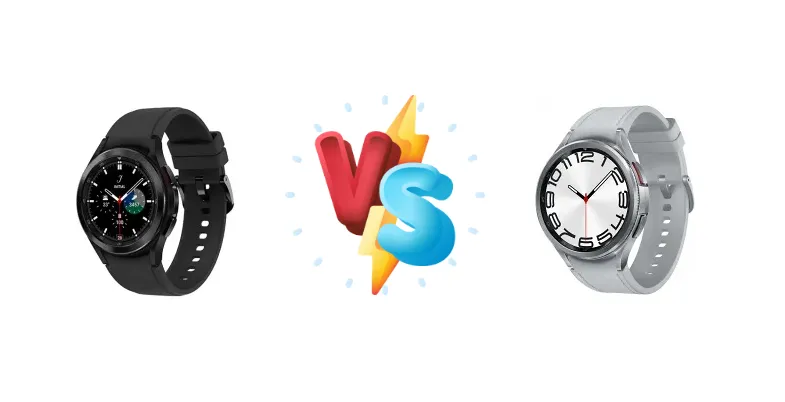
Samsung's Classic line consistently delivers a premium smartwatch experience, blending traditional aesthetics with modern functionality. The Galaxy Watch6 Classic arrives as a refinement of the popular Watch4 Classic, but the improvements aren't immediately obvious. This deep dive examines the core differences – from the updated Exynos chipset to the faster charging – to determine if upgrading is justified.
🏆 Quick Verdict
For most users, the Galaxy Watch6 Classic is the superior choice. The 1.4 GHz CPU and Exynos W930 chipset offer a noticeable performance boost over the Watch4 Classic’s 1.18 GHz CPU and W920, and the addition of 10W wireless charging significantly reduces charging times. While the core experience remains similar, the Watch6 Classic provides a smoother, more responsive experience.
| Network |
|---|
| 2G bands | GSM 850 / 900 / 1800 / 1900 | GSM 850 / 900 / 1800 / 1900 |
| 3G bands | HSDPA 850 / 900 / 2100 | HSDPA 850 / 900 / 1700(AWS) / 1900 / 2100 |
| 4G bands | 1, 3, 5, 7, 8, 20 | 1, 2, 3, 4, 5, 7, 8, 12, 13, 18, 19, 20, 25, 26, 28, 40, 66, 71 |
| Speed | HSPA, LTE | HSPA, LTE |
| Technology | GSM / HSPA / LTE | GSM / HSPA / LTE |
| Launch |
|---|
| Announced | 2021, August 11 | 2023, July 26 |
| Status | Available. Released 2021, August 27 | Available. Released 2023, August 11 |
| Body |
|---|
| Build | Glass front (Gorilla Glass DX), stainless steel frame 316L or titanium frame | Sapphire crystal front, stainless steel frame |
| Dimensions | 45.5 x 45.5 x 11 mm (1.79 x 1.79 x 0.43 in) | 46.5 x 46.5 x 10.9 mm (1.83 x 1.83 x 0.43 in) |
| SIM | eSIM | eSIM |
| Weight | 52 g (46mm), 46.5 g (42mm) (1.66 oz) | 59 g (47mm), 52 g (43mm) (2.08 oz) |
| | MIL-STD-810G compliant*
50m water resistant (IP68)
Compatible with standard 20mm straps
ECG certified
Blood pressure monitor
Rotating bezel
*does not guarantee ruggedness or use in extreme conditions | - |
| Display |
|---|
| Protection | Corning Gorilla Glass DX | Sapphire crystal |
| Resolution | 450 x 450 pixels (~321 ppi density) | 480 x 480 pixels (~453 ppi density) |
| Size | 1.4 inches | 1.5 inches |
| Type | Super AMOLED | Super AMOLED, 2000 nits (peak) |
| | Always-on display | - |
| Platform |
|---|
| CPU | Dual-core 1.18 GHz Cortex-A55 | Dual-core 1.4 GHz Cortex-A55 |
| Chipset | Exynos W920 (5 nm) | Exynos W930 (5 nm) |
| GPU | Mali-G68 | Mali-G68 |
| OS | Android Wear OS 4, One UI Watch 5 | Android Wear OS 4, upgradable to 6.0, One UI Watch 8 |
| Memory |
|---|
| Card slot | No | No |
| Internal | 16GB 1.5GB RAM | 16GB 2GB RAM |
| Sound |
|---|
| 3.5mm jack | No | - |
| 35mm jack | No | No |
| Loudspeaker | Yes | Yes |
| Comms |
|---|
| Bluetooth | 5.0, A2DP, LE | 5.3, A2DP, LE |
| NFC | Yes | Yes |
| Positioning | GPS, GLONASS, GALILEO, BDS | GPS, GLONASS, GALILEO, BDS |
| Radio | No | No |
| USB | No | No |
| WLAN | Wi-Fi 802.11 a/b/g/n, dual-band | Wi-Fi 802.11 a/b/g/n, dual-band |
| Features |
|---|
| Sensors | Accelerometer, gyro, compass, barometer, heart rate, SpO2 | Accelerometer, gyro, heart rate, barometer, altimeter, compass, SpO2, temperature (skin) |
| | Natural language commands and dictation
Samsung Pay | - |
| Battery |
|---|
| Charging | Wireless | 10W wireless |
| Type | Li-Ion 361 mAh | Li-Ion 425 mAh |
| Misc |
|---|
| Colors | Black, Silver, Thom Browne Edition, Bespoke Edition | Black, Silver |
| Models | SM-R880, SM-R890 | - |
| Price | About 90 EUR | $ 149.99 / € 195.88 |
Samsung Galaxy Watch4 Classic
- Lower price point, offering excellent value.
- Classic rotating bezel design for intuitive navigation.
- Mature Wear OS ecosystem with a wide range of apps.
- Slower processor (Exynos W920) compared to the Watch6 Classic.
- Slower wireless charging speeds.
- Potentially less refined software experience.
Samsung Galaxy Watch6 Classic
- Faster processor (Exynos W930) for improved performance.
- 10W wireless charging for quicker top-ups.
- Likely improved display technology for better visuals.
- Higher price tag.
- Similar design to the Watch4 Classic, offering incremental changes.
- Battery life may not be significantly improved despite faster charging.
Display Comparison
Both watches feature Super AMOLED displays, but specific details like brightness and resolution aren't provided. However, the Watch6 Classic benefits from the advancements in Samsung's display technology, likely offering improved color accuracy and outdoor visibility. The bezel design remains a key differentiator, with both offering a rotating physical bezel for intuitive navigation. The lack of detailed display specs makes a direct comparison difficult, but the Watch6 Classic’s newer panel is expected to be superior.
Camera Comparison
Neither watch is designed for serious photography, and detailed camera specifications are absent. Both likely feature basic front-facing cameras for video calls, but image quality is not a primary selling point. Focusing on the core smartwatch functionality is more relevant than scrutinizing the camera capabilities of these devices.
Performance
The core performance difference lies within the chipsets. The Galaxy Watch6 Classic’s Exynos W930, clocked at 1.4 GHz, represents a clear upgrade over the Watch4 Classic’s Exynos W920 (1.18 GHz). While both are built on a 5nm process, the higher clock speed translates to faster app loading times and smoother multitasking. The Watch6 Classic’s improved processing power will be most noticeable when running complex apps or utilizing features like voice assistants. The RAM configuration is not specified, but any increase in RAM on the Watch6 Classic would further enhance performance.
Battery Life
Battery capacity isn't specified for either model, making a direct mAh comparison impossible. However, the Galaxy Watch6 Classic introduces 10W wireless charging, a significant improvement over the Watch4 Classic’s unspecified wireless charging speed. This faster charging capability translates to a more convenient user experience, reducing the time spent tethered to a charger. While battery life will vary based on usage, the faster charging of the Watch6 Classic mitigates any potential drawbacks from a similar or slightly smaller battery capacity.
Buying Guide
Buy the Samsung Galaxy Watch4 Classic if you prioritize value and already own an older Wear OS device, as it remains a capable smartwatch available at a lower price point. Buy the Samsung Galaxy Watch6 Classic if you demand the latest performance, faster charging, and are willing to pay a premium for a more refined and responsive smartwatch experience, especially if you frequently use demanding apps or features.
Frequently Asked Questions
❓ Does the Exynos W930 in the Watch6 Classic overheat during intensive tasks like GPS tracking or long phone calls?
While the Exynos W930 is more powerful, Samsung has historically managed thermal performance well in their wearables. The 5nm process helps with efficiency, and the Watch6 Classic’s design likely incorporates improved thermal management compared to the Watch4 Classic. However, prolonged, demanding tasks will inevitably generate heat, but it shouldn't reach concerning levels.
❓ Is the faster charging on the Watch6 Classic a game-changer, or is it a minor convenience?
The jump to 10W wireless charging is a significant improvement. While it won't drastically alter daily usage, it reduces the frustration of waiting for a full charge. Users who frequently forget to charge their watch or need a quick top-up before a workout will particularly benefit from the faster charging speeds.
❓ Will the Galaxy Watch4 Classic receive the latest Wear OS 4 update, and how does the software experience differ between the two watches?
The Galaxy Watch4 Classic *has* received the Wear OS 4 update. The Watch6 Classic launched with Wear OS 4, offering a potentially more optimized experience. While the core Wear OS functionality is similar, the Watch6 Classic benefits from Samsung’s latest software refinements and optimizations tailored to the newer hardware.