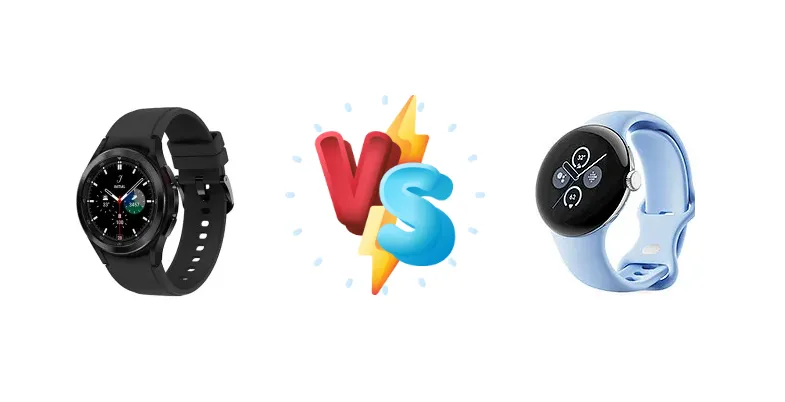
The smartwatch landscape is dominated by two key ecosystems: Samsung's Wear OS powered by One UI Watch, and Google's pure Wear OS experience. The Samsung Galaxy Watch4 Classic, while now a generation older, remains a popular choice for its traditional aesthetic and feature set. The Google Pixel Watch 2 aims to refine the Wear OS experience with a newer chipset and improved battery management. This comparison dissects the core differences to help you choose the right smartwatch for your wrist.
🏆 Quick Verdict
For most users, the Google Pixel Watch 2 emerges as the better choice. While the Galaxy Watch4 Classic boasts a more traditional design, the Pixel Watch 2’s Qualcomm 5100 chipset offers a more modern and efficient platform, coupled with significantly faster charging. The improved battery life and software experience make it a compelling upgrade.
| Network |
|---|
| 2G bands | GSM 850 / 900 / 1800 / 1900 | GSM 850 / 900 / 1800 / 1900 |
| 3G bands | HSDPA 850 / 900 / 2100 | HSDPA 850 / 900 / 1700(AWS) / 1900 / 2100 |
| 4G bands | 1, 3, 5, 7, 8, 20 | LTE |
| Speed | HSPA, LTE | HSPA, LTE |
| Technology | GSM / HSPA / LTE | GSM / HSPA / LTE |
| Launch |
|---|
| Announced | 2021, August 11 | 2023, October 04 |
| Status | Available. Released 2021, August 27 | Available. Released 2023, October 12 |
| Body |
|---|
| Build | Glass front (Gorilla Glass DX), stainless steel frame 316L or titanium frame | Glass front (Gorilla Glass 5), aluminum frame |
| Dimensions | 45.5 x 45.5 x 11 mm (1.79 x 1.79 x 0.43 in) | 41 x 41 x 12.3 mm (1.61 x 1.61 x 0.48 in) |
| SIM | eSIM | eSIM |
| Weight | 52 g (46mm), 46.5 g (42mm) (1.66 oz) | 31 g (1.09 oz) |
| | MIL-STD-810G compliant*
50m water resistant (IP68)
Compatible with standard 20mm straps
ECG certified
Blood pressure monitor
Rotating bezel
*does not guarantee ruggedness or use in extreme conditions | - |
| Display |
|---|
| Protection | Corning Gorilla Glass DX | Corning Gorilla Glass 5 |
| Resolution | 450 x 450 pixels (~321 ppi density) | 450 x 450 pixels (~320 ppi density) |
| Size | 1.4 inches | 1.2 inches |
| Type | Super AMOLED | AMOLED, 1000 nits (peak) |
| | Always-on display | - |
| Platform |
|---|
| CPU | Dual-core 1.18 GHz Cortex-A55 | - |
| Chipset | Exynos W920 (5 nm) | Qualcomm 5100 |
| GPU | Mali-G68 | - |
| OS | Android Wear OS 4, One UI Watch 5 | Android Wear OS 4 |
| Memory |
|---|
| Card slot | No | No |
| Internal | 16GB 1.5GB RAM | 32GB 2GB RAM |
| Sound |
|---|
| 3.5mm jack | No | - |
| 35mm jack | No | No |
| Loudspeaker | Yes | Yes |
| Comms |
|---|
| Bluetooth | 5.0, A2DP, LE | 5.0, A2DP, LE |
| NFC | Yes | Yes |
| Positioning | GPS, GLONASS, GALILEO, BDS | GPS, GLONASS, GALILEO, BDS, QZSS |
| Radio | No | No |
| USB | No | No |
| WLAN | Wi-Fi 802.11 a/b/g/n, dual-band | Wi-Fi 802.11 b/g/n |
| Features |
|---|
| Sensors | Accelerometer, gyro, compass, barometer, heart rate, SpO2 | Accelerometer, gyro, heart rate, altimeter, compass, SpO2, thermometer (skin temperature), skin conductance |
| | Natural language commands and dictation
Samsung Pay | - |
| Battery |
|---|
| Charging | Wireless | Wired, 80% in 45 min |
| Type | Li-Ion 361 mAh | Li-Ion 306 mAh |
| Misc |
|---|
| Colors | Black, Silver, Thom Browne Edition, Bespoke Edition | Polished Silver, Matte Black, Champagne Gold |
| Models | SM-R880, SM-R890 | G4TSL, GC3G8, GD2WG |
| Price | About 90 EUR | About 160 EUR |
Samsung Galaxy Watch4 Classic
- Classic watch design with rotating bezel
- Established Wear OS ecosystem with Samsung apps
- Potentially superior display color accuracy
- Slower wireless charging
- Older Exynos W920 chipset may show its age
- Potentially less efficient battery life
Google Pixel Watch 2
- Faster wired charging (80% in 45 minutes)
- More modern and efficient Qualcomm 5100 chipset
- Streamlined Wear OS experience with Google integration
- Lacks a physical rotating bezel
- May not appeal to those preferring a traditional watch aesthetic
- Relatively new platform, potential for early software bugs
Display Comparison
Both watches feature circular AMOLED displays, but detailed specifications are missing. However, given Samsung’s display expertise, the Galaxy Watch4 Classic likely benefits from superior color accuracy and potentially higher peak brightness. The Pixel Watch 2’s display, while likely excellent, focuses on efficiency to complement the Qualcomm 5100 chipset. The absence of detailed display specs makes a definitive comparison difficult, but Samsung’s history suggests a slight edge in visual fidelity.
Camera Comparison
Neither watch is designed for photography, and detailed camera specs are unavailable. Smartwatches primarily use cameras for limited features like video calls, and the quality is generally low. Therefore, this is not a significant differentiating factor between these two devices.
Performance
The core difference lies in the chipsets. The Samsung Galaxy Watch4 Classic utilizes the Exynos W920 (5nm), a dual-core 1.18 GHz Cortex-A55 processor. The Google Pixel Watch 2, however, is powered by the Qualcomm 5100. While clock speeds aren’t directly comparable, the Qualcomm 5100 is built on a more modern architecture, promising improved performance and power efficiency. This translates to snappier app launches and smoother animations on the Pixel Watch 2. The 5nm process node of the Exynos W920 is respectable, but the Qualcomm 5100’s architecture likely provides a more substantial performance uplift, especially in sustained tasks.
Battery Life
Battery capacity is not specified for either device. However, the Pixel Watch 2’s charging capabilities offer a significant advantage: 80% charge in 45 minutes via wired charging. The Galaxy Watch4 Classic relies solely on wireless charging, which is considerably slower. This faster charging speed mitigates any potential battery capacity disadvantage the Pixel Watch 2 might have. The Qualcomm 5100’s improved power efficiency also contributes to potentially longer real-world battery life on the Pixel Watch 2, despite potentially similar mAh ratings.
Buying Guide
Buy the Samsung Galaxy Watch4 Classic if you prioritize a classic watch design with a rotating bezel and are heavily invested in the Samsung ecosystem. Its established feature set and wider app compatibility within Samsung’s ecosystem are key benefits. Buy the Google Pixel Watch 2 if you value a streamlined Wear OS experience, faster charging, and a more modern, health-focused smartwatch. It’s ideal for users seeking seamless integration with Google services and a focus on fitness tracking.
Frequently Asked Questions
❓ Does the Exynos W920 chip in the Galaxy Watch4 Classic overheat during intensive tasks like GPS tracking or extended calls?
The Exynos W920 (5nm) is a relatively efficient chip, but it can experience thermal throttling during prolonged, demanding tasks. While not a major issue for typical use, users engaging in long workouts with GPS or frequent voice calls may notice some performance slowdown. The Qualcomm 5100 in the Pixel Watch 2 is expected to manage heat more effectively due to its newer architecture.
❓ How does the wired charging of the Pixel Watch 2 compare to the wireless charging of the Galaxy Watch4 Classic in terms of convenience and speed?
Wired charging, as implemented in the Pixel Watch 2 (80% in 45 minutes), is significantly faster and more efficient than the wireless charging of the Galaxy Watch4 Classic. While wireless charging offers convenience, it's considerably slower and less reliable. The Pixel Watch 2’s wired charging ensures you can quickly top up the battery when needed.
❓ Is the Google Pixel Watch 2’s integration with Fitbit Premium worth the additional cost for fitness tracking?
The Pixel Watch 2 comes with a 6-month Fitbit Premium trial. While the basic fitness tracking features are robust without Premium, the subscription unlocks advanced insights, personalized guidance, and detailed sleep analysis. Whether it’s worth the ongoing cost depends on your commitment to fitness and desire for in-depth data.