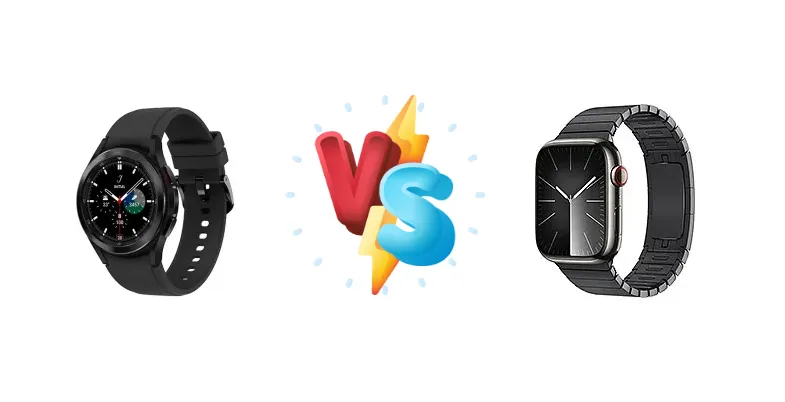
The smartwatch landscape is largely dominated by Apple and Samsung. While both the Galaxy Watch4 Classic and the Apple Watch Series 9 represent the pinnacle of their respective ecosystems, they cater to different user bases and offer distinct strengths. This comparison dissects the core hardware and software differences to determine which smartwatch delivers the best overall experience.
🏆 Quick Verdict
For iPhone users, the Apple Watch Series 9 is the clear winner due to its seamless integration and advanced features. However, Android users, or those seeking a more traditional watch aesthetic, will find the Galaxy Watch4 Classic a compelling alternative, offering a robust feature set and Wear OS flexibility.
| Network |
|---|
| 2G bands | GSM 850 / 900 / 1800 / 1900 | GSM 850 / 900 / 1800 / 1900 |
| 3G bands | HSDPA 850 / 900 / 2100 | HSDPA 850 / 900 / 1700(AWS) / 1900 / 2100 - International, China, HK |
| 4G bands | 1, 3, 5, 7, 8, 20 | 1, 2, 3, 4, 5, 6, 7, 8, 18, 19, 20, 25, 26, 28, 39, 40, 41, 66 - International, China, HK |
| Speed | HSPA, LTE | HSPA, LTE |
| Technology | GSM / HSPA / LTE | GSM / HSPA / LTE |
| Launch |
|---|
| Announced | 2021, August 11 | 2023, September 12 |
| Status | Available. Released 2021, August 27 | Available. Released 2023, September 22 |
| Body |
|---|
| Build | Glass front (Gorilla Glass DX), stainless steel frame 316L or titanium frame | Sapphire crystal front, ceramic/sapphire crystal back, stainless steel frame |
| Dimensions | 45.5 x 45.5 x 11 mm (1.79 x 1.79 x 0.43 in) | 45 x 38 x 10.7 mm (1.77 x 1.50 x 0.42 in) |
| SIM | eSIM | eSIM |
| Weight | 52 g (46mm), 46.5 g (42mm) (1.66 oz) | 42.3 g (41mm), 51.5 g (45mm) (1.48 oz) |
| | MIL-STD-810G compliant*
50m water resistant (IP68)
Compatible with standard 20mm straps
ECG certified
Blood pressure monitor
Rotating bezel
*does not guarantee ruggedness or use in extreme conditions | - |
| Display |
|---|
| Protection | Corning Gorilla Glass DX | Sapphire crystal glass |
| Resolution | 450 x 450 pixels (~321 ppi density) | 484 x 396 pixels (~326 ppi density) |
| Size | 1.4 inches | 1.9 inches |
| Type | Super AMOLED | Retina LTPO OLED, 2000 nits (peak) |
| | Always-on display | - |
| Platform |
|---|
| CPU | Dual-core 1.18 GHz Cortex-A55 | Dual-core |
| Chipset | Exynos W920 (5 nm) | Apple S9 |
| GPU | Mali-G68 | PowerVR |
| OS | Android Wear OS 4, One UI Watch 5 | watchOS 10, upgradable to watchOS 26.1 |
| Memory |
|---|
| Card slot | No | No |
| Internal | 16GB 1.5GB RAM | 64GB |
| Sound |
|---|
| 3.5mm jack | No | - |
| 35mm jack | No | No |
| Loudspeaker | Yes | Yes |
| Comms |
|---|
| Bluetooth | 5.0, A2DP, LE | 5.3, A2DP, LE |
| NFC | Yes | Yes |
| Positioning | GPS, GLONASS, GALILEO, BDS | GPS, GLONASS, GALILEO, QZSS, BDS |
| Radio | No | No |
| USB | No | No |
| WLAN | Wi-Fi 802.11 a/b/g/n, dual-band | Wi-Fi 802.11 b/g/n, dual-band |
| Features |
|---|
| Sensors | Accelerometer, gyro, compass, barometer, heart rate, SpO2 | Accelerometer, gyro, heart rate, barometer, always-on altimeter, compass, SpO2, VO2max, temperature (body) |
| | Natural language commands and dictation
Samsung Pay | - |
| Battery |
|---|
| Charging | Wireless | Wireless, 0-80% in 45 min |
| Type | Li-Ion 361 mAh | Li-Ion 308 mAh |
| Misc |
|---|
| Colors | Black, Silver, Thom Browne Edition, Bespoke Edition | Graphite, Silver, Gold, Red |
| Models | SM-R880, SM-R890 | A2982, A2984, A2983, A2985, Watch7,3, Watch7,4 |
| Price | About 90 EUR | About 630 EUR |
| SAR | - | 1.02 W/kg (head) |
| SAR EU | - | 0.64 W/kg (head) |
Samsung Galaxy Watch4 Classic
- Classic rotating bezel for intuitive navigation
- Wear OS offers greater app compatibility with Android
- More traditional watch aesthetic
- Exynos W920 chipset may not match Apple S9 performance
- Wireless charging is slower than Apple's fast charging
- Ecosystem lock-in is less pronounced, potentially leading to fragmentation
Apple Watch Series 9
- Apple S9 chip delivers superior performance and efficiency
- Seamless integration with the Apple ecosystem
- Advanced health tracking features (ECG, fall detection)
- Limited compatibility with Android devices
- Requires an iPhone for initial setup and full functionality
- Less customizable watch faces compared to Wear OS
Display Comparison
Both watches utilize wireless charging, but details on display technology are limited. The Galaxy Watch4 Classic’s display benefits from the classic watch face design, while the Apple Watch Series 9 likely employs a similar LTPO OLED panel as its predecessors, prioritizing always-on display efficiency. While specific nit brightness isn't provided, Apple typically leads in peak brightness, offering better outdoor visibility. The Series 9’s display is also rumored to have a smaller bezel, maximizing screen real estate, a detail not specified for the Watch4 Classic.
Camera Comparison
Neither watch features a camera, focusing instead on health and fitness tracking. This is a deliberate design choice prioritizing battery life and a more traditional watch form factor.
Performance
The core difference lies in the chipsets. The Apple Watch Series 9 boasts the Apple S9, a system-on-a-chip designed specifically for wearable performance and efficiency. In contrast, the Samsung Galaxy Watch4 Classic utilizes the Exynos W920 (5nm). While both are dual-core CPUs, Apple’s vertical integration allows for optimized performance within watchOS. The 5nm process node of the Exynos W920 is competitive, but Apple’s S9 likely benefits from architectural advantages and dedicated neural engine capabilities for faster processing of on-device tasks. This translates to smoother animations and quicker app loading times on the Apple Watch Series 9.
Battery Life
Battery life is a critical consideration. While mAh ratings aren’t provided, the Apple Watch Series 9 offers a 0-80% charge in 45 minutes, indicating a relatively fast charging speed. The Galaxy Watch4 Classic relies solely on wireless charging, and charging times are likely longer. The efficiency of the Apple S9 chip, combined with watchOS optimizations, likely contributes to comparable or slightly better real-world battery endurance despite potentially having a similar battery capacity to the Watch4 Classic.
Buying Guide
Buy the Samsung Galaxy Watch4 Classic if you need a smartwatch that seamlessly integrates with Android, appreciate a classic rotating bezel design, and value the flexibility of the Wear OS platform. Buy the Apple Watch Series 9 if you are deeply embedded in the Apple ecosystem, prioritize health tracking features like fall detection and ECG, and desire the most polished and intuitive smartwatch experience.
Frequently Asked Questions
❓ Does the Exynos W920 chip in the Galaxy Watch4 Classic overheat during intensive tasks like GPS tracking or workout recording?
The 5nm process node of the Exynos W920 helps mitigate overheating, but prolonged use of GPS and demanding apps can still generate heat. While not a major issue, users may experience slight performance throttling during extended, high-intensity activities. Apple’s S9 chip is likely more efficient in this regard due to its optimized architecture.
❓ How does the health tracking accuracy compare between the Galaxy Watch4 Classic and the Apple Watch Series 9, specifically regarding heart rate monitoring and sleep tracking?
Both watches offer accurate heart rate monitoring and sleep tracking, but the Apple Watch Series 9 benefits from Apple’s advanced algorithms and sensor calibration. The Series 9 also offers features like blood oxygen monitoring and ECG, which are not available on the Galaxy Watch4 Classic. While the Watch4 Classic provides comprehensive health data, the Apple Watch Series 9 offers a more complete and medically-focused health tracking experience.
❓ Is the Galaxy Watch4 Classic’s Wear OS platform as smooth and responsive as Apple’s watchOS?
Historically, Wear OS lagged behind watchOS in terms of smoothness and responsiveness. However, recent updates and optimizations have significantly improved the Wear OS experience. While still not quite as polished as watchOS, the Galaxy Watch4 Classic offers a fluid and intuitive user interface, especially with Samsung’s One UI Watch skin. Apple’s vertical integration gives it an edge in software optimization.