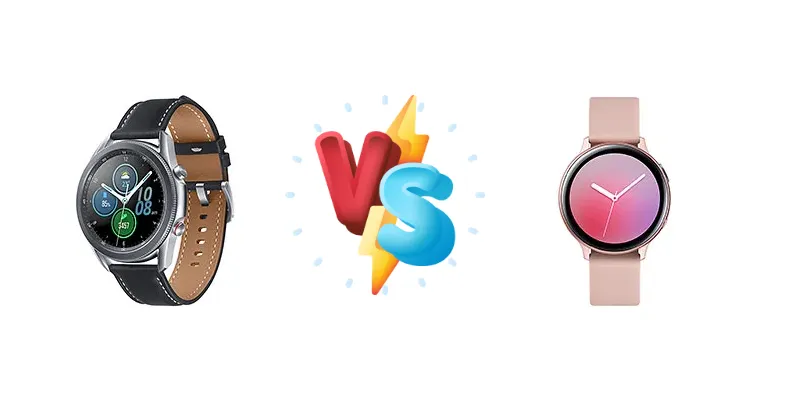
The Samsung Galaxy Watch3 and Galaxy Watch Active2 Aluminum represent distinct approaches to the Wear OS smartwatch experience. While both leverage the same Exynos 9110 chipset, they diverge significantly in design, features, and target audience. This comparison dissects these differences to help you determine which watch best suits your needs.
🏆 Quick Verdict
For the user prioritizing classic watch aesthetics and advanced health features like ECG and blood oxygen monitoring, the Galaxy Watch3 is the clear winner. However, the Active2 Aluminum offers a more streamlined, fitness-focused experience at a potentially lower price point, making it ideal for active users.
| Network |
|---|
| 2G bands | GSM 850 / 900 / 1800 / 1900 | N/A |
| 3G bands | HSDPA 850 / 900 / 2100 | HSDPA 900 / 2100 - 44mm LTE version only |
| 4G bands | 1, 3, 5, 7, 8, 20 | 1, 3, 7, 8, 20 - 44mm LTE version only |
| Speed | HSPA, LTE | No |
| Technology | GSM / HSPA / LTE | HSPA / LTE |
| Launch |
|---|
| Announced | 2020, August 05 | 2019, August. Released 2019, September |
| Status | Available. Released 2020, August 06 | Discontinued |
| Body |
|---|
| Build | Glass front (Gorilla Glass DX), stainless steel frame 316L or titanium frame | Glass front (Gorilla Glass DX+), aluminum frame |
| Dimensions | 46.2 x 45 x 11.1 mm (1.82 x 1.77 x 0.44 in) | 44 x 44 x 10.9 mm (1.73 x 1.73 x 0.43 in) |
| SIM | eSIM | No |
| Weight | 53.8 (45mm), 48.2 g (41mm), 43 g (45mm tt.) (1.90 oz) | 30 g (1.06 oz) |
| | MIL-STD-810G compliant*
50m water resistant (IP68)
ECG certified
Blood pressure monitor
Compatible with standard 22mm straps
Rotating bezel
*does not guarantee ruggedness or use in extreme conditions | 50m water resistant (IP68)
Compatible with standard 20mm straps
ECG certified
Touch-sensitive bezel
MIL-STD-810G compliant*
*does not guarantee ruggedness or use in extreme conditions |
| Display |
|---|
| Protection | Corning Gorilla Glass DX | Corning Gorilla Glass DX+ |
| Resolution | 360 x 360 pixels (~364 ppi density) | 360 x 360 pixels (~364 ppi density) |
| Size | 1.4 inches | 1.4 inches |
| Type | Super AMOLED | Super AMOLED |
| | Always-on display | Always-on display |
| Platform |
|---|
| CPU | Dual-core 1.15 GHz Cortex-A53 | Dual-core 1.15 GHz Cortex-A53 |
| Chipset | Exynos 9110 (10 nm) | Exynos 9110 (10 nm) |
| GPU | Mali-T720 | Mali-T720 |
| OS | Tizen OS 5.5 | Tizen OS 5.5 |
| Memory |
|---|
| Card slot | No | No |
| Internal | 4GB 1GB RAM, 8GB 1GB RAM | 4GB 768MB RAM, 4GB 1.5GB RAM |
| | eMMC | - |
| Sound |
|---|
| 3.5mm jack | No | No |
| 35mm jack | No | No |
| Loudspeaker | Yes | Yes |
| Comms |
|---|
| Bluetooth | 5.0, A2DP, LE | 5.0, A2DP, LE |
| NFC | Yes | Yes |
| Positioning | GPS, GLONASS, GALILEO, BDS | GPS, GLONASS, GALILEO, BDS |
| Radio | No | No |
| USB | No | No |
| WLAN | Wi-Fi 802.11 b/g/n | Wi-Fi 802.11 b/g/n |
| Features |
|---|
| Sensors | Accelerometer, gyro, heart rate, barometer | Accelerometer, gyro, heart rate, barometer |
| | Natural language commands and dictation
Samsung Pay | Natural language commands and dictation
Samsung Pay |
| Battery |
|---|
| Charging | Wireless | Wireless |
| Type | Li-Ion 340 mAh | Li-Ion 340 mAh, non-removable |
| Misc |
|---|
| Colors | Mystic Bronze, Mystic Black, Mystic White | Cloud Silver, Aqua Black, Pink Gold, Phantom Violet |
| Models | SM-R850, SM-R840, SM-R855F, SM-R845F, SM-R855U, SM-R845U | SM-R830 |
| Price | About 100 EUR | About 300 EUR |
Samsung Galaxy Watch3
- Classic watch design with rotating bezel
- Advanced health features (ECG, blood oxygen)
- Premium stainless steel build quality
- Potentially shorter battery life due to advanced features
- Larger size may not suit all wrists
Samsung Galaxy Watch Active2 Aluminum
- Lightweight and comfortable aluminum build
- Streamlined, fitness-focused design
- Potentially longer battery life for basic use
- Digital touch bezel less intuitive than physical bezel
- Lacks advanced health features like ECG
Display Comparison
Both watches utilize Super AMOLED displays, but the Galaxy Watch3 offers a more premium experience. While specific brightness data isn't provided, the Watch3's smaller bezel and available size options (41mm, 45mm) contribute to a more immersive viewing experience. The Active2 Aluminum comes in 40mm and 44mm sizes. The Active2 relies on a digital touch bezel, while the Watch3 boasts a physical rotating bezel, offering a more tactile and precise method of navigation. This physical bezel is a significant advantage for users accustomed to traditional watches.
Camera Comparison
Neither watch features a camera, a deliberate design choice by Samsung to focus on core smartwatch functionality and maintain a sleek profile. This absence isn't a detriment, as smartwatch cameras are often low-quality and rarely used.
Performance
Both the Galaxy Watch3 and Active2 Aluminum are powered by the Exynos 9110 dual-core 1.15 GHz processor fabricated on a 10nm process. This means raw processing power is virtually identical. Real-world performance will be similar for everyday tasks like notifications, app loading, and basic fitness tracking. However, the Watch3's potentially better thermal management due to its larger chassis could lead to slightly sustained performance during prolonged use. The impact of RAM isn't specified, but it's likely similar, meaning multitasking capabilities will be comparable.
Battery Life
Battery life is a critical consideration. While mAh capacity isn't specified, the Galaxy Watch3's larger size allows for a potentially larger battery. However, the more advanced features of the Watch3 – ECG, blood oxygen monitoring – will likely consume more power. Both watches support wireless charging, but real-world battery performance will depend heavily on usage patterns. Users heavily utilizing GPS and health tracking will see shorter battery life on both devices. The Active2's simpler feature set *could* translate to slightly longer battery life for basic usage.
Buying Guide
Buy the Samsung Galaxy Watch3 if you value a traditional watch design with a rotating bezel, require advanced health monitoring capabilities like ECG and blood oxygen saturation, and appreciate a premium stainless steel build. Buy the Galaxy Watch Active2 Aluminum if you prefer a lighter, more minimalist design focused on fitness tracking, and prioritize a lower price point without sacrificing core smartwatch functionality.
Frequently Asked Questions
❓ Does the Exynos 9110 chip in either watch tend to overheat during extended GPS use?
While the Exynos 9110 is a capable processor, prolonged GPS usage can generate heat. Both watches are susceptible to some thermal throttling, but the Galaxy Watch3's larger chassis may provide slightly better heat dissipation, potentially mitigating performance drops during long outdoor activities.
❓ Is the rotating bezel on the Galaxy Watch3 worth the extra cost compared to the touch bezel on the Active2 Aluminum?
For users accustomed to traditional watches, the physical rotating bezel on the Galaxy Watch3 is a significant advantage. It offers a more tactile and precise method of navigating the interface, making it easier to scroll through notifications and menus. The touch bezel on the Active2 Aluminum is functional, but lacks the same level of responsiveness and intuitiveness.
❓ How accurate are the health sensors (heart rate, SpO2, ECG) on the Galaxy Watch3 compared to dedicated medical devices?
While the Galaxy Watch3's health sensors are generally accurate for everyday monitoring, they are *not* substitutes for professional medical devices. The ECG and blood oxygen monitoring features are intended for wellness purposes and should not be used for self-diagnosis or treatment. Consult a healthcare professional for any health concerns.