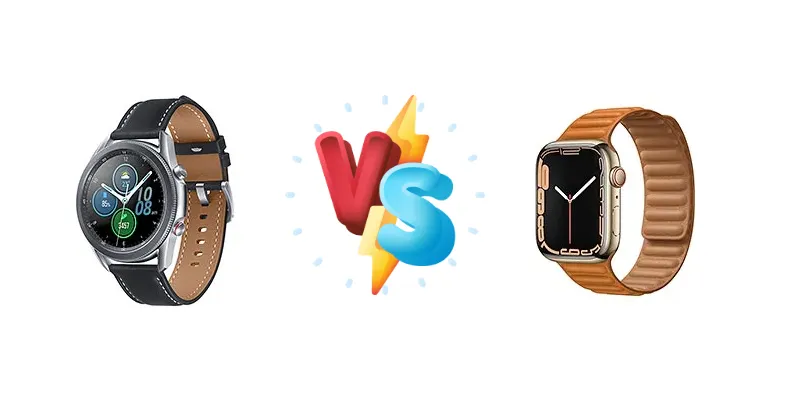
The smartwatch market is dominated by Apple and Samsung, offering compelling options for both iOS and Android users. We pit the Samsung Galaxy Watch3, known for its classic design and rotating bezel, against the Apple Watch Series 7, lauded for its larger display and faster charging, to determine which device delivers the best overall experience.
🏆 Quick Verdict
For the average user deeply embedded in the Apple ecosystem, the Apple Watch Series 7 is the clear winner due to its seamless integration and faster charging. However, Android users and those prioritizing a traditional watch aesthetic will find the Galaxy Watch3 a more compelling choice.
| Network |
|---|
| 2G bands | GSM 850 / 900 / 1800 / 1900 | GSM 850 / 900 / 1800 / 1900 |
| 3G bands | HSDPA 850 / 900 / 2100 | HSDPA 850 / 900 / 1700(AWS) / 1900 / 2100 - International |
| 4G bands | 1, 3, 5, 7, 8, 20 | 1, 2, 3, 4, 5, 7, 8, 18, 19, 20, 25, 26, 28, 39, 40, 41, 66 - International |
| Speed | HSPA, LTE | HSPA, LTE |
| Technology | GSM / HSPA / LTE | GSM / HSPA / LTE |
| | - | 1, 2, 3, 4, 5, 7, 12, 13, 14, 17, 18, 19, 25, 26, 39, 40, 41, 66 - USA, LATAM, Canada |
| Launch |
|---|
| Announced | 2020, August 05 | 2021, September 14 |
| Status | Available. Released 2020, August 06 | Available. Released 2021, October 15 |
| Body |
|---|
| Build | Glass front (Gorilla Glass DX), stainless steel frame 316L or titanium frame | Sapphire crystal front, ceramic/sapphire crystal back, stainless steel frame |
| Dimensions | 46.2 x 45 x 11.1 mm (1.82 x 1.77 x 0.44 in) | 45 x 38 x 10.7 mm (1.77 x 1.50 x 0.42 in) |
| SIM | eSIM | eSIM |
| Weight | 53.8 (45mm), 48.2 g (41mm), 43 g (45mm tt.) (1.90 oz) | 42.3 g (41mm), 51.5 g (45mm) (1.48 oz) |
| | MIL-STD-810G compliant*
50m water resistant (IP68)
ECG certified
Blood pressure monitor
Compatible with standard 22mm straps
Rotating bezel
*does not guarantee ruggedness or use in extreme conditions | IP6X certified
50m water resistant
ECG certified (region dependent SW application; HW available on all models) |
| Display |
|---|
| Protection | Corning Gorilla Glass DX | Sapphire crystal glass |
| Resolution | 360 x 360 pixels (~364 ppi density) | 484 x 396 pixels (~326 ppi density) |
| Size | 1.4 inches | 1.9 inches |
| Type | Super AMOLED | Retina LTPO OLED, 1000 nits (peak) |
| | Always-on display | Always-on display |
| Platform |
|---|
| CPU | Dual-core 1.15 GHz Cortex-A53 | Dual-core |
| Chipset | Exynos 9110 (10 nm) | Apple S7 |
| GPU | Mali-T720 | PowerVR |
| OS | Tizen OS 5.5 | watchOS 8.0, upgradable to watchOS 26.1 |
| Memory |
|---|
| Card slot | No | No |
| Internal | 4GB 1GB RAM, 8GB 1GB RAM | 32GB 1GB RAM |
| | eMMC | - |
| Sound |
|---|
| 3.5mm jack | No | No |
| 35mm jack | No | No |
| Loudspeaker | Yes | Yes |
| Comms |
|---|
| Bluetooth | 5.0, A2DP, LE | 5.0, A2DP, LE |
| NFC | Yes | Yes |
| Positioning | GPS, GLONASS, GALILEO, BDS | GPS, GLONASS, GALILEO, QZSS, BDS |
| Radio | No | No |
| USB | No | No |
| WLAN | Wi-Fi 802.11 b/g/n | Wi-Fi 802.11 b/g/n, dual-band |
| Features |
|---|
| Sensors | Accelerometer, gyro, heart rate, barometer | Accelerometer, gyro, heart rate, barometer, always-on altimeter, compass, SpO2, VO2max |
| | Natural language commands and dictation
Samsung Pay | Natural language commands and dictation (talking mode)
Ultra Wideband (UWB) support |
| Battery |
|---|
| Charging | Wireless | Wireless, 0-80% in 45 min |
| Type | Li-Ion 340 mAh | Li-Ion 309 mAh (1.19 Wh) |
| Misc |
|---|
| Colors | Mystic Bronze, Mystic Black, Mystic White | Graphite, Gold, Silver |
| Models | SM-R850, SM-R840, SM-R855F, SM-R845F, SM-R855U, SM-R845U | A2475, A2476, A2477, A2478, watch6,8, watch6,9 |
| Price | About 100 EUR | About 310 EUR |
| SAR | - | 1.10 W/kg (head) |
| SAR EU | - | 0.70 W/kg (head) 1.50 W/kg (body) |
Samsung Galaxy Watch3
- Classic watch design with rotating bezel
- Seamless integration with Android devices
- More open ecosystem and app availability
- Slower charging speeds compared to Apple Watch Series 7
- Exynos 9110 chipset may throttle under heavy load
- Smaller display compared to Apple Watch Series 7
Apple Watch Series 7
- Faster charging (0-80% in 45 minutes)
- Larger, brighter display with thinner bezels
- Optimized performance with Apple S7 chipset
- Limited to iOS ecosystem
- Less traditional watch aesthetic
- Potentially higher price point
Display Comparison
While display specifications aren't provided for the Galaxy Watch3, its Super AMOLED panel is known for vibrant colors. The Apple Watch Series 7 boasts a significantly larger display area, a key advantage for readability and interaction. The Series 7's ability to reach higher peak brightness levels, coupled with its thinner bezels, provides a more immersive viewing experience. The Series 7 also benefits from Apple's LTPO technology, enabling a more efficient always-on display that conserves battery life.
Camera Comparison
Neither watch is designed for photography, and neither device's specs include camera details. Therefore, this is not a significant comparison point. Both are primarily focused on health tracking and notifications, not image capture.
Performance
The Apple Watch Series 7’s Apple S7 chipset is a custom silicon solution, optimized for wearable performance and power efficiency. In contrast, the Samsung Galaxy Watch3 utilizes the Exynos 9110, a 10nm processor. While both are dual-core CPUs, Apple’s vertical integration allows for tighter hardware-software optimization, likely resulting in smoother animations and faster app loading times on the Series 7. The Exynos 9110, while capable, may exhibit more noticeable throttling under sustained load due to its larger manufacturing process.
Battery Life
Battery capacity isn't specified for either device, but the Apple Watch Series 7 offers a significant charging advantage with its 0-80% charge in 45 minutes capability. The Galaxy Watch3 relies on wireless charging, but lacks the rapid charging speeds of the Series 7. This faster charging translates to less downtime and greater convenience for Apple Watch Series 7 users, especially those who frequently forget to charge overnight.
Buying Guide
Buy the Samsung Galaxy Watch3 if you need a smartwatch that seamlessly integrates with Android, appreciate a classic watch design with a rotating bezel for intuitive navigation, and value a more open ecosystem. Buy the Apple Watch Series 7 if you prioritize tight integration with iOS, benefit from faster charging speeds, and desire a larger, always-on display for enhanced visibility and usability.
Frequently Asked Questions
❓ Does the Exynos 9110 chip in the Galaxy Watch3 overheat during intensive tasks like GPS tracking or workout recording?
The Exynos 9110, being a 10nm chip, is more prone to thermal throttling than newer processors. While it handles typical smartwatch usage well, prolonged GPS tracking or demanding workout recording sessions may lead to noticeable performance slowdowns as the chip attempts to manage heat.
❓ How does the Apple Watch Series 7's faster charging impact daily usability compared to the Galaxy Watch3?
The Apple Watch Series 7's ability to reach 80% charge in just 45 minutes is a significant convenience factor. This means less time tethered to a charger, especially beneficial for users who prefer to charge their watch during their morning routine or a quick break. The Galaxy Watch3's slower wireless charging requires more planning and downtime.
❓ Is the lack of a physical rotating bezel on the Apple Watch Series 7 a significant drawback for navigation?
The Apple Watch Series 7 relies on the Digital Crown and touch gestures for navigation. While effective, it lacks the tactile feedback and intuitive control offered by the Galaxy Watch3's rotating bezel. Users accustomed to physical controls may find the Series 7's navigation less satisfying.