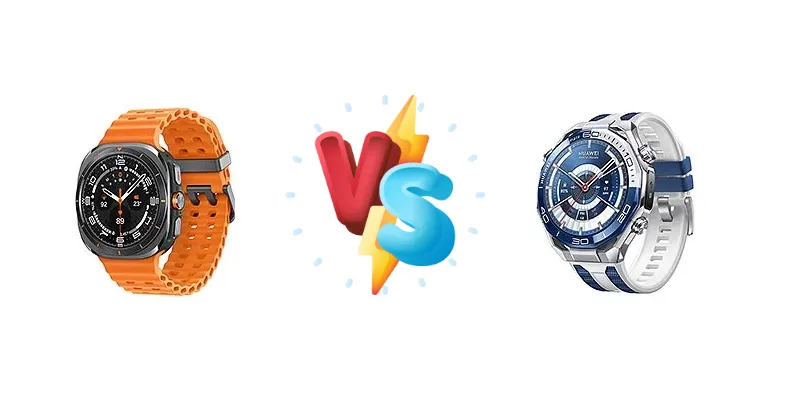
The premium smartwatch market is heating up, with Samsung and Huawei both vying for dominance. The Samsung Galaxy Watch Ultra, powered by the cutting-edge Exynos W1000, aims for peak performance. Meanwhile, the Huawei Watch Ultimate 2 focuses on a refined experience. This comparison dissects their core differences to determine which wearable reigns supreme.
🏆 Quick Verdict
For the average user prioritizing raw processing power and a potentially wider app ecosystem, the Samsung Galaxy Watch Ultra emerges as the winner. Its 3nm Exynos W1000 chipset promises superior performance, though real-world benefits depend on software optimization. However, Huawei’s focus on efficiency could translate to longer battery life.
| Network |
|---|
| 2G bands | GSM 850 / 900 / 1800 / 1900 | GSM 850 / 900 / 1800 / 1900 |
| 3G bands | HSDPA 850 / 900 / 1700(AWS) / 1900 / 2100 | HSDPA 850 / 900 / 1900 / 2100 |
| 4G bands | 1, 2, 3, 4, 5, 7, 8, 12, 13, 14, 18, 19, 20, 25, 26, 28, 40, 66, 71 | LTE |
| Speed | HSPA, LTE | HSPA, LTE |
| Technology | GSM / HSPA / LTE | GSM / HSPA / LTE |
| Launch |
|---|
| Announced | 2024, July 10 | 2025, September 19 |
| Status | Available. Released 2024, July 24 | Available. Released 2025, September 29 |
| Body |
|---|
| Build | Sapphire crystal front, ceramic/sapphire crystal back, titanium frame (grade 4) | Sapphire crystal front, cerramic bezzel, zirconium front case, ceramic back |
| Dimensions | 47.4 x 47.4 x 12.1 mm (1.87 x 1.87 x 0.48 in) | 48.5 x 48.5 x 12.9 mm - Black47.8 x 47.8 x 12.9 mm - Blue |
| SIM | eSIM | eSIM |
| Weight | 60.5 g (2.15 oz) | 80.5 g (2.86 oz) |
| Display |
|---|
| Protection | Sapphire crystal glass | - |
| Resolution | 480 x 480 pixels (~327 ppi density) | 466 x 466 pixels (~310 ppi density) |
| Size | 1.5 inches | 1.5 inches |
| Type | Super AMOLED | LTPO2 AMOLED, 3500 nits (peak) |
| Platform |
|---|
| CPU | Penta-core | - |
| Chipset | Exynos W1000 (3 nm) | - |
| GPU | Mali-G68 | - |
| OS | Android Wear OS 5, upgradable to 6.0, One UI Watch 8 | HarmonyOS 5.1 |
| Memory |
|---|
| Card slot | No | No |
| Internal | 32GB 2GB RAM, 64GB 2GB RAM | Unspecified |
| Sound |
|---|
| 35mm jack | No | No |
| Loudspeaker | Yes | Yes |
| Comms |
|---|
| Bluetooth | 5.3, A2DP, LE | 5.2, A2DP, LE |
| NFC | Yes | Yes |
| Positioning | GPS (L1+L5), GLONASS, GALILEO, BDS | GPS (L1+L5), BDS (B1I+B1c), GALILEO (E1+E5a), QZSS (L1+L5), GLONASS |
| Radio | No | No |
| USB | No | No |
| WLAN | Wi-Fi 802.11 a/b/g/n, dual-band | Wi-Fi 802.11 a/b/g/n/ac/6 |
| Features |
|---|
| Sensors | Accelerometer, gyro, heart rate, barometer, altimeter, compass, SpO2, temperature (body), temperature (water), BioActive | Accelerometer, gyro, heart rate, barometer, compass, SpO2, thermometer (body temperature), X-TAP |
| Battery |
|---|
| Charging | 10W wireless | 10W wireless |
| Type | Li-Ion 590 mAh | Li-Ion 867 mAh |
| Misc |
|---|
| Colors | Titanium Sliver, Titanium Gray, Titanium White, Titanium Blue | Black, Blue |
| Models | SM-L705F, SM-L705N, SM-L705U | MCH-AL00 |
| Price | $ 649.99 / € 368.24 | € 849.00 |
| SAR EU | 0.11 W/kg (head) 0.36 W/kg (body) | - |
Samsung Galaxy Watch Ultra
- Cutting-edge 3nm Exynos W1000 chipset for superior performance.
- Penta-core CPU enables smoother multitasking.
- 10W wireless charging offers convenient power replenishment.
- Battery life is unknown and could be impacted by the powerful processor.
- Software optimization is crucial to fully leverage the Exynos W1000’s potential.
Huawei Watch Ultimate 2
- 10W wireless charging for convenient power replenishment.
- Potential for optimized power management within the Huawei ecosystem.
- Refined user experience (assumed based on brand reputation).
- Chipset details are missing, potentially indicating an older or less powerful processor.
- Lack of information on display technology hinders a full comparison.
Display Comparison
Both watches feature wireless charging at 10W, indicating a similar approach to convenience. However, details regarding display technology (AMOLED, LTPO) and resolution are missing for the Huawei Watch Ultimate 2. The Galaxy Watch Ultra’s display benefits from the Exynos W1000’s processing power for smoother animations and potentially higher refresh rates. Without comparable display specs for the Huawei device, it’s difficult to assess visual fidelity beyond charging speed.
Camera Comparison
Neither device is marketed for its camera capabilities, and no camera specifications are provided in the context data. Therefore, a meaningful comparison is impossible. The focus for both appears to be on core smartwatch functionality rather than photography.
Performance
The Samsung Galaxy Watch Ultra’s Exynos W1000, fabricated on a 3nm process, represents a significant leap in wearable chipset technology. This smaller node size translates to increased transistor density, leading to improved performance and power efficiency compared to larger node processes. While the Huawei Watch Ultimate 2’s chipset details are absent, it’s likely built on a larger node, potentially impacting sustained performance under heavy load. The penta-core CPU in the Galaxy Watch Ultra suggests a focus on multi-tasking and responsiveness.
Battery Life
Both the Samsung Galaxy Watch Ultra and the Huawei Watch Ultimate 2 support 10W wireless charging. However, without knowing the battery capacity (mAh) of either device, it’s impossible to determine which offers superior battery life. The Exynos W1000’s 3nm process *should* contribute to better power efficiency, potentially offsetting a smaller battery capacity in the Galaxy Watch Ultra, but this is speculative without concrete data.
Buying Guide
Buy the Samsung Galaxy Watch Ultra if you need a smartwatch capable of handling demanding applications and appreciate the latest in processor technology. This is for the user who wants the fastest possible experience and anticipates future software updates leveraging the Exynos W1000’s capabilities. Buy the Huawei Watch Ultimate 2 if you prioritize a potentially more refined user experience and are invested in the Huawei ecosystem, potentially benefiting from optimized power management and a focus on core smartwatch functions.
Frequently Asked Questions
❓ Does the Exynos W1000 in the Galaxy Watch Ultra generate significant heat during prolonged use?
While the 3nm process is designed for efficiency, the Exynos W1000 is a powerful processor. Heat generation will depend heavily on software optimization and workload. Samsung will need to implement effective thermal management to prevent throttling during demanding tasks like GPS tracking or intensive app usage.
❓ How does the lack of chipset information for the Huawei Watch Ultimate 2 impact its performance compared to the Galaxy Watch Ultra?
The absence of chipset details is a significant drawback. It suggests Huawei may be relying on an older or less powerful processor. This could result in slower app loading times, less responsive animations, and a generally less fluid user experience compared to the Galaxy Watch Ultra’s Exynos W1000.
❓ Will the 10W wireless charging be sufficient for daily use on either device?
10W wireless charging is relatively standard for smartwatches. Whether it’s sufficient depends entirely on battery capacity and usage patterns. If both devices have similar battery sizes, 10W charging should provide adequate replenishment overnight. However, heavy users may need to top up during the day.