
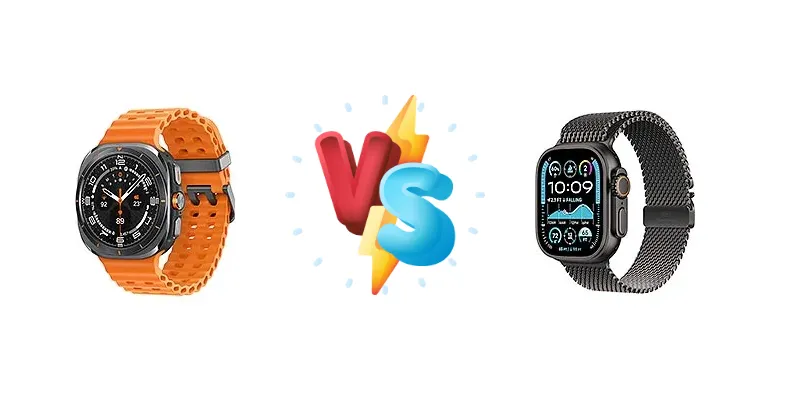
Samsung Galaxy Watch Ultra vs Apple Watch Ultra 2: A Detailed Comparison
| Phones Images | |||||
|---|---|---|---|---|---|
|
🏆 Quick Verdict
For the average user prioritizing raw processing power and potentially longer sustained performance, the Samsung Galaxy Watch Ultra, with its penta-core Exynos W1000 (3nm) chipset, edges out the Apple Watch Ultra 2. However, Apple’s optimized software and faster charging mitigate the core count difference, making the Ultra 2 a strong contender for those deeply embedded in the Apple ecosystem.
| PHONES | ||
|---|---|---|
| Phone Names | Samsung Galaxy Watch Ultra | Apple Watch Ultra 2 |
| Network | ||
|---|---|---|
| 2G bands | GSM 850 / 900 / 1800 / 1900 | GSM 850 / 900 / 1800 / 1900 |
| 3G bands | HSDPA 850 / 900 / 1700(AWS) / 1900 / 2100 | HSDPA 850 / 900 / 1700(AWS) / 1900 / 2100 - International, China, HK |
| 4G bands | 1, 2, 3, 4, 5, 7, 8, 12, 13, 14, 18, 19, 20, 25, 26, 28, 40, 66, 71 | 1, 2, 3, 4, 5, 6, 7, 8, 18, 19, 20, 25, 26, 28, 39, 40, 41, 66 - International, China, HK |
| Speed | HSPA, LTE | HSPA, LTE |
| Technology | GSM / HSPA / LTE | GSM / HSPA / LTE |
| Launch | ||
|---|---|---|
| Announced | 2024, July 10 | 2023, September 12 |
| Status | Available. Released 2024, July 24 | Available. Released 2023, September 22 |
| Body | ||
|---|---|---|
| Build | Sapphire crystal front, ceramic/sapphire crystal back, titanium frame (grade 4) | Sapphire crystal front, ceramic/sapphire crystal back, titanium frame |
| Dimensions | 47.4 x 47.4 x 12.1 mm (1.87 x 1.87 x 0.48 in) | 49 x 44 x 14.4 mm (1.93 x 1.73 x 0.57 in) |
| SIM | eSIM | eSIM |
| Weight | 60.5 g (2.15 oz) | 61.4 g or 61.8 g (black) (2.15 oz) |
| Display | ||
|---|---|---|
| Protection | Sapphire crystal glass | Sapphire crystal glass |
| Resolution | 480 x 480 pixels (~327 ppi density) | 502 x 410 pixels (~338 ppi density) |
| Size | 1.5 inches | 1.92 inches |
| Type | Super AMOLED | Retina LTPO2 OLED, 3000 nits (peak) |
| Platform | ||
|---|---|---|
| CPU | Penta-core | Dual-core |
| Chipset | Exynos W1000 (3 nm) | Apple S9 |
| GPU | Mali-G68 | PowerVR |
| OS | Android Wear OS 5, upgradable to 6.0, One UI Watch 8 | watchOS 10, upgradable to watchOS 26.1 |
| Memory | ||
|---|---|---|
| Card slot | No | No |
| Internal | 32GB 2GB RAM, 64GB 2GB RAM | 64GB |
| Sound | ||
|---|---|---|
| 35mm jack | No | No |
| Loudspeaker | Yes | Yes, with dual speakers (86-decibel) |
| Comms | ||
|---|---|---|
| Bluetooth | 5.3, A2DP, LE | 5.3, A2DP, LE |
| NFC | Yes | Yes |
| Positioning | GPS (L1+L5), GLONASS, GALILEO, BDS | GPS (L1+L5), GLONASS, GALILEO, BDS |
| Radio | No | No |
| USB | No | No |
| WLAN | Wi-Fi 802.11 a/b/g/n, dual-band | Wi-Fi 802.11 b/g/n, dual-band |
| Features | ||
|---|---|---|
| Sensors | Accelerometer, gyro, heart rate, barometer, altimeter, compass, SpO2, temperature (body), temperature (water), BioActive | Accelerometer, gyro, heart rate, barometer, always-on altimeter (-500m to 9000m), compass, SpO2, VO2max, temperature (body), temperature (water) |
| Battery | ||
|---|---|---|
| Charging | 10W wireless | Wireless, 0-80% in 60 min |
| Type | Li-Ion 590 mAh | Li-Ion 564 mAh |
| Misc | ||
|---|---|---|
| Colors | Titanium Sliver, Titanium Gray, Titanium White, Titanium Blue | Titanium, Black |
| Models | SM-L705F, SM-L705N, SM-L705U | A2986, A2987, Watch7,5 |
| Price | $ 649.99 / € 368.24 | $ 469.99 / € 584.49 |
| SAR | - | 0.88 W/kg (head) |
| SAR EU | 0.11 W/kg (head) 0.36 W/kg (body) | 0.22 W/kg (head) |
Samsung Galaxy Watch Ultra
- Potentially superior processing power due to penta-core CPU and 3nm Exynos W1000.
- Likely more flexible software customization options.
- Potentially better power efficiency from the 3nm process.
- Slower wireless charging speed (10W).
- May experience software fragmentation compared to Apple’s ecosystem.
Apple Watch Ultra 2
- Faster charging (0-80% in 60 minutes).
- Seamless integration with the Apple ecosystem.
- Optimized hardware-software integration for smooth performance.
- Dual-core CPU may limit sustained performance in demanding tasks.
- Likely less flexible software customization options.
Display Comparison
While display specifications aren't provided, both watches target a premium experience. The Ultra 2 likely benefits from Apple’s established display calibration and potentially higher peak brightness. However, the Galaxy Watch Ultra’s potential for more flexible display customization options, a hallmark of Samsung’s panels, shouldn’t be discounted. Both will almost certainly utilize LTPO technology for variable refresh rates, optimizing battery life.
Camera Comparison
Neither device is marketed for its camera capabilities, and detailed camera specs are absent. This suggests both are primarily focused on functionality beyond photography. Any camera features are likely intended for quick actions or emergency use, rather than high-quality image capture.
Performance
The core architectural difference lies in the CPU: Samsung’s Galaxy Watch Ultra utilizes a penta-core Exynos W1000 built on a 3nm process, while the Apple Watch Ultra 2 employs a dual-core Apple S9. The 3nm node of the Exynos W1000 theoretically provides superior transistor density and power efficiency compared to Apple’s likely 4nm S9. This suggests the Galaxy Watch Ultra could handle more complex tasks and sustained workloads with less thermal throttling. However, Apple’s tight hardware-software integration and custom silicon design often allow them to extract impressive performance from fewer cores. The impact of LPDDR5x RAM speed, not specified for either device, will also play a role in overall responsiveness.
Battery Life
Battery capacity isn’t specified, but the charging speeds reveal a key difference. The Galaxy Watch Ultra offers 10W wireless charging, while the Apple Watch Ultra 2 achieves 0-80% charge in 60 minutes. This faster charging speed on the Apple Watch Ultra 2 is a significant convenience factor, potentially offsetting a smaller battery capacity. The Exynos W1000’s 3nm process *should* contribute to better power efficiency, potentially extending battery life on the Galaxy Watch Ultra despite the slower charging.
Buying Guide
Buy the Samsung Galaxy Watch Ultra if you need maximum processing capability for demanding applications, value a potentially more open ecosystem, and prioritize a chipset built on a leading-edge 3nm process. Buy the Apple Watch Ultra 2 if you prefer seamless integration with other Apple devices, prioritize fast charging, and appreciate Apple’s established health and fitness features and software ecosystem.