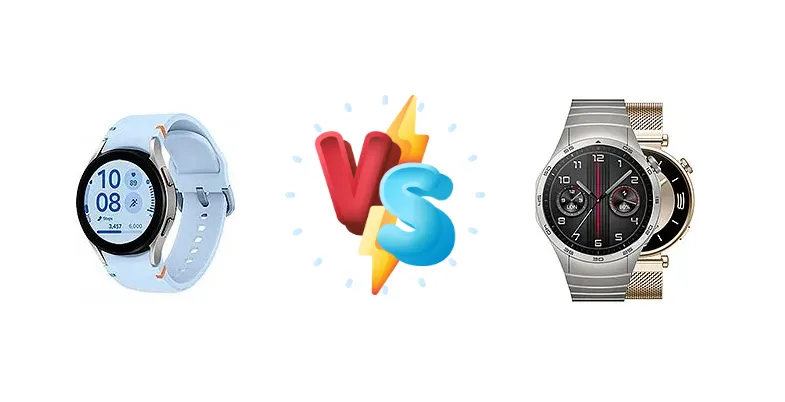
The smartwatch market is increasingly competitive, with options ranging from premium flagships to more affordable alternatives. The Samsung Galaxy Watch FE, a recent addition to Samsung’s lineup, aims to deliver a core smartwatch experience at a more accessible price point. It faces stiff competition from the Huawei Watch GT 4, known for its focus on battery life and health tracking. This comparison dissects the key differences between these two devices, focusing on their performance, features, and overall value proposition.
🏆 Quick Verdict
For the average user prioritizing a robust app ecosystem and seamless smartphone integration, the Samsung Galaxy Watch FE emerges as the stronger choice. Its Exynos W920 chipset, while not the newest, provides a more versatile platform than the GT 4, despite the latter’s potential battery life advantages.
| Network |
|---|
| 2G bands | GSM 850 / 900 / 1800 / 1900 | N/A |
| 3G bands | HSDPA 850 / 900 / 2100 | N/A |
| 4G bands | LTE | N/A |
| EDGE | - | No |
| GPRS | - | No |
| Speed | HSPA, LTE | No |
| Technology | GSM / HSPA / LTE | No cellular connectivity |
| Launch |
|---|
| Announced | 2024, June 13 | 2023, September 14 |
| Status | Available. Released 2024, June 24 | Available. Released 2023, October 02 |
| Body |
|---|
| Build | Glass front (sapphire crystal), aluminum frame | Glass front, plastic back, stainless steel frame |
| Dimensions | 40.4 x 39.3 x 9.8 mm (1.59 x 1.55 x 0.39 in) | 46 x 46 x 10.9 mm (1.81 x 1.81 x 0.43 in) |
| SIM | eSIM | No |
| Weight | 26.6 g (0.95 oz) | 37 g (41mm) / 48 g (46mm) (1.31 oz) |
| Display |
|---|
| Protection | Sapphire crystal glass | - |
| Resolution | 396 x 396 pixels (~330 ppi density) | 466 x 466 pixels (~326 ppi density) |
| Size | 1.2 inches | 1.43 inches |
| Type | Super AMOLED | AMOLED |
| Platform |
|---|
| CPU | Dual-core 1.18 GHz Cortex-A55 | - |
| Chipset | Exynos W920 (5 nm) | - |
| GPU | Mali-G68 | - |
| OS | Android Wear OS 4, One UI Watch 5 | HarmonyOS 4.0 |
| Memory |
|---|
| Card slot | No | No |
| Internal | 16GB 1.5GB RAM | Unspecified |
| Sound |
|---|
| 35mm jack | No | No |
| Loudspeaker | Yes | Yes |
| Comms |
|---|
| Bluetooth | 5.0, A2DP, LE | 5.2, A2DP, LE |
| NFC | Yes | Yes |
| Positioning | GPS, GALILEO, GLONASS, BDS | GPS (L1+L5), GLONASS, BDS, GALILEO, QZSS |
| Radio | No | No |
| USB | No | No |
| WLAN | Wi-Fi 802.11 a/b/g/n, dual-band | No |
| Features |
|---|
| Sensors | Accelerometer, gyro, heart rate, barometer, altimeter, compass, SpO2, temperature (skin) | Accelerometer, gyro, heart rate, barometer, compass, SpO2, thermometer (body temperature) |
| Battery |
|---|
| Charging | Wireless | Wireless |
| Type | Li-Ion 247 mAh battery | Li-Ion 524 mAh |
| Misc |
|---|
| Colors | Black, Pink Gold, Silver | Black, Steel, Silver, Gold |
| Models | SM-R861, SM-R866 | ARA-B19, PNX-B19 |
| Price | € 136.42 | About 270 EUR |
| SAR EU | 0.52 W/kg (head) 0.17 W/kg (body) | - |
Samsung Galaxy Watch FE
- More versatile Wear OS platform with a wider app selection.
- Exynos W920 offers sufficient performance for most smartwatch tasks.
- Seamless integration with the Android ecosystem.
- Battery life likely shorter than the Huawei Watch GT 4.
- Wireless charging speed may be slower than competitors.
Huawei Watch GT 4
- Potentially superior battery life due to Huawei’s optimization.
- Sleek and minimalist design aesthetic.
- Focus on health and fitness tracking features.
- HarmonyOS has a limited app ecosystem compared to Wear OS.
- Performance may be limited for demanding applications.
Display Comparison
Both the Galaxy Watch FE and GT 4 utilize wireless charging, but details regarding display technology are absent for the GT 4. The Galaxy Watch FE’s reliance on a standard wireless charging method suggests a slower charging speed compared to some competitors utilizing proprietary fast wireless charging. Without display specs for the GT 4, a direct comparison of brightness, color accuracy, or outdoor visibility is impossible. However, Huawei typically focuses on AMOLED displays, suggesting a vibrant and power-efficient panel.
Camera Comparison
Neither device is marketed as having camera capabilities, and no camera specifications are available for either. This is typical for smartwatches focused on fitness tracking and notifications.
Performance
The Samsung Galaxy Watch FE is powered by the Exynos W920 (5nm) dual-core 1.18 GHz Cortex-A55 processor. This chipset, while launched in 2021, remains capable for typical smartwatch tasks. The 5nm fabrication process contributes to improved power efficiency compared to older nodes. The Huawei Watch GT 4’s processor details are not provided, making a direct performance comparison challenging. However, Huawei often prioritizes power efficiency over raw processing power in its GT series, potentially resulting in a smoother experience for basic functions but slower performance for demanding apps. The Exynos W920’s architecture allows for a wider range of applications and features, benefiting users who actively utilize third-party apps and complex watch faces.
Battery Life
Battery life is a key differentiator, but specific mAh ratings and charging speeds are unavailable for either device. The Huawei Watch GT 4, historically, has excelled in battery endurance due to Huawei’s optimization of HarmonyOS and focus on power efficiency. The Exynos W920 in the Galaxy Watch FE, while efficient for its performance class, will likely require more frequent charging, especially with heavy app usage. Both devices support wireless charging, but the lack of wattage information prevents a definitive comparison of charging times.
Buying Guide
Buy the Samsung Galaxy Watch FE if you need a smartwatch deeply integrated with the Android ecosystem, rely on Wear OS apps, and value a responsive user experience. Buy the Huawei Watch GT 4 if you prioritize exceptionally long battery life, prefer a more minimalist design aesthetic, and are comfortable with Huawei’s HarmonyOS ecosystem, which has a more limited app selection.
Frequently Asked Questions
❓ Does the Exynos W920 chip in the Galaxy Watch FE overheat during extended use, such as GPS tracking for a marathon?
The Exynos W920, built on a 5nm process, is generally efficient. While it can generate heat during prolonged, intensive tasks like GPS tracking, it’s unlikely to overheat to the point of malfunction. Samsung’s thermal management system should mitigate any significant temperature increases, but performance may be slightly throttled during extended use.
❓ How does the app ecosystem of HarmonyOS on the Huawei Watch GT 4 compare to Wear OS on the Galaxy Watch FE for third-party applications?
The Wear OS app ecosystem is significantly more mature and extensive than HarmonyOS. While Huawei is expanding its app library, it still lags behind Wear OS in terms of variety and functionality. Users who rely on specific third-party apps will find a wider selection and better compatibility on the Galaxy Watch FE.
❓ What type of wireless charging does each watch support, and what are the estimated charging times?
Both watches support wireless charging, but specific standards (Qi, proprietary) and wattage information are unavailable. Based on typical smartwatch charging speeds, the Galaxy Watch FE likely takes around 2-3 hours for a full charge, while the GT 4 may charge slightly slower due to its focus on power efficiency and potentially lower wattage support.