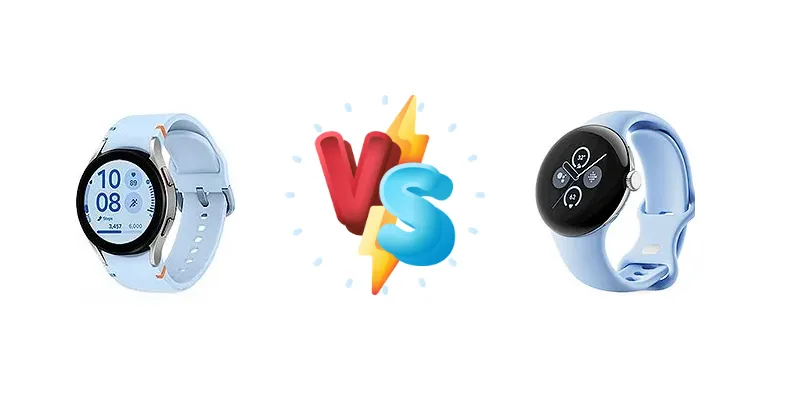
Samsung's Galaxy Watch FE enters the fray as a more accessible entry point into the Galaxy Watch ecosystem, challenging Google's second-generation Pixel Watch 2. While the Pixel Watch 2 represents Google's refined vision for Wear OS, the FE aims to deliver core functionality at a lower price. This comparison dissects the key differences in chipset architecture, charging capabilities, and overall user experience to determine which smartwatch reigns supreme.
🏆 Quick Verdict
For most users, the Google Pixel Watch 2 is the superior choice, offering a more streamlined software experience and significantly faster charging. However, the Samsung Galaxy Watch FE provides a compelling value proposition for those prioritizing affordability and already invested in the Samsung ecosystem.
| Network |
|---|
| 2G bands | GSM 850 / 900 / 1800 / 1900 | GSM 850 / 900 / 1800 / 1900 |
| 3G bands | HSDPA 850 / 900 / 2100 | HSDPA 850 / 900 / 1700(AWS) / 1900 / 2100 |
| 4G bands | LTE | LTE |
| Speed | HSPA, LTE | HSPA, LTE |
| Technology | GSM / HSPA / LTE | GSM / HSPA / LTE |
| Launch |
|---|
| Announced | 2024, June 13 | 2023, October 04 |
| Status | Available. Released 2024, June 24 | Available. Released 2023, October 12 |
| Body |
|---|
| Build | Glass front (sapphire crystal), aluminum frame | Glass front (Gorilla Glass 5), aluminum frame |
| Dimensions | 40.4 x 39.3 x 9.8 mm (1.59 x 1.55 x 0.39 in) | 41 x 41 x 12.3 mm (1.61 x 1.61 x 0.48 in) |
| SIM | eSIM | eSIM |
| Weight | 26.6 g (0.95 oz) | 31 g (1.09 oz) |
| Display |
|---|
| Protection | Sapphire crystal glass | Corning Gorilla Glass 5 |
| Resolution | 396 x 396 pixels (~330 ppi density) | 450 x 450 pixels (~320 ppi density) |
| Size | 1.2 inches | 1.2 inches |
| Type | Super AMOLED | AMOLED, 1000 nits (peak) |
| Platform |
|---|
| CPU | Dual-core 1.18 GHz Cortex-A55 | - |
| Chipset | Exynos W920 (5 nm) | Qualcomm 5100 |
| GPU | Mali-G68 | - |
| OS | Android Wear OS 4, One UI Watch 5 | Android Wear OS 4 |
| Memory |
|---|
| Card slot | No | No |
| Internal | 16GB 1.5GB RAM | 32GB 2GB RAM |
| Sound |
|---|
| 35mm jack | No | No |
| Loudspeaker | Yes | Yes |
| Comms |
|---|
| Bluetooth | 5.0, A2DP, LE | 5.0, A2DP, LE |
| NFC | Yes | Yes |
| Positioning | GPS, GALILEO, GLONASS, BDS | GPS, GLONASS, GALILEO, BDS, QZSS |
| Radio | No | No |
| USB | No | No |
| WLAN | Wi-Fi 802.11 a/b/g/n, dual-band | Wi-Fi 802.11 b/g/n |
| Features |
|---|
| Sensors | Accelerometer, gyro, heart rate, barometer, altimeter, compass, SpO2, temperature (skin) | Accelerometer, gyro, heart rate, altimeter, compass, SpO2, thermometer (skin temperature), skin conductance |
| Battery |
|---|
| Charging | Wireless | Wired, 80% in 45 min |
| Type | Li-Ion 247 mAh battery | Li-Ion 306 mAh |
| Misc |
|---|
| Colors | Black, Pink Gold, Silver | Polished Silver, Matte Black, Champagne Gold |
| Models | SM-R861, SM-R866 | G4TSL, GC3G8, GD2WG |
| Price | € 136.42 | About 160 EUR |
| SAR EU | 0.52 W/kg (head) 0.17 W/kg (body) | - |
Samsung Galaxy Watch FE
- More affordable price point
- Seamless integration with Samsung ecosystem
- Proven Exynos W920 chipset
- Slower wireless charging
- Potentially less efficient chipset compared to Qualcomm
- May lack the latest Wear OS features
Google Pixel Watch 2
- Faster wired charging (80% in 45 minutes)
- More efficient Qualcomm 5100 chipset
- Clean and refined Wear OS experience
- Higher price tag
- Requires a proprietary charger
- May not integrate as seamlessly with Samsung devices
Display Comparison
Display specifications are not provided in the context data. However, given the market positioning, we can infer the Pixel Watch 2 likely features a higher-quality AMOLED panel with potentially better color accuracy and peak brightness. Samsung typically excels in display technology, so the FE's display is likely good, but may not match the Pixel Watch 2's premium offering. Bezels are also a likely differentiator, with the Pixel Watch 2 aiming for a more edge-to-edge design.
Camera Comparison
Neither device is primarily marketed for its camera capabilities, and no camera specs are provided. This section is largely irrelevant for this comparison.
Performance
The core difference lies in the chipsets. The Samsung Galaxy Watch FE utilizes the Exynos W920 (5nm), a proven performer but now a generation behind. The Google Pixel Watch 2 leverages the Qualcomm 5100. While clock speeds (1.18 GHz for the Exynos) don't tell the whole story, the Qualcomm 5100's architecture is likely more efficient, leading to better sustained performance and potentially improved power management. The 5nm process node of the Exynos W920 is a positive, but Qualcomm's advancements in CPU architecture likely offset this advantage. Users demanding consistently smooth performance for apps and fitness tracking will likely find the Pixel Watch 2 more responsive.
Battery Life
Battery capacity is not specified, but the charging methods are drastically different. The Galaxy Watch FE relies on wireless charging, which is convenient but slower. The Pixel Watch 2 offers wired charging, achieving 80% charge in just 45 minutes. This faster charging is a significant advantage for users who frequently need to top up their watch. The slower wireless charging of the FE could be a pain point for those with active lifestyles. The efficiency of the Qualcomm 5100 may also contribute to better overall battery life on the Pixel Watch 2, despite potentially similar battery capacities.
Buying Guide
Buy the Samsung Galaxy Watch FE if you need a feature-rich smartwatch at a lower price point and are already deeply integrated into the Samsung ecosystem, benefiting from seamless connectivity with Galaxy devices. Buy the Google Pixel Watch 2 if you prioritize a clean Wear OS experience, faster charging, and tighter integration with Google services, even at a higher cost.
Frequently Asked Questions
❓ Does the Exynos W920 chip in the Galaxy Watch FE overheat during intensive tasks like GPS tracking or workout recording?
The Exynos W920 is a capable chip, but its 5nm process, while efficient, may lead to some thermal throttling during prolonged, demanding tasks. While unlikely to cause significant issues, users engaging in long outdoor workouts with GPS enabled may experience slight performance dips. The Qualcomm 5100 in the Pixel Watch 2 is likely to manage heat more effectively.
❓ Is the wired charging of the Pixel Watch 2 a significant inconvenience compared to the wireless charging of the Galaxy Watch FE?
The convenience of wireless charging is undeniable, but the Pixel Watch 2's 80% charge in 45 minutes significantly outweighs this benefit. The faster charging speed minimizes downtime and ensures you're less likely to be caught with a low battery during your day. The need for a proprietary charger is a minor drawback, but the speed advantage is substantial.
❓ How does the software experience differ between Wear OS on the Pixel Watch 2 and Samsung's One UI Watch on the Galaxy Watch FE?
The Pixel Watch 2 offers a stock Wear OS experience, prioritizing simplicity and Google service integration. Samsung's One UI Watch, while based on Wear OS, adds a layer of customization and features tailored to Samsung users. This can be a pro or con depending on preference; some users prefer the cleaner Google experience, while others appreciate Samsung's added functionality.