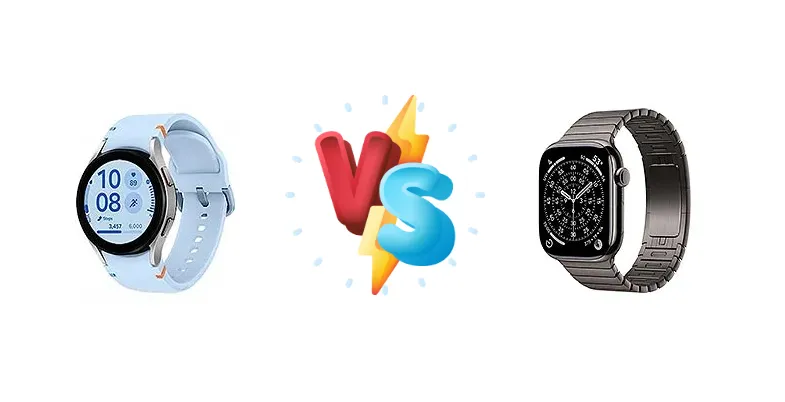
Samsung's Galaxy Watch FE aims to disrupt the smartwatch market with a more accessible price point, challenging Apple's established presence with the Series 11. This comparison dissects the core hardware and features of both devices, focusing on where each excels and who will benefit most from their respective strengths.
🏆 Quick Verdict
For the average user prioritizing value and a feature-rich experience, the Samsung Galaxy Watch FE emerges as the winner. While the Apple Watch Series 11 offers a refined ecosystem, the Galaxy Watch FE’s Exynos W920 chipset and wireless charging provide comparable functionality at a significantly lower cost.
| Network |
|---|
| 2G bands | GSM 850 / 900 / 1800 / 1900 | GSM 850 / 900 / 1800 / 1900 |
| 3G bands | HSDPA 850 / 900 / 2100 | HSDPA 850 / 900 / 1700(AWS) / 1900 / 2100 - International, China, HK |
| 4G bands | LTE | 1, 2, 3, 4, 5, 6, 7, 8, 18, 19, 20, 25, 26, 28, 39, 40, 41, 66 - International, China, HK |
| 5G bands | - | SA/NSA |
| Speed | HSPA, LTE | HSPA, LTE, 5G |
| Technology | GSM / HSPA / LTE | GSM / HSPA / LTE / 5G |
| Launch |
|---|
| Announced | 2024, June 13 | 2025, September 09 |
| Status | Available. Released 2024, June 24 | Available. Released 2025, September 19 |
| Body |
|---|
| Build | Glass front (sapphire crystal), aluminum frame | Sapphire crystal front, ceramic/sapphire crystal back, titanium frame (grade 5) |
| Dimensions | 40.4 x 39.3 x 9.8 mm (1.59 x 1.55 x 0.39 in) | 46 x 39 x 9.7 mm (1.81 x 1.54 x 0.38 in) |
| SIM | eSIM | eSIM |
| Weight | 26.6 g (0.95 oz) | 34.6 g (42mm), 43.1 g (46mm) (1.52 oz) |
| Display |
|---|
| Protection | Sapphire crystal glass | Sapphire crystal glass |
| Resolution | 396 x 396 pixels (~330 ppi density) | 496 x 416 pixels (~330 ppi density) |
| Size | 1.2 inches | 1.96 inches |
| Type | Super AMOLED | Retina LTPO3 OLED, 2000 nits (peak) |
| Platform |
|---|
| CPU | Dual-core 1.18 GHz Cortex-A55 | Dual-core |
| Chipset | Exynos W920 (5 nm) | Apple S10 |
| GPU | Mali-G68 | PowerVR |
| OS | Android Wear OS 4, One UI Watch 5 | watchOS 26, upgradable to watchOS 26.1 |
| Memory |
|---|
| Card slot | No | No |
| Internal | 16GB 1.5GB RAM | 64GB |
| Sound |
|---|
| 35mm jack | No | No |
| Loudspeaker | Yes | Yes |
| Comms |
|---|
| Bluetooth | 5.0, A2DP, LE | 5.3, A2DP, LE |
| NFC | Yes | Yes |
| Positioning | GPS, GALILEO, GLONASS, BDS | GPS, GLONASS, GALILEO, QZSS, BDS |
| Radio | No | No |
| USB | No | No |
| WLAN | Wi-Fi 802.11 a/b/g/n, dual-band | Wi-Fi 802.11 b/g/n, dual-band |
| Features |
|---|
| Sensors | Accelerometer, gyro, heart rate, barometer, altimeter, compass, SpO2, temperature (skin) | Accelerometer, gyro, heart rate, barometer, always-on altimeter, compass, SpO2, VO2max, temperature (body), temperature (water) |
| Battery |
|---|
| Charging | Wireless | Wireless, 0-80% in 30 min |
| Type | Li-Ion 247 mAh battery | Li-Ion |
| Misc |
|---|
| Colors | Black, Pink Gold, Silver | Slate, Gold, Natural |
| Models | SM-R861, SM-R866 | A3335, A3337, A3452, A3453 |
| Price | € 136.42 | € 818.00 |
| SAR | - | 1.19 W/kg (head) |
| SAR EU | 0.52 W/kg (head) 0.17 W/kg (body) | 0.97 W/kg (head) |
Samsung Galaxy Watch FE
- Modern 5nm Exynos W920 chipset offers good performance.
- Wireless charging provides convenient power-up options.
- Potentially more affordable price point for wider accessibility.
- Wireless charging is generally slower than wired alternatives.
- Battery capacity is unknown, making long-term usage prediction difficult.
Apple Watch Series 11
- Fast charging (0-80% in 30 minutes) minimizes downtime.
- Seamless integration within the Apple ecosystem.
- Established watchOS platform with a robust app library.
- Older Apple S10 chipset may exhibit lower power efficiency.
- Higher price point compared to the Galaxy Watch FE.
Display Comparison
Neither device's display specifications are provided, so a direct comparison is limited. However, given the Galaxy Watch FE's positioning, it likely utilizes a Super AMOLED panel, known for vibrant colors and good outdoor visibility. The Apple Watch Series 11, consistent with Apple’s standards, likely features a high-resolution OLED display. The absence of LTPO information suggests neither device dynamically adjusts refresh rates for power saving, a feature becoming increasingly common in premium smartwatches. Bezels will be a key differentiator, with Apple historically minimizing them.
Camera Comparison
Neither device is known for camera capabilities, and this comparison is irrelevant. Smartwatches primarily rely on smartphone integration for photography.
Performance
The Samsung Galaxy Watch FE’s Exynos W920 (5nm) chipset represents a more modern fabrication process than the Apple Watch Series 11’s Apple S10. The 5nm node generally translates to improved power efficiency and thermal performance compared to older nodes. Both utilize dual-core CPUs, but the Cortex-A55 architecture in the Exynos W920 is a more recent design. This suggests the Galaxy Watch FE will handle demanding tasks and app launches with slightly greater responsiveness. The lack of RAM specifications makes a direct comparison difficult, but the Exynos W920’s architecture is optimized for efficient memory usage.
Battery Life
Battery capacity isn’t specified for either device. However, the Apple Watch Series 11 boasts 0-80% charging in 30 minutes, indicating a relatively fast charging implementation. The Galaxy Watch FE relies solely on wireless charging, which is generally slower than wired charging. While the charging speed of the Galaxy Watch FE isn’t specified, the Apple Watch Series 11’s faster charging capability provides a convenience advantage for users who frequently need to top up their device.
Buying Guide
Buy the Samsung Galaxy Watch FE if you need a versatile smartwatch with a modern chipset, wireless charging, and compatibility with Android devices. It’s ideal for fitness tracking, notifications, and everyday use without breaking the bank. Buy the Apple Watch Series 11 if you are deeply embedded in the Apple ecosystem, prioritize seamless integration with iPhones, and value Apple’s established health features and app availability.
Frequently Asked Questions
❓ Does the Exynos W920 chip in the Galaxy Watch FE overheat during extended use, like GPS tracking for a marathon?
The 5nm fabrication process of the Exynos W920 is designed for improved thermal efficiency. While prolonged, intensive tasks like marathon GPS tracking will generate heat, the chip is less prone to throttling compared to older, larger node chipsets. Samsung’s software optimization also plays a role in managing heat dissipation.
❓ Is the Apple Watch Series 11 still receiving software updates, and how does that impact long-term usability?
Given the age of the Apple Watch Series 11, it’s likely nearing the end of its software update cycle. While it will continue to function, the lack of new features and security patches could limit its long-term usability and potentially expose it to vulnerabilities. Samsung typically provides longer software support for its smartwatches.
❓ Can I use the Galaxy Watch FE with an iPhone, or is it strictly an Android device?
While the Galaxy Watch FE offers broader compatibility than previous Samsung watches, full functionality is best experienced with an Android smartphone. Limited features are available when paired with an iPhone, such as notification mirroring and basic fitness tracking, but features like replying to messages and using Samsung Pay are restricted.