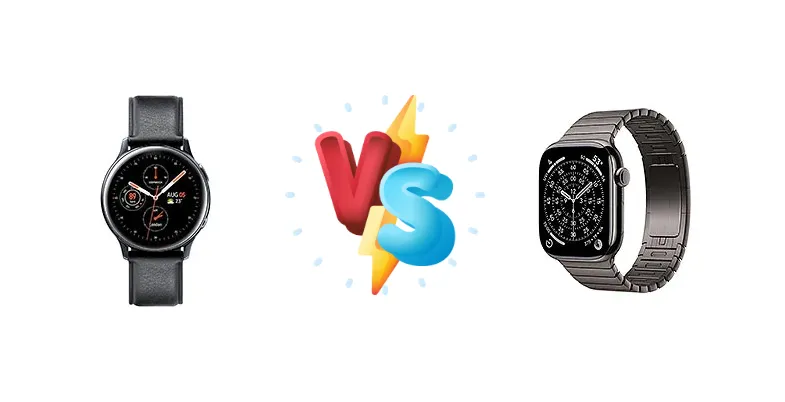
The smartwatch market has matured, but core differences remain. We pit the Samsung Galaxy Watch Active2, powered by Samsung’s Exynos 9110, against the Apple Watch Series 11, utilizing Apple’s custom S10 chip. This comparison focuses on the fundamental performance and convenience factors – processing power and charging speed – to determine which device delivers a smoother, more usable experience.
🏆 Quick Verdict
For the average user prioritizing quick top-ups and a potentially smoother software experience, the Apple Watch Series 11 edges out the Galaxy Watch Active2. Its 0-80% charge in 30 minutes provides a significant convenience factor, while the Apple S10, though details are limited, likely offers optimized performance within the watchOS ecosystem.
| Network |
|---|
| 2G bands | GSM 850 / 900 / 1800 / 1900 | GSM 850 / 900 / 1800 / 1900 |
| 3G bands | HSDPA 850 / 900 / 2100 - Global | HSDPA 850 / 900 / 1700(AWS) / 1900 / 2100 - International, China, HK |
| 4G bands | 1, 3, 5, 7, 8, 20 - Global | 1, 2, 3, 4, 5, 6, 7, 8, 18, 19, 20, 25, 26, 28, 39, 40, 41, 66 - International, China, HK |
| 5G bands | - | SA/NSA |
| Speed | HSPA, LTE | HSPA, LTE, 5G |
| Technology | GSM / HSPA / LTE | GSM / HSPA / LTE / 5G |
| Launch |
|---|
| Announced | 2019, August. Released 2019, September | 2025, September 09 |
| Status | Discontinued | Available. Released 2025, September 19 |
| Body |
|---|
| Build | Glass front (Gorilla Glass DX+), stainless steel frame 316L | Sapphire crystal front, ceramic/sapphire crystal back, titanium frame (grade 5) |
| Dimensions | 44 x 44 x 10.9 mm (1.73 x 1.73 x 0.43 in) | 46 x 39 x 9.7 mm (1.81 x 1.54 x 0.38 in) |
| SIM | eSIM | eSIM |
| Weight | 42 g (1.48 oz) | 34.6 g (42mm), 43.1 g (46mm) (1.52 oz) |
| Display |
|---|
| Protection | Corning Gorilla Glass DX+ | Sapphire crystal glass |
| Resolution | 360 x 360 pixels (~364 ppi density) | 496 x 416 pixels (~330 ppi density) |
| Size | 1.4 inches | 1.96 inches |
| Type | Super AMOLED | Retina LTPO3 OLED, 2000 nits (peak) |
| Platform |
|---|
| CPU | Dual-core 1.15 GHz Cortex-A53 | Dual-core |
| Chipset | Exynos 9110 (10 nm) | Apple S10 |
| GPU | Mali-T720 | PowerVR |
| OS | Tizen OS 5.5 | watchOS 26, upgradable to watchOS 26.1 |
| Memory |
|---|
| Card slot | No | No |
| Internal | 4GB 768MB RAM, 4GB 1.5GB RAM | 64GB |
| Sound |
|---|
| 35mm jack | No | No |
| Loudspeaker | Yes | Yes |
| Comms |
|---|
| Bluetooth | 5.0, A2DP, LE | 5.3, A2DP, LE |
| NFC | Yes | Yes |
| Positioning | GPS, GLONASS, GALILEO, BDS | GPS, GLONASS, GALILEO, QZSS, BDS |
| Radio | No | No |
| USB | No | No |
| WLAN | Wi-Fi 802.11 b/g/n | Wi-Fi 802.11 b/g/n, dual-band |
| Features |
|---|
| Sensors | Accelerometer, gyro, heart rate, barometer, VO2max | Accelerometer, gyro, heart rate, barometer, always-on altimeter, compass, SpO2, VO2max, temperature (body), temperature (water) |
| Battery |
|---|
| Charging | Wireless | Wireless, 0-80% in 30 min |
| Type | Li-Ion 340 mAh, non-removable | Li-Ion |
| Misc |
|---|
| Colors | Black, Silver, Gold | Slate, Gold, Natural |
| Models | SM-R825F, SM-R835F, SM-R825U, SM-R835U | A3335, A3337, A3452, A3453 |
| Price | About 80 EUR | € 818.00 |
| SAR | - | 1.19 W/kg (head) |
| SAR EU | - | 0.97 W/kg (head) |
Samsung Galaxy Watch Active2
- Wear OS offers greater app compatibility with Android devices.
- Wireless charging provides convenient charging options.
- Exynos 9110 is a capable processor for everyday smartwatch tasks.
- Lacks fast charging capabilities compared to the Apple Watch Series 11.
- 10nm process node may result in slightly lower efficiency.
Apple Watch Series 11
- 0-80% charge in 30 minutes offers significant convenience.
- Apple S10 chip benefits from Apple’s hardware-software optimization.
- Seamless integration with the Apple ecosystem.
- Limited compatibility with Android devices.
- watchOS is a closed ecosystem with less customization.
Display Comparison
Display specifications are absent from the provided data, but considering the Active2’s focus on fitness, it likely features a Super AMOLED panel optimized for outdoor visibility. The Series 11, typical of Apple, likely prioritizes color accuracy and brightness. Without specific nit ratings or panel technology details, it’s difficult to definitively declare a winner, but Apple’s historical emphasis on display quality suggests a potential advantage.
Camera Comparison
Neither device is specified as having a camera, which is typical for this generation of smartwatches. Therefore, this section is not applicable.
Performance
The Samsung Galaxy Watch Active2 utilizes a dual-core 1.15 GHz Cortex-A53 CPU built on Samsung’s 10nm Exynos 9110 chipset. This is a capable processor for smartwatch tasks, but the Apple Watch Series 11’s dual-core Apple S10 chip benefits from Apple’s tight hardware-software integration. While clock speed isn’t everything, Apple’s silicon is known for its efficiency and optimized performance within watchOS. The 10nm process node of the Exynos 9110, while respectable, is likely less efficient than the process node used in the S10, potentially leading to slightly more thermal throttling under sustained load. This impacts responsiveness during demanding tasks like app loading or complex workout tracking.
Battery Life
Battery capacity is not provided for either device. However, the Apple Watch Series 11’s charging capability – 0-80% in 30 minutes – is a significant advantage. The Galaxy Watch Active2 relies solely on wireless charging, lacking the quick-charge functionality of its competitor. This means users will likely spend more time tethered to a charger, especially with frequent use. While a larger mAh capacity on the Active2 *could* offset this, the faster charging of the Series 11 provides a more convenient user experience.
Buying Guide
Buy the Samsung Galaxy Watch Active2 if you need a more open ecosystem, prefer Wear OS, and aren't overly concerned with the fastest charging speeds. It's a solid choice for Android users seeking a feature-rich smartwatch. Buy the Apple Watch Series 11 if you are deeply embedded in the Apple ecosystem, value seamless integration with iPhones, and prioritize a faster charging experience to minimize downtime.
Frequently Asked Questions
❓ Does the Exynos 9110 chip in the Galaxy Watch Active2 overheat during extended GPS use?
While the Exynos 9110 is a capable chip, its 10nm process node may lead to some thermal throttling during prolonged, demanding tasks like GPS tracking for long runs or hikes. Users may experience slight performance dips in these scenarios, but it shouldn't be a major issue for typical use.
❓ How does the Apple S10 chip’s optimization within watchOS affect real-world performance compared to the Exynos 9110?
Apple’s tight control over both hardware and software allows for significant optimization. The S10 chip is likely to deliver a smoother and more responsive experience within watchOS, even with potentially similar raw processing power to the Exynos 9110. This optimization translates to faster app loading times and more efficient background processing.
❓ Is the lack of fast charging on the Galaxy Watch Active2 a significant drawback for daily use?
Yes, the absence of fast charging is a notable disadvantage. The Apple Watch Series 11’s 0-80% in 30 minutes charging capability provides a substantial convenience factor. Without it, the Active2 requires more time on the charger, potentially disrupting daily routines.