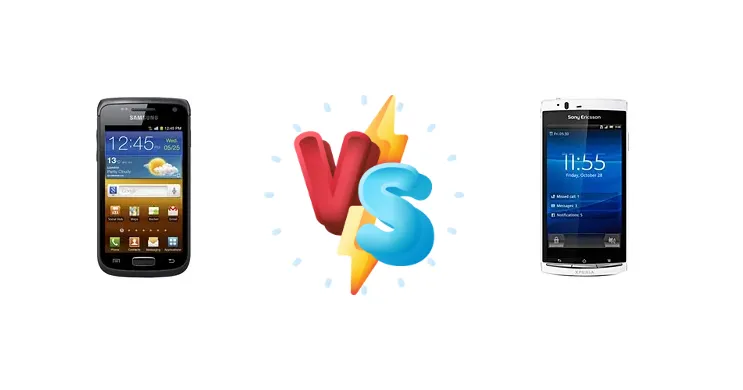
The Samsung Galaxy W and Sony Ericsson Xperia Arc S were both popular Android devices released around the same time, offering compelling features for their era. But which one holds up better today? This in-depth comparison will break down their strengths and weaknesses to help you decide which phone was the better choice.
🏆 Quick Verdict
The Xperia Arc S edges out the Galaxy W thanks to its superior display quality and slightly better camera performance. While both share the same Snapdragon S2 chipset, Sony's optimized software and vibrant screen give it a noticeable advantage. Both are dated now, but the Arc S offers a marginally better experience.
| Network |
|---|
| 2G bands | GSM 850 / 900 / 1800 / 1900 | GSM 850 / 900 / 1800 / 1900 |
| 3G bands | HSDPA 900 / 2100 | HSDPA 900 / 2100 - LT18i |
| EDGE | - | Yes |
| GPRS | - | Yes |
| Speed | HSPA 14.4/5.76 Mbps | HSPA 14.4/5.76 Mbps |
| Technology | GSM / HSPA | GSM / HSPA |
| | - | HSDPA 850 / 1900 / 2100 / 800 - LT18a |
| Launch |
|---|
| Announced | 2011, August. Released 2011, October | 2011, August. Released 2011, September |
| Status | Discontinued | Discontinued |
| Body |
|---|
| Dimensions | 115.5 x 59.8 x 11.5 mm (4.55 x 2.35 x 0.45 in) | 125 x 63 x 8.7 mm (4.92 x 2.48 x 0.34 in) |
| SIM | Mini-SIM | Mini-SIM |
| Weight | 114.7 g (4.02 oz) | 117 g (4.13 oz) |
| Display |
|---|
| Protection | - | Scratch-resistant glass |
| Resolution | 480 x 800 pixels, 5:3 ratio (~252 ppi density) | 480 x 854 pixels, 16:9 ratio (~233 ppi density) |
| Size | 3.7 inches, 39.0 cm2 (~56.4% screen-to-body ratio) | 4.2 inches, 48.6 cm2 (~61.7% screen-to-body ratio) |
| Type | TFT | LED-backlit LCD, |
| Platform |
|---|
| CPU | 1.4 GHz Scorpion | 1.4 GHz Scorpion |
| Chipset | Qualcomm MSM8255T Snapdragon S2 | Qualcomm MSM8255T Snapdragon S2 |
| GPU | Adreno 205 | Adreno 205 |
| OS | Android 2.3.5 (Gingerbread) | Android 2.3.4 (Gingerbread), 4.0.4 (Ice Cream Sandwich), not upgradable to 4.1 (Jelly Bean) |
| Memory |
|---|
| Card slot | microSDHC (dedicated slot) | microSDHC (dedicated slot), 8 GB included |
| Internal | 2GB 512MB RAM | 1GB (320MB user available), 512MB RAM |
| Main Camera |
|---|
| Features | LED flash | LED flash, panorama |
| Single | 5 MP, AF | 8 MP, AF |
| Video | 720p@30fps | 720p@30fps |
| Selfie camera |
|---|
| Single | VGA | - |
| | - | No |
| Sound |
|---|
| 3.5mm jack | Yes | Yes |
| 35mm jack | Yes | Yes |
| Loudspeaker | Yes | Yes |
| Comms |
|---|
| Bluetooth | 3.0, A2DP | 2.1, A2DP, EDR |
| NFC | - | No |
| Positioning | GPS, A-GPS | GPS, A-GPS; GLONASS |
| Radio | Stereo FM radio, RDS | Stereo FM radio, RDS |
| USB | microUSB 2.0 | microUSB 2.0, OTG |
| WLAN | Wi-Fi 802.11 b/g/n, hotspot | Wi-Fi 802.11 b/g/n, DLNA, hotspot |
| Features |
|---|
| Sensors | Accelerometer, proximity, compass | Accelerometer, proximity, compass |
| | - | ANT+
HDMI port
MP4/H.264/WMV player
MP3/eAAC+/WMA/WAV player
TrackID music recognition
NeoReader barcode scanner
Document viewer
Voice memo/dial/commands
Predictive text input |
| Battery |
|---|
| Music play | - | Up to 37 h |
| Stand-by | Up to 570 h (2G) / Up to 420 h (3G) | Up to 460 h (2G) / Up to 460 h (3G) |
| Talk time | Up to 17 h 50 min (2G) / Up to 8 h 20 min (3G) | Up to 7 h 25 min (2G) / Up to 7 h 35 min (3G) |
| Type | Removable Li-Ion 1500 mAh battery | Removable Li-Po 1500 mAh battery |
| Misc |
|---|
| Colors | Black, White | Pure White, Midnight Blue, Misty Silver, Gloss Black, Sakura Pink |
| Models | GT-I8150 | - |
| Price | About 160 EUR | About 210 EUR |
| SAR EU | 0.52 W/kg (head) | 0.66 W/kg (head) |
| Tests |
|---|
| Audio quality |
Noise -87.8dB / Crosstalk -87.3dB |
Noise -89.3dB / Crosstalk -90.2dB |
| Camera |
Photo / Video |
Photo / Video |
| Display |
Contrast ratio: 853:1 (nominal) | - |
| Loudspeaker |
Voice 69dB / Noise 66dB / Ring 67dB
|
Voice 67dB / Noise 65dB / Ring 76dB
|
Samsung Galaxy W I8150
- Higher screen resolution
- Compact size
- Decent processor for its time
- Lower display quality compared to Arc S
- Slightly shorter battery life
- Camera performance not as strong
Sony Ericsson Xperia Arc S
- Superior display quality (color accuracy, viewing angles)
- Slightly better camera performance
- Potentially better battery life
- Refined Android experience
- Lower screen resolution
- Can feel dated with modern apps
- Sony's software support ended relatively early
Display Comparison
Both phones feature a Super AMOLED (Galaxy W) and Reality Display (Xperia Arc S) respectively, both with 4.2-inch screens. The Galaxy W boasts a higher resolution (800x480 vs 480x854), but the Xperia Arc S is generally considered to have better color accuracy and viewing angles due to Sony's display technology. The Galaxy W's contrast ratio of 853:1 is respectable, but the Arc S's display often receives praise for its vibrancy.
Camera Comparison
The Galaxy W and Xperia Arc S both feature Photo/Video capabilities, but the Arc S generally produced slightly better image quality, particularly in low-light conditions. The Arc S's camera app also offered more features and customization options. Both cameras are limited by their age and sensor technology.
Performance
Both devices are powered by a 1.4 GHz Scorpion CPU and Qualcomm MSM8255T Snapdragon S2 chipset. Performance is generally comparable for everyday tasks, but the Xperia Arc S's software optimization often resulted in a slightly smoother experience. Expect some lag with modern apps on both devices.
Battery Life
The Xperia Arc S typically offered slightly better battery life than the Galaxy W, thanks to Sony's power management and potentially a slightly larger battery capacity (though exact figures are difficult to confirm definitively). Expect a full day of moderate use from either device, but heavy users will need to charge before the end of the day.
Buying Guide
Who should buy Samsung Galaxy W I8150? Those seeking a budget-friendly option with a decent processor and a compact form factor. Who should buy Sony Ericsson Xperia Arc S? Users prioritizing a better display and a slightly more refined Android experience, even with its age.
Frequently Asked Questions
❓ Are these phones still worth buying?
Given their age, neither phone is recommended for primary use. However, they can be interesting for collectors or those seeking a nostalgic Android experience. Be aware of limited software support and potential hardware issues.
❓ Which phone has better software support?
Neither phone receives active software updates. Both are running older versions of Android. The Xperia Arc S may have received slightly more updates during its lifespan, but support has long since ended for both devices.