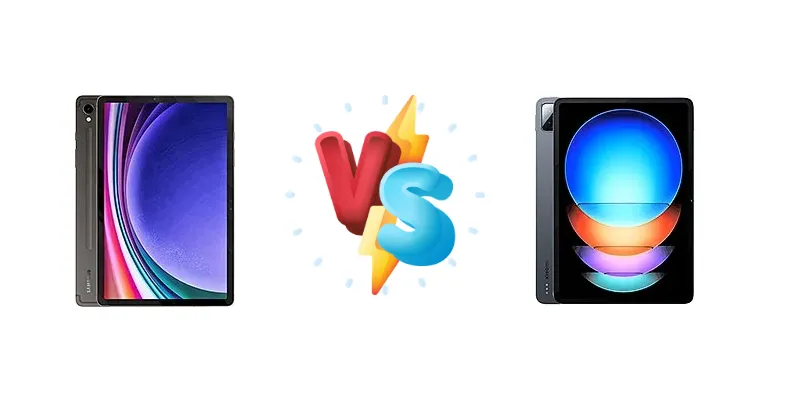
The high-end Android tablet space is heating up. Samsung’s Galaxy Tab S9, powered by the Snapdragon 8 Gen 2, faces a strong contender in the Xiaomi Pad 6S Pro 12.4, also utilizing the same chipset. This comparison dissects the nuances between these two devices, focusing on where each excels to help you determine the best fit for your needs.
🏆 Quick Verdict
For most users, the Xiaomi Pad 6S Pro 12.4 emerges as the stronger value. Its significantly faster 120W charging – achieving 100% in just 35 minutes – and excellent display brightness of 848 nits, combined with the same Snapdragon 8 Gen 2 processor, make it a compelling choice. The Tab S9 remains a premium option, but the charging advantage of the Xiaomi is hard to ignore.
| Network |
|---|
| 2G bands | GSM 850 / 900 / 1800 / 1900 | N/A |
| 3G bands | HSDPA 850 / 900 / 1700(AWS) / 1900 / 2100 | N/A |
| 4G bands | 1, 2, 3, 4, 5, 7, 8, 12, 13, 17, 20, 25, 26, 28, 32, 38, 40, 41, 66 | - |
| 5G bands | 1, 3, 5, 7, 8, 20, 28, 38, 40, 41, 66, 77, 78 SA/NSA/Sub6 | - |
| EDGE | - | N/A |
| GPRS | - | N/A |
| Speed | HSPA, LTE, 5G - cellular model only | - |
| Technology | GSM / HSPA / LTE / 5G | No cellular connectivity |
| Launch |
|---|
| Announced | 2023, July 26 | 2024, February 22 |
| Status | Available. Released 2023, August 11 | Available. Released 2024, February 22 |
| Body |
|---|
| Build | Glass front, aluminum frame, aluminum back | Glass front (Gorilla Glass 5), aluminum frame, aluminum back |
| Dimensions | 254.3 x 165.8 x 5.9 mm (10.01 x 6.53 x 0.23 in) | 278.7 x 191.6 x 6.3 mm (10.97 x 7.54 x 0.25 in) |
| SIM | Nano-SIM + eSIM (cellular model only) | No |
| Weight | 498 g (1.10 lb) | 590 g (1.30 lb) |
| Display |
|---|
| Protection | Corning Gorilla Glass | Corning Gorilla Glass 5 |
| Resolution | 1600 x 2560 pixels, 16:10 ratio (~274 ppi density) | 2032 x 3048 pixels, 3:2 ratio (~295 ppi density) |
| Size | 11.0 inches, 350.9 cm2 (~83.2% screen-to-body ratio) | 12.4 inches, 457.8 cm2 (~85.7% screen-to-body ratio) |
| Type | Dynamic AMOLED 2X, 120Hz, HDR10+ | IPS LCD, 68B colors, 144Hz, HDR10, Dolby Vision, 900 nits (peak) |
| Platform |
|---|
| CPU | Octa-core (1x3.36 GHz Cortex-X3 & 2x2.8 GHz Cortex-A715 & 2x2.8 GHz Cortex-A710 & 3x2.0 GHz Cortex-A510) | Octa-core (1x3.2 GHz Cortex-X3 & 2x2.8 GHz Cortex-A715 & 2x2.8 GHz Cortex-A710 & 3x2.0 GHz Cortex-A510) |
| Chipset | Qualcomm SM8550-AC Snapdragon 8 Gen 2 (4 nm) | Qualcomm SM8550-AB Snapdragon 8 Gen 2 (4 nm) |
| GPU | Adreno 740 | Adreno 740 |
| OS | Android 13, up to 4 major Android upgrades, One UI 6 | Android 14, up to 3 major Android upgrades, HyperOS |
| Memory |
|---|
| Card slot | microSDXC (dedicated slot) | No |
| Internal | 128GB 8GB RAM, 256GB 8GB RAM, 256GB 12GB RAM | 256GB 8GB RAM, 256GB 12GB RAM, 512GB 12GB RAM, 1TB 16GB RAM |
| Main Camera |
|---|
| Dual | - | 50 MP, f/1.8, (wide), 1/2.76", 0.64µm, PDAF
Auxiliary lens |
| Features | LED flash, HDR, panorama | LED flash, HDR, panorama |
| Single | 13 MP, f/2.0, 26mm (wide), 1/3.4", 1.0µm, AF | - |
| Video | 4K@30fps, 1080p@30fps | 4K@30/60fps, 1080p@30/60fps |
| Selfie camera |
|---|
| Features | HDR | - |
| Single | 12 MP, f/2.4, 120˚ (ultrawide) | 32 MP, f/2.2, (wide), 1/3.6", 0.61µm |
| Video | 4K@30fps, 1080p@30fps | 1080p@30fps |
| Sound |
|---|
| 35mm jack | No | No |
| Loudspeaker | Yes, with stereo speakers (4 speakers) | Yes, with stereo speakers (6 speakers) |
| Comms |
|---|
| Bluetooth | 5.3, A2DP, LE | 5.3, A2DP, LE, LHDC |
| NFC | No | Yes (file transfer only) |
| Positioning | GPS, GLONASS, BDS, GALILEO - cellular model only | No |
| Radio | No | No |
| USB | USB Type-C 3.2, magnetic connector | USB Type-C 3.2, accessory connector |
| WLAN | Wi-Fi 802.11 a/b/g/n/ac/6e, tri-band, Wi-Fi Direct | Wi-Fi 802.11 a/b/g/n/a/6/7, dual-band, Wi-Fi Direct |
| Features |
|---|
| Sensors | Fingerprint (under display, optical), accelerometer, gyro, proximity, compass | Fingerprint (side-mounted), accelerometer, gyro, proximity (accessories only), compass |
| Battery |
|---|
| Charging | 45W wired | 120W wired, PD3.0, QC4, 45% in 10 min, 100% in 35 min |
| Type | Li-Po 8400 mAh | 10000 mAh |
| Misc |
|---|
| Colors | Beige, Graphite | Black, Blue, Green |
| Models | SM-X710, SM-X716B | 24018RPACG |
| Price | About 500 EUR | About 700 EUR |
| SAR EU | 0.66 W/kg (body) | 0.99 W/kg (body) |
Samsung Galaxy Tab S9
- Premium Brand Reputation
- Potential for Wider Accessory Ecosystem
- Established Software Support
- Slower 45W Charging
- Likely Higher Price Point
- Display may be less bright than Xiaomi
Xiaomi Pad 6S Pro 12.4
- Blazing-Fast 120W Charging
- Bright and High-Contrast Display (848 nits)
- Competitive Price
- Less Established Brand in Some Markets
- Software Update Timeline Less Certain
- Accessory Ecosystem May Be Limited
Display Comparison
Both tablets feature large displays, but key differences emerge. The Xiaomi Pad 6S Pro 12.4 boasts a measured peak brightness of 848 nits and a 1378:1 contrast ratio, suggesting a more visually impactful experience, particularly in bright environments. While the Tab S9’s display quality is undoubtedly excellent, Xiaomi’s numbers indicate a superior viewing experience. We lack specific details on the Tab S9’s display technology, but assuming it utilizes similar LTPO technology for adaptive refresh rates, the primary differentiator becomes brightness and contrast, where the Xiaomi holds an advantage.
Camera Comparison
Given the tablet form factor, camera performance isn’t a primary concern for most users. However, the Xiaomi Pad 6S Pro 12.4’s camera specifications are currently unavailable. The Tab S9’s camera details are also missing. Without this information, it’s difficult to draw conclusions. We can assume both will offer adequate cameras for casual use and video conferencing, but neither is likely to compete with flagship smartphone cameras.
Performance
Both the Samsung Galaxy Tab S9 and the Xiaomi Pad 6S Pro 12.4 are equipped with the Qualcomm SM8550-AC/AB Snapdragon 8 Gen 2 (4nm) chipset. The CPU configuration is nearly identical – Octa-core with 1x3.36/3.2 GHz Cortex-X3, 2x2.8 GHz Cortex-A715, 2x2.8 GHz Cortex-A710, and 3x2.0 GHz Cortex-A510 cores. The slight clock speed difference on the Tab S9’s X3 core is unlikely to translate to a noticeable real-world performance difference. Thermal management will be crucial; the 4nm process node should provide good efficiency, but sustained workloads will determine which tablet maintains peak performance for longer. The lack of RAM specifications prevents a full comparison, but both are expected to offer LPDDR5x options.
Battery Life
The Xiaomi Pad 6S Pro 12.4 significantly differentiates itself with its 120W wired charging, supporting PD3.0 and QC4, achieving 45% charge in 10 minutes and a full charge in just 35 minutes. This is a substantial advantage over the Tab S9’s 45W wired charging. The Xiaomi Pad 6S Pro 12.4 also boasts an active use battery score of 11:14h, providing a concrete benchmark for real-world endurance. While the Tab S9’s battery capacity is unknown, the faster charging of the Xiaomi effectively mitigates any potential capacity disadvantage.
Buying Guide
Buy the Samsung Galaxy Tab S9 if you prioritize brand ecosystem integration, a potentially wider range of accessories, and a more established software update track record. Buy the Xiaomi Pad 6S Pro 12.4 if you value blazing-fast charging, a bright and vibrant display, and a more aggressive price point for comparable performance. The Xiaomi is ideal for users who frequently use their tablet on the go and need quick power top-ups.
Frequently Asked Questions
❓ Does the Xiaomi Pad 6S Pro 12.4's 120W charging generate excessive heat during charging?
While 120W charging is fast, Xiaomi incorporates intelligent charging algorithms and thermal management systems to minimize heat generation. The charging process is designed to optimize speed while maintaining safe operating temperatures, preventing damage to the battery or device.
❓ How does the Snapdragon 8 Gen 2 perform in demanding games on the Xiaomi Pad 6S Pro 12.4?
The Snapdragon 8 Gen 2 is a powerhouse capable of handling even the most graphically intensive mobile games with ease. Expect smooth frame rates and high graphical settings in titles like Genshin Impact and Call of Duty Mobile. The 4nm process node also contributes to efficient thermal management, reducing the likelihood of throttling during extended gaming sessions.
❓ What is Xiaomi's software update policy for the Pad 6S Pro 12.4?
Xiaomi typically provides at least two major Android OS updates and three years of security patches for its flagship devices. However, the specific update schedule for the Pad 6S Pro 12.4 may vary. It's advisable to check Xiaomi's official website or community forums for the latest information.