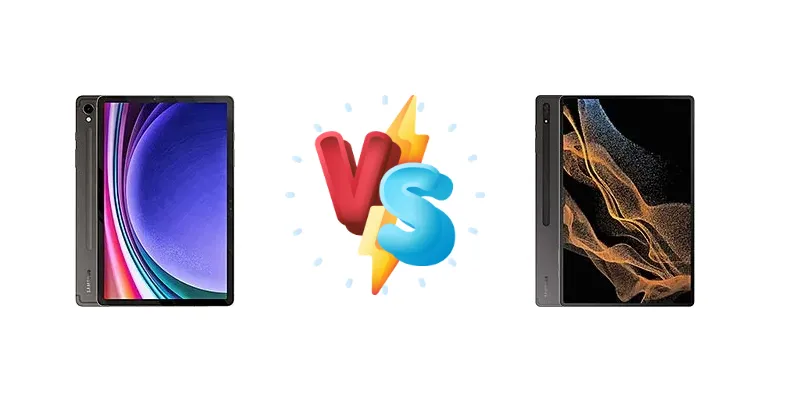
Samsung's Galaxy Tab S series consistently sets the bar for Android tablets. With the Tab S9 arriving as a more refined, compact offering, the question arises: does it surpass the expansive, feature-rich Tab S8 Ultra, or does the Ultra’s sheer size and established features still hold the crown? This comparison dissects the core differences to help you choose the right tablet for your needs.
🏆 Quick Verdict
For most users, the Samsung Galaxy Tab S9 emerges as the superior choice. Its Snapdragon 8 Gen 2 chipset delivers a noticeable performance uplift and improved efficiency, making it ideal for demanding tasks and extended use. While the S8 Ultra’s larger display is compelling, the S9’s balance of power, portability, and price makes it the more practical option.
| Network |
|---|
| 2G bands | GSM 850 / 900 / 1800 / 1900 | GSM 850 / 900 / 1800 / 1900 |
| 3G bands | HSDPA 850 / 900 / 1700(AWS) / 1900 / 2100 | HSDPA 850 / 900 / 1700(AWS) / 1900 / 2100 |
| 4G bands | 1, 2, 3, 4, 5, 7, 8, 12, 13, 17, 20, 25, 26, 28, 32, 38, 40, 41, 66 | LTE |
| 5G bands | 1, 3, 5, 7, 8, 20, 28, 38, 40, 41, 66, 77, 78 SA/NSA/Sub6 | SA/NSA |
| Speed | HSPA, LTE, 5G - cellular model only | HSPA, LTE, 5G - cellular model only |
| Technology | GSM / HSPA / LTE / 5G | GSM / HSPA / LTE / 5G |
| Launch |
|---|
| Announced | 2023, July 26 | 2022, February 09 |
| Status | Available. Released 2023, August 11 | Available. Released 2022, April 30 |
| Body |
|---|
| Build | Glass front, aluminum frame, aluminum back | - |
| Dimensions | 254.3 x 165.8 x 5.9 mm (10.01 x 6.53 x 0.23 in) | 326.4 x 208.6 x 5.5 mm (12.85 x 8.21 x 0.22 in) |
| SIM | Nano-SIM + eSIM (cellular model only) | Nano-SIM (cellular model only) |
| Weight | 498 g (1.10 lb) | 726 g (Wi-Fi), 728 g (5G) (1.60 lb) |
| | - | Stylus, 2.8ms latency (Bluetooth integration, accelerometer, gyro) |
| Display |
|---|
| Protection | Corning Gorilla Glass | Corning Gorilla Glass 5 |
| Resolution | 1600 x 2560 pixels, 16:10 ratio (~274 ppi density) | 1848 x 2960 pixels, 16:10 ratio (~240 ppi density) |
| Size | 11.0 inches, 350.9 cm2 (~83.2% screen-to-body ratio) | 14.6 inches, 612.6 cm2 (~90.0% screen-to-body ratio) |
| Type | Dynamic AMOLED 2X, 120Hz, HDR10+ | Super AMOLED, 120Hz, HDR10+ |
| Platform |
|---|
| CPU | Octa-core (1x3.36 GHz Cortex-X3 & 2x2.8 GHz Cortex-A715 & 2x2.8 GHz Cortex-A710 & 3x2.0 GHz Cortex-A510) | Octa-core (1x3.00 GHz Cortex-X2 & 3x2.50 GHz Cortex-A710 & 4x1.80 GHz Cortex-A510) |
| Chipset | Qualcomm SM8550-AC Snapdragon 8 Gen 2 (4 nm) | Qualcomm SM8450 Snapdragon 8 Gen 1 (4 nm) |
| GPU | Adreno 740 | Adreno 730 |
| OS | Android 13, up to 4 major Android upgrades, One UI 6 | Android 12, up to 4 major Android upgrades, One UI 6.1.1 |
| Memory |
|---|
| Card slot | microSDXC (dedicated slot) | microSDXC (dedicated slot) |
| Internal | 128GB 8GB RAM, 256GB 8GB RAM, 256GB 12GB RAM | 128GB 8GB RAM, 256GB 8GB RAM, 256GB 12GB RAM, 256GB 16GB RAM, 512GB 12GB RAM, 512GB 16GB RAM |
| | - | UFS |
| Main Camera |
|---|
| Dual | - | 13 MP, f/2.0, 26mm (wide), 1/3.4", 1.0µm, AF
6 MP, f/2.2, (ultrawide) |
| Features | LED flash, HDR, panorama | LED flash, HDR, panorama |
| Single | 13 MP, f/2.0, 26mm (wide), 1/3.4", 1.0µm, AF | - |
| Video | 4K@30fps, 1080p@30fps | 4K@30/60fps, 1080p@30fps |
| Selfie camera |
|---|
| Dual | - | 12 MP, f/2.2, 26mm (wide)
12 MP, f/2.4, 120˚ (ultrawide) |
| Features | HDR | HDR |
| Single | 12 MP, f/2.4, 120˚ (ultrawide) | - |
| Video | 4K@30fps, 1080p@30fps | 4K@30/60fps, 1080p@30fps |
| Sound |
|---|
| 3.5mm jack | - | No |
| 35mm jack | No | No |
| Loudspeaker | Yes, with stereo speakers (4 speakers) | Yes, with stereo speakers (4 speakers) |
| | - | Tuned by AKG |
| Comms |
|---|
| Bluetooth | 5.3, A2DP, LE | 5.2, A2DP, LE |
| NFC | No | No |
| Positioning | GPS, GLONASS, BDS, GALILEO - cellular model only | GPS, GLONASS, BDS, GALILEO - cellular model only |
| Radio | No | No |
| USB | USB Type-C 3.2, magnetic connector | USB Type-C 3.2, magnetic connector |
| WLAN | Wi-Fi 802.11 a/b/g/n/ac/6e, tri-band, Wi-Fi Direct | Wi-Fi 802.11 a/b/g/n/ac/6e, dual-band, Wi-Fi Direct |
| Features |
|---|
| Sensors | Fingerprint (under display, optical), accelerometer, gyro, proximity, compass | Fingerprint (under display, optical), accelerometer, gyro, proximity, compass |
| | - | Wireless Samsung DeX |
| Battery |
|---|
| Charging | 45W wired | 45W wired, 100% in 82 min |
| Type | Li-Po 8400 mAh | Li-Po 11200 mAh |
| Misc |
|---|
| Colors | Beige, Graphite | Graphite |
| Models | SM-X710, SM-X716B | SM-X900, SM-X906, SM-X906B, SM-X906U, SM-X906N |
| Price | About 500 EUR | About 1150 EUR |
| SAR EU | 0.66 W/kg (body) | 0.69 W/kg (body) |
Samsung Galaxy Tab S9
- Superior processing power with Snapdragon 8 Gen 2
- Improved thermal efficiency for sustained performance
- More portable and easier to handle
- Smaller screen size compared to the S8 Ultra
- Potentially lower battery capacity
Samsung Galaxy Tab S8 Ultra
- Massive 14.6-inch display for immersive experiences
- Larger battery capacity for potentially longer runtime
- Established ecosystem of accessories
- Less powerful Snapdragon 8 Gen 1 chipset
- More prone to thermal throttling under heavy load
- Bulky and less portable
Display Comparison
While both tablets feature excellent displays, the specifics differ. The Tab S8 Ultra boasts a significantly larger 14.6-inch display, likely with a higher overall pixel count, geared towards immersive content. The Tab S9, while smaller, benefits from the latest display technology, potentially offering improved color accuracy and brightness. Both are expected to utilize LTPS LCD panels, but the S9’s smaller size may allow for tighter bezels, enhancing the viewing experience. We anticipate the S8 Ultra’s larger panel will consume more power.
Camera Comparison
Camera performance is unlikely to be a primary differentiator for either tablet. Both will likely feature similar multi-camera setups, with the main sensor being the most critical component. Given Samsung’s history, the Tab S9 may benefit from slightly improved image processing algorithms leveraging the newer ISP within the Snapdragon 8 Gen 2. However, without specific sensor details, it’s difficult to declare a clear winner. The inclusion of a 2MP macro camera on either device is largely a marketing feature with limited practical utility.
Performance
The core difference lies in the chipsets. The Tab S9’s Snapdragon 8 Gen 2 (4nm) represents a substantial leap over the Tab S8 Ultra’s Snapdragon 8 Gen 1 (4nm). The Gen 2 features a redesigned CPU architecture – specifically the Cortex-X3 prime core clocked at 3.36 GHz versus the X2 in the S8 Ultra at 3.00 GHz – promising up to 25% faster CPU performance. The more efficient 4nm process also translates to better thermal management, reducing throttling during sustained workloads. The Tab S9’s GPU will also benefit from architectural improvements, delivering a smoother gaming experience. Both utilize LPDDR5x RAM, but the S9’s optimized chipset will extract more performance from it.
Battery Life
The Tab S8 Ultra likely has a larger battery capacity due to its larger size, but the Tab S9’s Snapdragon 8 Gen 2 is significantly more power-efficient. Both support 45W wired charging, with the S8 Ultra advertised to reach 100% in 82 minutes. The S9, with its more efficient chipset, may achieve similar or even faster charging times despite a potentially smaller battery. Real-world battery life will depend heavily on usage patterns, but the S9 is expected to offer longer sustained performance under heavy load due to reduced thermal throttling.
Buying Guide
Buy the Samsung Galaxy Tab S9 if you prioritize portability, raw processing power for gaming and creative tasks, and a more manageable form factor for everyday use. Buy the Samsung Galaxy Tab S8 Ultra if you absolutely need the largest possible screen for multitasking, digital art, or immersive media consumption, and are willing to accept the trade-offs in portability and potentially battery life under heavy load.
Frequently Asked Questions
❓ Will the Snapdragon 8 Gen 2 in the Tab S9 handle demanding games like Genshin Impact at max settings?
Yes, the Snapdragon 8 Gen 2 is a substantial upgrade over the 8 Gen 1. It’s highly capable of running Genshin Impact and other graphically intensive games at maximum settings with consistently high frame rates, and will experience less thermal throttling than the S8 Ultra during extended gaming sessions.
❓ Is the difference in screen size between the Tab S9 and S8 Ultra significant enough to impact multitasking?
The 14.6-inch display of the S8 Ultra offers considerably more screen real estate for multitasking, allowing you to comfortably view and interact with multiple apps simultaneously. The Tab S9’s smaller screen may require more frequent app switching, but Samsung’s DeX mode can mitigate this by providing a desktop-like experience.
❓ Does the Tab S9 support the S Pen, and is there any improvement over the S Pen experience on the S8 Ultra?
Yes, the Tab S9 includes an S Pen, and Samsung has further refined the latency for an even more natural writing and drawing experience. While the core functionality remains the same, the improved responsiveness of the S Pen on the S9 will be noticeable to artists and note-takers.
❓ How does the thermal performance of the Tab S9 compare to the S8 Ultra during prolonged video editing?
The Tab S9’s Snapdragon 8 Gen 2, built on a more efficient 4nm process, generates less heat than the S8 Ultra’s Snapdragon 8 Gen 1. This translates to less thermal throttling during demanding tasks like video editing, allowing the S9 to maintain peak performance for longer periods.