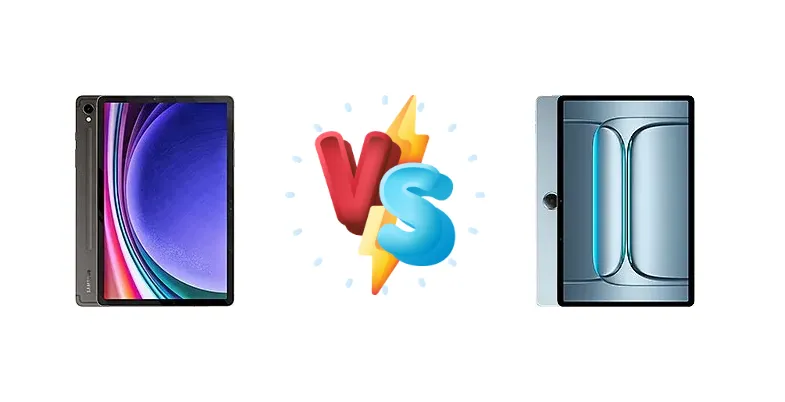
The Android tablet market is heating up, with Samsung continuing to push the premium envelope and OnePlus aiming for a compelling balance of features and price. We pit the flagship-level Samsung Galaxy Tab S9, powered by the Snapdragon 8 Gen 2, against the more budget-conscious OnePlus Pad Lite, featuring the MediaTek Helio G100, to determine which tablet reigns supreme for different user needs.
🏆 Quick Verdict
For users prioritizing raw performance, gaming, and future-proofing, the Samsung Galaxy Tab S9 is the clear winner. However, the OnePlus Pad Lite offers a surprisingly capable experience at a significantly lower price point, making it ideal for everyday tasks and media consumption.
| Network |
|---|
| 2G bands | GSM 850 / 900 / 1800 / 1900 | GSM 850 / 900 / 1800 / 1900 - cellular model only |
| 3G bands | HSDPA 850 / 900 / 1700(AWS) / 1900 / 2100 | HSDPA 850 / 900 / 2100 - cellular model only |
| 4G bands | 1, 2, 3, 4, 5, 7, 8, 12, 13, 17, 20, 25, 26, 28, 32, 38, 40, 41, 66 | LTE - cellular model only |
| 5G bands | 1, 3, 5, 7, 8, 20, 28, 38, 40, 41, 66, 77, 78 SA/NSA/Sub6 | - |
| Speed | HSPA, LTE, 5G - cellular model only | HSPA, LTE - cellular model only |
| Technology | GSM / HSPA / LTE / 5G | GSM / HSPA / LTE |
| Launch |
|---|
| Announced | 2023, July 26 | 2025, July 08 |
| Status | Available. Released 2023, August 11 | Available. Released 2025, August 14 |
| Body |
|---|
| Build | Glass front, aluminum frame, aluminum back | - |
| Dimensions | 254.3 x 165.8 x 5.9 mm (10.01 x 6.53 x 0.23 in) | 254.9 x 166.5 x 7.4 mm (10.04 x 6.56 x 0.29 in) |
| SIM | Nano-SIM + eSIM (cellular model only) | Yes - cellular model only |
| Weight | 498 g (1.10 lb) | 530 g (1.17 lb) |
| Display |
|---|
| Protection | Corning Gorilla Glass | - |
| Resolution | 1600 x 2560 pixels, 16:10 ratio (~274 ppi density) | 1200 x 1920 pixels, 16:10 ratio (~207 ppi density) |
| Size | 11.0 inches, 350.9 cm2 (~83.2% screen-to-body ratio) | 11.0 inches, 347.5 cm2 (~81.9% screen-to-body ratio) |
| Type | Dynamic AMOLED 2X, 120Hz, HDR10+ | IPS LCD, 1B colors, 90Hz, 500 nits |
| Platform |
|---|
| CPU | Octa-core (1x3.36 GHz Cortex-X3 & 2x2.8 GHz Cortex-A715 & 2x2.8 GHz Cortex-A710 & 3x2.0 GHz Cortex-A510) | Octa-core (2x2.2 GHz Cortex-A76 & 6x2.0 GHz Cortex-A55) |
| Chipset | Qualcomm SM8550-AC Snapdragon 8 Gen 2 (4 nm) | Mediatek Helio G100 (6 nm) |
| GPU | Adreno 740 | Mali-G57 MC2 |
| OS | Android 13, up to 4 major Android upgrades, One UI 6 | Android 15, OxygenOS 15 |
| Memory |
|---|
| Card slot | microSDXC (dedicated slot) | Unspecified |
| Internal | 128GB 8GB RAM, 256GB 8GB RAM, 256GB 12GB RAM | 128GB 6GB RAM, 128GB 8GB RAM |
| Main Camera |
|---|
| Features | LED flash, HDR, panorama | - |
| Single | 13 MP, f/2.0, 26mm (wide), 1/3.4", 1.0µm, AF | 5 MP |
| Video | 4K@30fps, 1080p@30fps | 1080p@30fps |
| Selfie camera |
|---|
| Features | HDR | - |
| Single | 12 MP, f/2.4, 120˚ (ultrawide) | 5 MP |
| Video | 4K@30fps, 1080p@30fps | 1080p@30fps |
| Sound |
|---|
| 35mm jack | No | No |
| Loudspeaker | Yes, with stereo speakers (4 speakers) | Yes, with stereo speakers (4 speakers, Hi-Res audio) |
| Comms |
|---|
| Bluetooth | 5.3, A2DP, LE | 5.2, A2DP, LE, aptX HD |
| NFC | No | No |
| Positioning | GPS, GLONASS, BDS, GALILEO - cellular model only | GPS, (cellular model only) - unconfirmed |
| Radio | No | No |
| USB | USB Type-C 3.2, magnetic connector | USB Type-C 2.0 |
| WLAN | Wi-Fi 802.11 a/b/g/n/ac/6e, tri-band, Wi-Fi Direct | Wi-Fi 802.11 a/b/g/n/ac, dual-band |
| Features |
|---|
| Sensors | Fingerprint (under display, optical), accelerometer, gyro, proximity, compass | Unspecified |
| Battery |
|---|
| Charging | 45W wired | 33W wired |
| Type | Li-Po 8400 mAh | Li-Po 9340 mAh |
| Misc |
|---|
| Colors | Beige, Graphite | Aero Blue |
| Models | SM-X710, SM-X716B | OPD2480 |
| Price | About 500 EUR | About 200 EUR |
| SAR EU | 0.66 W/kg (body) | - |
Samsung Galaxy Tab S9
- Unmatched performance with Snapdragon 8 Gen 2
- Faster 45W charging for quicker top-ups
- Likely superior display quality and features
- Higher price point
- Potentially larger and heavier build
OnePlus Pad Lite
- More affordable price
- Potentially lighter and more portable design
- Decent performance for everyday tasks
- Significantly less powerful chipset
- Slower 33W charging
- Likely compromises in display quality
Display Comparison
While display specs are missing for the OnePlus Pad Lite, the Samsung Galaxy Tab S9 benefits from the Snapdragon 8 Gen 2's ability to drive high-resolution, high-refresh-rate panels. The S9's chipset allows for features like adaptive refresh rates (LTPO) for improved battery life and smoother scrolling. The Helio G100 in the Pad Lite, while capable, will likely be paired with a less advanced display to manage costs. Expect the S9 to offer superior color accuracy and peak brightness, crucial for HDR content consumption.
Camera Comparison
Given the context data, a detailed camera comparison is limited. However, it's reasonable to assume the Tab S9 will feature a more sophisticated camera system, leveraging the Snapdragon 8 Gen 2’s image signal processor (ISP). The OnePlus Pad Lite will likely prioritize cost savings in this area. While neither tablet is likely to compete with smartphone cameras, the S9 will likely offer better image quality and video recording capabilities.
Performance
The core difference lies in the chipsets. The Samsung Galaxy Tab S9’s Qualcomm SM8550-AC Snapdragon 8 Gen 2 (4nm) is a significant leap ahead of the OnePlus Pad Lite’s MediaTek Helio G100 (6nm). The Snapdragon 8 Gen 2’s octa-core configuration, featuring a Cortex-X3 prime core clocked at 3.36 GHz, delivers substantially higher single-core and multi-core performance. The 4nm fabrication process also provides better thermal efficiency, minimizing throttling during sustained workloads. The Helio G100, while an octa-core processor, utilizes older Cortex-A76 and A55 cores, resulting in lower peak performance. This translates to faster app loading, smoother multitasking, and a more responsive gaming experience on the S9.
Battery Life
The Samsung Galaxy Tab S9 supports 45W wired charging, enabling faster replenishment of its battery compared to the OnePlus Pad Lite’s 33W charging. While battery capacity isn't specified, the faster charging speed of the S9 is a tangible benefit for users who need to quickly top up their device. The 6nm process of the Helio G100 in the Pad Lite may offer slightly better power efficiency at lower workloads, but the Snapdragon 8 Gen 2’s optimizations and potentially larger battery in the S9 will likely provide comparable or better real-world battery life, especially during demanding tasks.
Buying Guide
Buy the Samsung Galaxy Tab S9 if you need uncompromising performance for demanding tasks like video editing, graphic design, or high-end gaming, and if you value the longevity offered by a flagship chipset. Buy the OnePlus Pad Lite if you prioritize value, portability, and a smooth experience for everyday tasks like browsing, streaming, and light productivity, without breaking the bank.
Frequently Asked Questions
❓ Will the OnePlus Pad Lite struggle with graphically intensive games like Genshin Impact?
The MediaTek Helio G100 is capable of running many games, but demanding titles like Genshin Impact will likely require significant graphics settings reductions and may still experience frame drops. The Snapdragon 8 Gen 2 in the Tab S9 will provide a much smoother and more consistent gaming experience at higher settings.
❓ How much faster is the 45W charging on the Tab S9 compared to the 33W charging on the Pad Lite?
While exact charging times depend on battery capacity, 45W charging generally provides a 20-30% faster charge rate than 33W. This means you can expect to reach a full charge on the Tab S9 quicker, minimizing downtime.
❓ Is the difference in chipset performance noticeable for everyday tasks like browsing and streaming?
For basic tasks like web browsing, video streaming, and social media, the difference between the two chipsets won't be dramatically noticeable. However, the Snapdragon 8 Gen 2 will offer snappier app loading times and smoother multitasking, especially when switching between multiple apps.