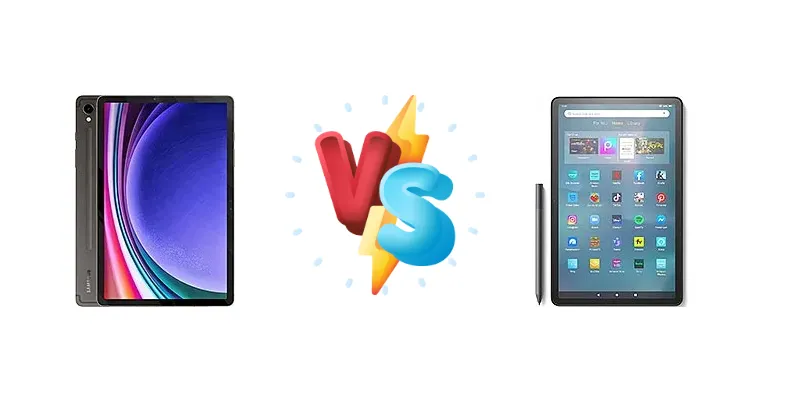
The tablet market offers a wide spectrum of choices, from premium flagships to budget-friendly options. This comparison pits the Samsung Galaxy Tab S9, powered by the cutting-edge Snapdragon 8 Gen 2, against the Amazon Fire Max 11, a more affordable device utilizing the Mediatek MT8188J. We'll dissect their core components to determine which tablet best suits your needs and budget.
🏆 Quick Verdict
For users prioritizing performance, especially demanding tasks like gaming or content creation, the Samsung Galaxy Tab S9 is the clear winner. Its Snapdragon 8 Gen 2 chipset delivers significantly faster processing speeds. However, the Amazon Fire Max 11 provides a compelling value proposition for casual users focused on media consumption and basic productivity.
| Network |
|---|
| 2G bands | GSM 850 / 900 / 1800 / 1900 | N/A |
| 3G bands | HSDPA 850 / 900 / 1700(AWS) / 1900 / 2100 | - |
| 4G bands | 1, 2, 3, 4, 5, 7, 8, 12, 13, 17, 20, 25, 26, 28, 32, 38, 40, 41, 66 | - |
| 5G bands | 1, 3, 5, 7, 8, 20, 28, 38, 40, 41, 66, 77, 78 SA/NSA/Sub6 | - |
| EDGE | - | No |
| GPRS | - | No |
| Speed | HSPA, LTE, 5G - cellular model only | - |
| Technology | GSM / HSPA / LTE / 5G | No cellular connectivity |
| Launch |
|---|
| Announced | 2023, July 26 | 2023, May 23 |
| Status | Available. Released 2023, August 11 | Available. Released 2023, May 23 |
| Body |
|---|
| Build | Glass front, aluminum frame, aluminum back | - |
| Dimensions | 254.3 x 165.8 x 5.9 mm (10.01 x 6.53 x 0.23 in) | 259.1 x 163.7 x 7.5 mm (10.20 x 6.44 x 0.30 in) |
| SIM | Nano-SIM + eSIM (cellular model only) | No |
| Weight | 498 g (1.10 lb) | 490 g (1.08 lb) |
| Display |
|---|
| Protection | Corning Gorilla Glass | - |
| Resolution | 1600 x 2560 pixels, 16:10 ratio (~274 ppi density) | 2000 x 1200 pixels, 5:3 ratio (~212 ppi density) |
| Size | 11.0 inches, 350.9 cm2 (~83.2% screen-to-body ratio) | 11.0 inches, 344.4 cm2 (~81.2% screen-to-body ratio) |
| Type | Dynamic AMOLED 2X, 120Hz, HDR10+ | IPS LCD |
| Platform |
|---|
| CPU | Octa-core (1x3.36 GHz Cortex-X3 & 2x2.8 GHz Cortex-A715 & 2x2.8 GHz Cortex-A710 & 3x2.0 GHz Cortex-A510) | Octa-core (2x2.2 GHz Cortex-A78 & 6x2.0 GHz Cortex-A55) |
| Chipset | Qualcomm SM8550-AC Snapdragon 8 Gen 2 (4 nm) | Mediatek MT8188J |
| GPU | Adreno 740 | Mali-G57 MC2 |
| OS | Android 13, up to 4 major Android upgrades, One UI 6 | Android 11, Fire OS 8 |
| Memory |
|---|
| Card slot | microSDXC (dedicated slot) | microSDXC (dedicated slot) |
| Internal | 128GB 8GB RAM, 256GB 8GB RAM, 256GB 12GB RAM | 64GB 4GB RAM, 128GB 4GB RAM |
| Main Camera |
|---|
| Features | LED flash, HDR, panorama | - |
| Single | 13 MP, f/2.0, 26mm (wide), 1/3.4", 1.0µm, AF | 8 MP, AF |
| Video | 4K@30fps, 1080p@30fps | 1080p |
| Selfie camera |
|---|
| Features | HDR | - |
| Single | 12 MP, f/2.4, 120˚ (ultrawide) | 8 MP |
| Video | 4K@30fps, 1080p@30fps | 1080p |
| Sound |
|---|
| 35mm jack | No | No |
| Loudspeaker | Yes, with stereo speakers (4 speakers) | Yes, with stereo speakers |
| Comms |
|---|
| Bluetooth | 5.3, A2DP, LE | 5.3, A2DP, LE |
| NFC | No | No |
| Positioning | GPS, GLONASS, BDS, GALILEO - cellular model only | No |
| Radio | No | No |
| USB | USB Type-C 3.2, magnetic connector | USB Type-C 2.0, OTG, magnetic accessory connector |
| WLAN | Wi-Fi 802.11 a/b/g/n/ac/6e, tri-band, Wi-Fi Direct | Wi-Fi 802.11 a/b/g/n/ac/6, dual-band |
| Features |
|---|
| Sensors | Fingerprint (under display, optical), accelerometer, gyro, proximity, compass | Fingerprint (side-mounted), accelerometer, proximity (accessories only) |
| Battery |
|---|
| Charging | 45W wired | 15W wired |
| Type | Li-Po 8400 mAh | Li-Ion |
| Misc |
|---|
| Colors | Beige, Graphite | Gray |
| Models | SM-X710, SM-X716B | KFSNWI |
| Price | About 500 EUR | About 270 EUR |
| SAR EU | 0.66 W/kg (body) | - |
Samsung Galaxy Tab S9
- Exceptional performance with Snapdragon 8 Gen 2
- Faster 45W charging
- Likely superior display quality
- Higher price point
- Potentially shorter battery life due to power-hungry chipset (though mitigated by efficiency)
Amazon Fire Max 11
- Significantly more affordable
- Decent performance for basic tasks
- Potentially longer battery life due to less powerful chipset
- Slower Mediatek chipset
- Slower 15W charging
- Likely lower display quality
Display Comparison
While display specifications aren't provided for the Fire Max 11, the Tab S9 benefits from a premium panel likely featuring a high refresh rate and excellent color accuracy. The core difference lies in the processing power driving the display; the Snapdragon 8 Gen 2 ensures smooth animations and responsiveness, even with graphically intensive content. The Fire Max 11, with its less powerful chipset, may exhibit some lag or stuttering in similar scenarios. The Tab S9's potential for LTPO technology (based on Samsung's typical implementation) would further enhance efficiency by dynamically adjusting the refresh rate.
Camera Comparison
Given the context data, a detailed camera comparison is limited. However, it's reasonable to assume the Tab S9 will feature a more sophisticated camera system with larger sensors and advanced image processing capabilities, typical of Samsung's flagship devices. The Fire Max 11 likely prioritizes cost savings in this area. The Snapdragon 8 Gen 2’s integrated ISP (Image Signal Processor) also contributes to superior image quality and faster processing speeds for photos and videos on the Tab S9.
Performance
The performance gap between these tablets is substantial. The Samsung Galaxy Tab S9’s Qualcomm SM8550-AC Snapdragon 8 Gen 2 (4nm) is a flagship-tier chipset featuring an octa-core CPU with a prime Cortex-X3 core clocked at 3.36 GHz. This architecture, built on a 4nm process, delivers exceptional performance and power efficiency. In contrast, the Amazon Fire Max 11 utilizes the Mediatek MT8188J, an octa-core CPU with a configuration of 2x2.2 GHz Cortex-A78 and 6x2.0 GHz Cortex-A55 cores. The A78 cores, while capable, are a generation behind the Cortex-X3 and the 4nm process node provides a significant advantage to the Snapdragon in terms of sustained performance and thermal management. This translates to faster app loading times, smoother multitasking, and a more responsive user experience on the Tab S9.
Battery Life
The Samsung Galaxy Tab S9 supports 45W wired charging, enabling significantly faster charging speeds compared to the Amazon Fire Max 11’s 15W wired charging. While battery capacity isn't specified for either device, the faster charging of the Tab S9 minimizes downtime. The Snapdragon 8 Gen 2’s 4nm process also contributes to better power efficiency, potentially offsetting a smaller battery capacity with longer real-world usage. The Fire Max 11, while potentially having a larger battery, will take considerably longer to fully charge.
Buying Guide
Buy the Samsung Galaxy Tab S9 if you need a tablet capable of handling intensive applications, demanding games, and multitasking without compromise. Its superior processing power and faster charging are ideal for professionals and power users. Buy the Amazon Fire Max 11 if you prefer a more affordable tablet for streaming videos, browsing the web, reading ebooks, and light productivity tasks. It’s a great choice for families or individuals on a tighter budget.
Frequently Asked Questions
❓ Will the Amazon Fire Max 11 struggle with graphically demanding games like Genshin Impact?
Yes, the Mediatek MT8188J chipset in the Fire Max 11 is not designed for high-end gaming. While it can handle simpler games, you'll likely experience significant frame rate drops and lag in more demanding titles like Genshin Impact. The Samsung Galaxy Tab S9, with its Snapdragon 8 Gen 2, is far better equipped for a smooth gaming experience.
❓ Is the 15W charging on the Fire Max 11 slow enough to be a major inconvenience?
Compared to the 45W charging on the Tab S9, 15W is considerably slower. Expect a full charge to take several hours. This is less of an issue if you primarily use the tablet at home and charge it overnight, but it can be inconvenient if you need a quick top-up before traveling.
❓ How does the Snapdragon 8 Gen 2 benefit multitasking on the Tab S9?
The Snapdragon 8 Gen 2's powerful CPU and ample RAM (likely LPDDR5x) allow the Tab S9 to seamlessly switch between multiple apps without lag or slowdown. The Cortex-X3 prime core handles demanding tasks efficiently, ensuring a smooth multitasking experience even with resource-intensive applications open simultaneously.