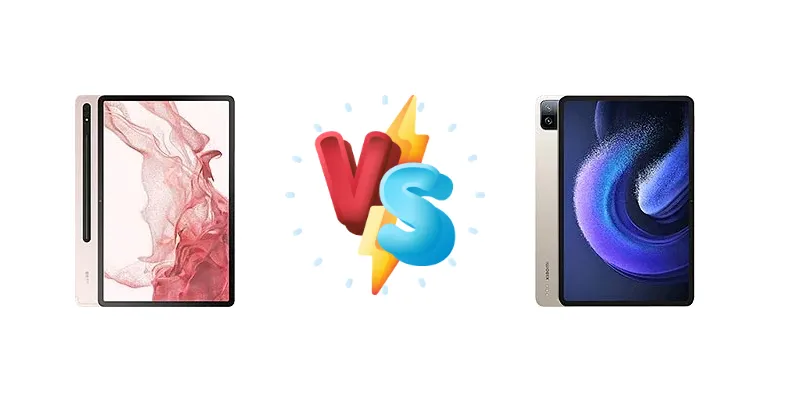
The Android tablet market is heating up, and two contenders are vying for the top spot: the Samsung Galaxy Tab S8+ and the Xiaomi Pad 6 Pro. Both offer premium features and impressive performance, but which one is the better choice for your needs? Let's dive into a detailed comparison.
🏆 Quick Verdict
The Xiaomi Pad 6 Pro edges out the Tab S8+ thanks to its faster charging, slightly improved performance, and competitive pricing. However, the Tab S8+ boasts a superior display and S Pen support, making it a strong contender for creative users. Ultimately, the best choice depends on your priorities.
| Network |
|---|
| 2G bands | GSM 850 / 900 / 1800 / 1900 | N/A |
| 3G bands | HSDPA 850 / 900 / 1700(AWS) / 1900 / 2100 | N/A |
| 4G bands | LTE | - |
| 5G bands | SA/NSA | - |
| EDGE | - | N/A |
| GPRS | - | N/A |
| Speed | HSPA, LTE, 5G - cellular model only | - |
| Technology | GSM / HSPA / LTE / 5G | No cellular connectivity |
| Launch |
|---|
| Announced | 2022, February 09 | 2023, April 18 |
| Status | Available. Released 2022, April 14 | Available. Released 2023, April 30 |
| Body |
|---|
| Build | - | Glass front (Gorilla Glass 3), aluminum frame, aluminum back |
| Dimensions | 285 x 185 x 5.7 mm (11.22 x 7.28 x 0.22 in) | 254 x 165.2 x 6.5 mm (10.0 x 6.50 x 0.26 in) |
| SIM | Nano-SIM (cellular model only) | No |
| Weight | 567 g (Wi-Fi), 572 g (5G) (1.25 lb) | 490 g (1.08 lb) |
| | Stylus, 6.2ms latency (Bluetooth integration, accelerometer, gyro) | Stylus support (magnetic) |
| Display |
|---|
| Protection | Corning Gorilla Glass 5 | Corning Gorilla Glass 3 |
| Resolution | 1752 x 2800 pixels, 16:10 ratio (~266 ppi density) | 1800 x 2880 pixels, 16:10 ratio (~309 ppi density) |
| Size | 12.4 inches, 446.1 cm2 (~84.6% screen-to-body ratio) | 11.0 inches, 350.9 cm2 (~83.6% screen-to-body ratio) |
| Type | Super AMOLED, 120Hz, HDR10+ | IPS LCD, 1B colors, 144Hz, HDR10, Dolby Vision, 550 nits |
| Platform |
|---|
| CPU | Octa-core (1x3.00 GHz Cortex-X2 & 3x2.50 GHz Cortex-A710 & 4x1.80 GHz Cortex-A510) | Octa-core (1x3.19 GHz Cortex-X2 & 3x2.75 GHz Cortex-A710 & 4x1.80 GHz Cortex-A510) |
| Chipset | Qualcomm SM8450 Snapdragon 8 Gen 1 (4 nm) | Qualcomm SM8475 Snapdragon 8+ Gen 1 (4 nm) |
| GPU | Adreno 730 | Adreno 730 |
| OS | Android 12, up to 4 major Android upgrades, One UI 6.1.1 | Android 13, MIUI 14 |
| Memory |
|---|
| Card slot | microSDXC (dedicated slot) | No |
| Internal | 128GB 8GB RAM, 256GB 8GB RAM, 256GB 12GB RAM, 512GB 8GB RAM, 512GB 16GB RAM | 128GB 8GB RAM, 256GB 8GB RAM, 256GB 12GB RAM, 512GB 12GB RAM |
| | UFS | UFS 3.1 |
| Main Camera |
|---|
| Dual | 13 MP, f/2.0, 26mm (wide), 1/3.4", 1.0µm, AF
6 MP, f/2.2, (ultrawide) | 50 MP, f/1.8, (wide), 1/2.76", 0.64µm, PDAF
Auxiliary lens |
| Features | LED flash, HDR, panorama | Dual-LED flash, HDR, panorama |
| Video | 4K@30/60fps, 1080p@30fps | 4K@30/60fps, 1080p@30/60fps |
| Selfie camera |
|---|
| Dual | 12 MP, f/2.4, 120˚ (ultrawide) | - |
| Features | HDR | - |
| Single | - | 20 MP, f/2.2, (wide), 1/3.4", 0.8µm |
| Video | 4K@30/60fps, 1080p@30fps | 1080p@30/60fps |
| Sound |
|---|
| 3.5mm jack | No | No |
| 35mm jack | No | No |
| Loudspeaker | Yes, with stereo speakers (4 speakers) | Yes, with stereo speakers (4 speakers) |
| | Tuned by AKG | 24-bit/192kHz audio |
| Comms |
|---|
| Bluetooth | 5.2, A2DP, LE | 5.3, A2DP, LE |
| NFC | No | No |
| Positioning | GPS, GLONASS, BDS, GALILEO - cellular model only | No |
| Radio | No | No |
| USB | USB Type-C 3.2, magnetic connector | USB Type-C 3.2, accessory connector |
| WLAN | Wi-Fi 802.11 a/b/g/n/ac/6e, dual-band, Wi-Fi Direct | Wi-Fi 802.11 a/b/g/n/a/6e, dual-band, Wi-Fi Direct |
| Features |
|---|
| Sensors | Fingerprint (under display, optical), accelerometer, gyro, proximity, compass | Accelerometer, gyro, proximity (accessories only) |
| | Wireless Samsung DeX | - |
| Battery |
|---|
| Charging | 45W wired, 100% in 82 min | 67W wired, PD3.0, QC4, 100% in 1 hour |
| Type | Li-Po 10090 mAh | Li-Po 8600 mAh |
| Misc |
|---|
| Colors | Graphite, Silver, Pink Gold | Black, Blue, Gold |
| Models | SM-X800, SM-X806, SM-X806B, SM-X806U, SM-X806N | 23046RP50C |
| Price | About 950 EUR | About 330 EUR |
| SAR EU | 0.68 W/kg (body) | - |
Samsung Galaxy Tab S8+
- Superior Display (AMOLED)
- S Pen Support
- Versatile Camera System
- Samsung Ecosystem Integration
- Slower Charging
- Higher Price
- Slightly Less Powerful Chip
Xiaomi Pad 6 Pro
- Faster Charging (67W)
- Slightly Better Performance (Snapdragon 8+ Gen 1)
- Competitive Price
- High Refresh Rate Display (144Hz)
- LCD Display (Not as vibrant as AMOLED)
- No Stylus Support
- Less Versatile Camera System
Display Comparison
The Samsung Galaxy Tab S8+ features a stunning 12.4-inch Super AMOLED display with a 120Hz refresh rate, delivering vibrant colors and exceptional clarity. The Xiaomi Pad 6 Pro boasts an 11-inch LCD display with a 144Hz refresh rate, offering smooth visuals. While the Xiaomi Pad 6 Pro has a higher refresh rate, the Samsung's AMOLED technology provides a richer, more immersive viewing experience.
Camera Comparison
The Samsung Galaxy Tab S8+ has a triple-camera system (13MP wide, 6MP ultrawide, 5MP depth) and a 12MP front-facing camera. The Xiaomi Pad 6 Pro features a 50MP wide camera and an 8MP front-facing camera. The Xiaomi Pad 6 Pro's main camera captures more detailed photos, while the Tab S8+ offers more versatility with its ultrawide lens.
Performance
Both tablets are powered by Qualcomm Snapdragon chips, but the Xiaomi Pad 6 Pro utilizes the Snapdragon 8+ Gen 1, a slightly faster and more efficient chip than the Tab S8+'s Snapdragon 8 Gen 1. This translates to marginally better performance in demanding tasks and games. However, both offer flagship-level performance.
Battery Life
The Samsung Galaxy Tab S8+ has a 10,090 mAh battery, while the Xiaomi Pad 6 Pro has an 8,720 mAh battery. However, the Xiaomi Pad 6 Pro's 67W fast charging significantly outperforms the Tab S8+'s 45W charging, allowing it to charge much faster.
Buying Guide
Who should buy the Samsung Galaxy Tab S8+? Creative professionals and users who value a top-tier display and stylus support will appreciate the Tab S8+. Who should buy the Xiaomi Pad 6 Pro? Budget-conscious users seeking excellent performance and fast charging will find the Pad 6 Pro a compelling option.
Frequently Asked Questions
❓ Does the Xiaomi Pad 6 Pro support a stylus?
No, the Xiaomi Pad 6 Pro does not officially support a stylus. While some third-party styluses may work, it doesn't offer the same seamless experience as the S Pen on the Tab S8+.
❓ Which tablet is better for gaming?
Both tablets offer excellent gaming performance. The Xiaomi Pad 6 Pro's slightly faster chip and higher refresh rate display give it a marginal edge, but the Tab S8+'s superior cooling system might prevent throttling during extended gaming sessions.