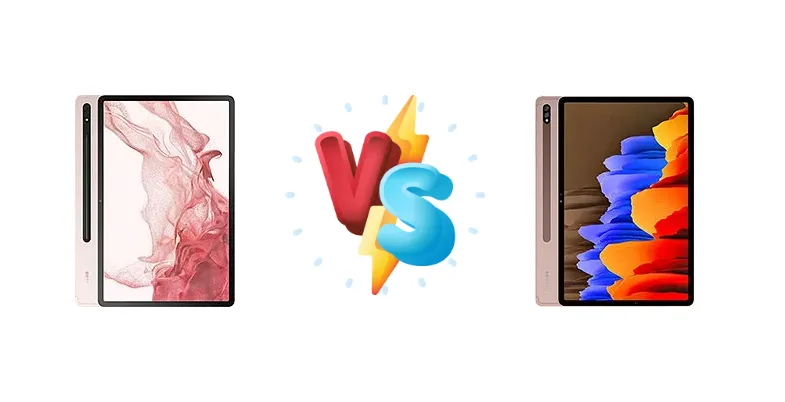
Choosing between the Samsung Galaxy Tab S8+ and the Tab S7+ can be tough – both are excellent Android tablets. This comprehensive comparison breaks down the key differences to help you decide which one best suits your needs and budget. We'll cover everything from display quality to performance and battery life.
🏆 Quick Verdict
The Galaxy Tab S8+ offers a significant performance boost thanks to its Snapdragon 8 Gen 1 chipset and a slightly improved display. However, the Tab S7+ remains a compelling option, especially if you're looking for a more budget-friendly high-quality tablet. The S8+ is the clear winner for power users.
| Network |
|---|
| 2G bands | GSM 850 / 900 / 1800 / 1900 | GSM 850 / 900 / 1800 / 1900 |
| 3G bands | HSDPA 850 / 900 / 1700(AWS) / 1900 / 2100 | HSDPA 850 / 900 / 1700(AWS) / 1900 / 2100 |
| 4G bands | LTE | 1, 2, 3, 4, 5, 7, 8, 12, 13, 20, 25, 26, 28, 38, 40, 41, 66 |
| 5G bands | SA/NSA | 1, 3, 5, 7, 8, 20, 28, 40, 77, 78 SA/NSA |
| EDGE | - | No |
| GPRS | - | Class 10 |
| Speed | HSPA, LTE, 5G - cellular model only | HSPA 42.2/5.76 Mbps, LTE (6CA) Cat20 2000/150 Mbps, 5G - cellular model only |
| Technology | GSM / HSPA / LTE / 5G | GSM / HSPA / LTE / 5G |
| Launch |
|---|
| Announced | 2022, February 09 | 2020, August 05 |
| Status | Available. Released 2022, April 14 | Available. Released 2020, August 21 |
| Body |
|---|
| Build | - | Glass front, aluminum back, aluminum frame |
| Dimensions | 285 x 185 x 5.7 mm (11.22 x 7.28 x 0.22 in) | 285 x 185 x 5.7 mm (11.22 x 7.28 x 0.22 in) |
| SIM | Nano-SIM (cellular model only) | Nano-SIM (cellular model only) |
| Weight | 567 g (Wi-Fi), 572 g (5G) (1.25 lb) | 575 g (1.27 lb) |
| | Stylus, 6.2ms latency (Bluetooth integration, accelerometer, gyro) | Stylus support, 5.6ms latency (Bluetooth integration, accelerometer, gyro) |
| Display |
|---|
| Protection | Corning Gorilla Glass 5 | - |
| Resolution | 1752 x 2800 pixels, 16:10 ratio (~266 ppi density) | 1752 x 2800 pixels, 16:10 ratio (~266 ppi density) |
| Size | 12.4 inches, 446.1 cm2 (~84.6% screen-to-body ratio) | 12.4 inches, 446.1 cm2 (~84.6% screen-to-body ratio) |
| Type | Super AMOLED, 120Hz, HDR10+ | Super AMOLED, 120Hz, HDR10+ |
| Platform |
|---|
| CPU | Octa-core (1x3.00 GHz Cortex-X2 & 3x2.50 GHz Cortex-A710 & 4x1.80 GHz Cortex-A510) | Octa-core (1x3.09 GHz Cortex-A77 & 3x2.42 GHz Cortex-A77 & 4x1.80 GHz Cortex-A55 |
| Chipset | Qualcomm SM8450 Snapdragon 8 Gen 1 (4 nm) | Qualcomm SM8250 Snapdragon 865 5G+ (7 nm+) |
| GPU | Adreno 730 | Adreno 650 |
| OS | Android 12, up to 4 major Android upgrades, One UI 6.1.1 | Android 10, upgradable to Android 13, One UI 5.1 |
| Memory |
|---|
| Call records | - | 20 dialed, 20 received, 20 missed calls |
| Card slot | microSDXC (dedicated slot) | microSDXC (dedicated slot) |
| Internal | 128GB 8GB RAM, 256GB 8GB RAM, 256GB 12GB RAM, 512GB 8GB RAM, 512GB 16GB RAM | 128GB 6GB RAM, 256GB 8GB RAM, 512GB 8GB RAM |
| Phonebook | - | 500 entries |
| | UFS | UFS 3.0 |
| Main Camera |
|---|
| Dual | 13 MP, f/2.0, 26mm (wide), 1/3.4", 1.0µm, AF
6 MP, f/2.2, (ultrawide) | 13 MP, f/2.0, 26mm (wide), 1/3.4", 1.0µm, AF
5 MP, f/2.2, 12mm (ultrawide), 1.12µm |
| Features | LED flash, HDR, panorama | HDR, panorama |
| Single | - | 1.3 MP |
| Video | 4K@30/60fps, 1080p@30fps | 4K@30fps |
| Selfie camera |
|---|
| Dual | 12 MP, f/2.4, 120˚ (ultrawide) | - |
| Features | HDR | - |
| Single | - | 8 MP, f/2.0, 26mm (wide), 1/4.0", 1.12µm |
| Video | 4K@30/60fps, 1080p@30fps | 1080p@30fps |
| Sound |
|---|
| 3.5mm jack | No | No |
| 35mm jack | No | No |
| Loudspeaker | Yes, with stereo speakers (4 speakers) | Yes, with stereo speakers (4 speakers) |
| | Tuned by AKG | Tuned by AKG |
| Comms |
|---|
| Bluetooth | 5.2, A2DP, LE | 5.0, A2DP, LE |
| NFC | No | No |
| Positioning | GPS, GLONASS, BDS, GALILEO - cellular model only | GPS, GLONASS, BDS, GALILEO - cellular model only |
| Radio | No | No |
| USB | USB Type-C 3.2, magnetic connector | USB Type-C 3.2, magnetic connector |
| WLAN | Wi-Fi 802.11 a/b/g/n/ac/6e, dual-band, Wi-Fi Direct | Wi-Fi 802.11 a/b/g/n/ac/6, dual-band, Wi-Fi Direct |
| Features |
|---|
| Games | - | Yes |
| Java | - | No |
| Messaging | - | SMS, MMS |
| Sensors | Fingerprint (under display, optical), accelerometer, gyro, proximity, compass | Fingerprint (under display, optical), accelerometer, gyro, proximity, compass |
| | Wireless Samsung DeX | Samsung DeX |
| Battery |
|---|
| Charging | 45W wired, 100% in 82 min | 45W wired |
| Stand-by | - | Up to 200 h |
| Talk time | - | Up to 8 h |
| Type | Li-Po 10090 mAh | Li-Po 10090 mAh |
| Misc |
|---|
| Colors | Graphite, Silver, Pink Gold | Mystic Black, Mystic Bronze, Mystic Silver, Phantom Navy |
| Models | SM-X800, SM-X806, SM-X806B, SM-X806U, SM-X806N | SM-T970, SM-T976B, SM-T975 |
| Price | About 950 EUR | About 900 EUR |
| SAR | - | 1.16 W/kg (body) |
| SAR EU | 0.68 W/kg (body) | 1.06 W/kg (body) |
| Tests |
|---|
| Display | - |
Contrast ratio: Infinite (nominal) |
| Loudspeaker | - |
-23.1 LUFS (Very good)
|
| Performance | - |
AnTuTu: 566786 (v8)
GeekBench: 2690 (v5.1)
GFXBench: 24fps (ES 3.1 onscreen) |
Samsung Galaxy Tab S8+
- Significantly faster performance
- Improved display brightness and color accuracy
- Better cameras
- S Pen included
- Slightly larger battery
- Higher price
- Can get warm under heavy load
Samsung Galaxy Tab S7+
- More affordable
- Excellent display quality
- Solid performance for everyday tasks
- S Pen included
- Slim and lightweight design
- Older chipset shows its age
- Less impressive camera system
- Lower peak brightness
Display Comparison
The Galaxy Tab S8+ boasts a slightly brighter display (estimated 600 nits vs 484 nits on the S7+) and improved color accuracy. Both feature a stunning 120Hz refresh rate and excellent contrast, but the S8+'s subtle enhancements give it a slight edge. The S7+’s ‘infinite’ contrast ratio is a marketing term, but the display is still excellent.
Camera Comparison
The Tab S8+ features improved front and rear cameras, offering better image quality and video recording capabilities. While neither tablet is a primary photography device, the S8+’s cameras are a noticeable step up, particularly for video calls and content creation. Both have decent rear cameras for quick snapshots.
Performance
The Snapdragon 8 Gen 1 in the Tab S8+ is a substantial upgrade over the Snapdragon 865 5G+ in the Tab S7+. Expect noticeably faster app loading times, smoother multitasking, and better performance in graphically intensive games. The S8+ handles demanding tasks with ease, while the S7+ remains capable but shows its age in comparison.
Battery Life
Both tablets offer all-day battery life under typical usage. The Tab S8+'s larger battery capacity (10,090 mAh vs 7,700 mAh) provides a slight advantage, but real-world battery performance is comparable. Both support 45W fast charging.
Buying Guide
Who should buy the Samsung Galaxy Tab S8+? Power users, creatives, and anyone needing the best possible performance for demanding tasks like gaming, video editing, and multitasking. Who should buy the Samsung Galaxy Tab S7+? Users seeking a premium Android tablet experience at a more accessible price point, prioritizing a great display and solid performance for everyday use.
Frequently Asked Questions
❓ Is the Galaxy Tab S8+ worth the upgrade from the Tab S7+?
If you prioritize performance and the best possible display, then yes. However, if you're happy with the S7+'s performance and want to save money, it's still a great tablet.
❓ Does the S Pen come included with both tablets?
Yes, both the Galaxy Tab S8+ and the Galaxy Tab S7+ include an S Pen in the box.