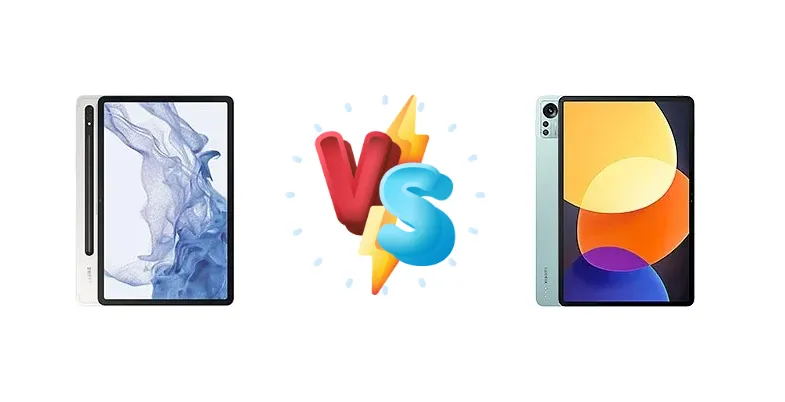
The Android tablet market is heating up, with Samsung and Xiaomi offering compelling high-end options. The Samsung Galaxy Tab S8, powered by the latest Snapdragon 8 Gen 1, faces off against the Xiaomi Pad 5 Pro 12.4, utilizing the proven Snapdragon 870. This comparison dissects the key differences to determine which tablet delivers the best experience for demanding users.
🏆 Quick Verdict
For users prioritizing raw processing power and future-proofing, the Samsung Galaxy Tab S8 emerges as the winner. Its Snapdragon 8 Gen 1 offers a noticeable performance edge, despite the Xiaomi Pad 5 Pro 12.4’s faster charging. However, the Pad 5 Pro 12.4 presents a strong value proposition with excellent performance for the price.
| Network |
|---|
| 2G bands | GSM 850 / 900 / 1800 / 1900 | N/A |
| 3G bands | HSDPA 850 / 900 / 1700(AWS) / 1900 / 2100 | N/A |
| 4G bands | LTE | N/A |
| 5G bands | SA/NSA | - |
| EDGE | - | No |
| GPRS | - | No |
| Speed | HSPA, LTE, 5G - cellular model only | - |
| Technology | GSM / HSPA / LTE / 5G | No cellular connectivity |
| Launch |
|---|
| Announced | 2022, February 09 | 2022, August 11 |
| Status | Available. Released 2022, March 22 | Available. Released 2022, August 24 |
| Body |
|---|
| Build | - | Glass front (Gorilla Glass 3), aluminum frame, aluminum back |
| Dimensions | 253.8 x 165.3 x 6.3 mm (9.99 x 6.51 x 0.25 in) | 285 x 185.2 x 6.7 mm (11.22 x 7.29 x 0.26 in) |
| SIM | Nano-SIM (cellular model only) | No |
| Weight | 503 g (Wi-Fi), 507 g (5G) (1.11 lb) | 620 g (1.37 lb) |
| | Stylus, 6.2ms latency (Bluetooth integration, accelerometer, gyro) | Stylus support (magnetic) |
| Display |
|---|
| Protection | Corning Gorilla Glass 5 | Corning Gorilla Glass 3 |
| Resolution | 1600 x 2560 pixels, 16:10 ratio (~274 ppi density) | 1600 x 2560 pixels, 16:10 ratio (~243 ppi density) |
| Size | 11.0 inches, 350.9 cm2 (~83.6% screen-to-body ratio) | 12.4 inches, 445.8 cm2 (~84.5% screen-to-body ratio) |
| Type | TFT LCD, 120Hz | IPS LCD, 120Hz, HDR10, Dolby Vision, 500 nits |
| Platform |
|---|
| CPU | Octa-core (1x3.00 GHz Cortex-X2 & 3x2.50 GHz Cortex-A710 & 4x1.80 GHz Cortex-A510) | Octa-core (1x3.2 GHz Kryo 585 & 3x2.42 GHz Kryo 585 & 4x1.80 GHz Kryo 585) |
| Chipset | Qualcomm SM8450 Snapdragon 8 Gen 1 (4 nm) | Qualcomm SM8250-AC Snapdragon 870 5G (7 nm) |
| GPU | Adreno 730 | Adreno 650 |
| OS | Android 12, up to 4 major Android upgrades, One UI 6.1.1 | Android 12, MIUI Pad 13 |
| Memory |
|---|
| Card slot | microSDXC (dedicated slot) | No |
| Internal | 128GB 8GB RAM, 256GB 8GB RAM, 256GB 12GB RAM | 128GB 6GB RAM, 256GB 8GB RAM, 512GB 12GB RAM |
| | UFS | UFS 3.1 |
| Main Camera |
|---|
| Dual | 13 MP, f/2.0, 26mm (wide), 1/3.4", 1.0µm, AF
6 MP, f/2.2, (ultrawide) | 50 MP, f/1.8, 1/2.76", 0.64µm, PDAF
Auxiliary lens |
| Features | LED flash, HDR, panorama | Color spectrum sensor, LED flash, panorama, HDR |
| Video | 4K@30/60fps, 1080p@30fps | 4K@30fps, 1080p@30/60fps |
| Selfie camera |
|---|
| Dual | 12 MP, f/2.4, 120˚ (ultrawide) | - |
| Features | HDR | - |
| Single | - | 20 MP, f/2.2, 1/3.4", 0.8µm |
| Video | 4K@30/60fps, 1080p@30fps | 1080p@30/60fps |
| Sound |
|---|
| 3.5mm jack | No | No |
| 35mm jack | No | No |
| Loudspeaker | Yes, with stereo speakers (4 speakers) | Yes, with stereo speakers (4 speakers) |
| | Tuned by AKG | - |
| Comms |
|---|
| Bluetooth | 5.2, A2DP, LE | 5.2, A2DP, LE |
| NFC | No | No |
| Positioning | GPS, GLONASS, BDS, GALILEO - cellular model only | No |
| Radio | No | No |
| USB | USB Type-C 3.2, magnetic connector | USB Type-C 3.2 video output |
| WLAN | Wi-Fi 802.11 a/b/g/n/ac/6e, dual-band, Wi-Fi Direct | Wi-Fi 802.11 a/b/g/n/ac/6, dual-band, Wi-Fi Direct |
| Features |
|---|
| Sensors | Fingerprint (side-mounted), accelerometer, gyro, proximity, compass | Accelerometer, gyro, proximity, compass |
| | Wireless Samsung DeX | - |
| Battery |
|---|
| Charging | 45W wired, 100% in 80 min | 67W wired, PD3.0, QC4, 60% in 36 min, 100% in 68 min |
| Type | Li-Po 8000 mAh | Li-Po 10000 mAh |
| Misc |
|---|
| Colors | Graphite, Silver, Pink Gold | Black, Silver, Green |
| Models | SM-X700, SM-X706, SM-X706B, SM-X706U, SM-X706N | - |
| Price | About 350 EUR | About 400 EUR |
| SAR EU | 0.87 W/kg (body) | - |
Samsung Galaxy Tab S8
- Superior processing power with Snapdragon 8 Gen 1
- Potentially better display quality (AMOLED likely)
- Faster RAM (likely LPDDR5X)
- Slower charging speed (45W vs 67W)
- Potentially higher price
Xiaomi Pad 5 Pro 12.4
- Significantly faster charging (67W)
- Excellent performance for the price
- Potentially better battery life due to efficient chipset
- Less powerful processor (Snapdragon 870)
- Potentially lower display quality (IPS LCD likely)
Display Comparison
While both tablets feature large 12.4-inch displays, detailed display specs are missing. However, given Samsung’s history with AMOLED panels, the Tab S8 likely boasts superior color accuracy and contrast. The Xiaomi Pad 5 Pro 12.4, while potentially using an IPS LCD, benefits from its larger size. The Snapdragon 8 Gen 1 in the Tab S8 may support higher refresh rate displays, potentially offering smoother scrolling and animations, but this is unconfirmed. Bezels are likely comparable, focusing on maximizing screen real estate.
Camera Comparison
Detailed camera specifications are unavailable. However, given the tablet form factor, camera quality is less critical than on smartphones. Both devices likely feature capable main sensors for casual photography and video conferencing. The Xiaomi Pad 5 Pro 12.4 may prioritize camera features given Xiaomi’s recent focus on imaging, but without specific sensor details, it’s difficult to assess a clear advantage. The absence of detailed information suggests neither tablet is positioned as a photography powerhouse.
Performance
The core difference lies in the chipsets. The Samsung Galaxy Tab S8’s Snapdragon 8 Gen 1 (4nm) represents a significant leap in performance and efficiency over the Xiaomi Pad 5 Pro 12.4’s Snapdragon 870 (7nm). The 8 Gen 1’s Cortex-X2 prime core, clocked at 3.00 GHz, provides a substantial single-core performance boost, crucial for responsive UI and demanding applications. While the 870’s Kryo 585 cores are capable, the 8 Gen 1’s architecture offers improved multi-core performance and GPU capabilities. The Tab S8 likely utilizes faster LPDDR5X RAM, further enhancing performance. The 4nm process of the 8 Gen 1 also translates to better thermal management, potentially reducing throttling during sustained workloads.
Battery Life
The Xiaomi Pad 5 Pro 12.4 significantly outperforms the Tab S8 in charging speed. Its 67W wired charging, supporting PD3.0 and QC4, can reach 60% in just 36 minutes and 100% in 68 minutes. The Tab S8’s 45W charging takes 80 minutes for a full charge. While battery capacity is unknown for both, the faster charging of the Pad 5 Pro 12.4 mitigates any potential disadvantage from a smaller battery. The Snapdragon 870’s 7nm process also contributes to better power efficiency, potentially offsetting the Tab S8’s more powerful, but less efficient, chipset.
Buying Guide
Buy the Samsung Galaxy Tab S8 if you need the absolute best performance for demanding tasks like video editing, high-end gaming, or running multiple intensive applications simultaneously. Buy the Xiaomi Pad 5 Pro 12.4 if you prioritize a balance of performance, fast charging, and value, making it ideal for media consumption, note-taking, and everyday productivity without breaking the bank.
Frequently Asked Questions
❓ Will the Snapdragon 870 in the Xiaomi Pad 5 Pro 12.4 struggle with demanding games like Genshin Impact?
The Snapdragon 870 is a capable chip, and will run Genshin Impact, but you may need to lower graphics settings for a consistently smooth experience. The Tab S8’s Snapdragon 8 Gen 1 will handle these games at higher settings with less performance throttling.
❓ How much does the faster charging of the Xiaomi Pad 5 Pro 12.4 actually impact daily use?
The 67W charging is a game-changer for users who frequently use their tablet throughout the day. Being able to top up the battery quickly during short breaks minimizes downtime and ensures you’re always ready to go.
❓ Is the difference in performance between the Snapdragon 8 Gen 1 and 870 noticeable for everyday tasks like browsing and video streaming?
For basic tasks, the difference will be minimal. Both tablets offer a fluid experience. The Snapdragon 8 Gen 1’s advantage becomes apparent when multitasking, editing large files, or running graphically intensive applications.