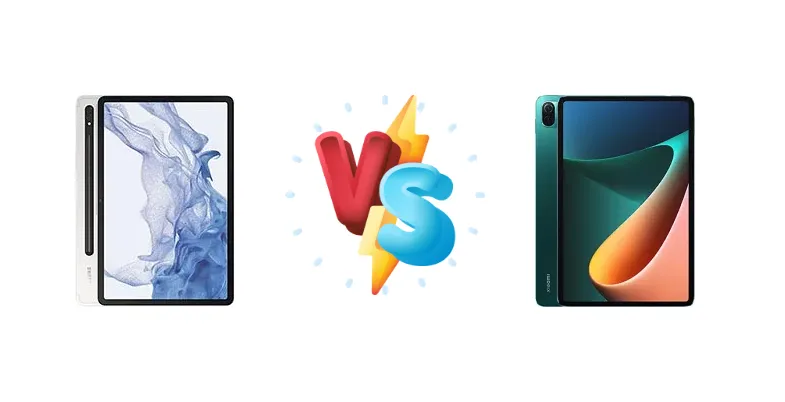
The Android tablet market is heating up, and two contenders are vying for your attention: the Samsung Galaxy Tab S8 and the Xiaomi Pad 5. Both offer impressive features and performance, but cater to slightly different needs and budgets. Let's dive into a detailed comparison to help you decide which one is right for you.
🏆 Quick Verdict
The Galaxy Tab S8 boasts a more powerful processor, a superior display, and S Pen support, making it the overall winner for power users. However, the Xiaomi Pad 5 offers incredible value with a stunning display and solid performance at a more accessible price point.
| Network |
|---|
| 2G bands | GSM 850 / 900 / 1800 / 1900 | N/A |
| 3G bands | HSDPA 850 / 900 / 1700(AWS) / 1900 / 2100 | N/A |
| 4G bands | LTE | - |
| 5G bands | SA/NSA | - |
| EDGE | - | N/A |
| GPRS | - | N/A |
| Speed | HSPA, LTE, 5G - cellular model only | - |
| Technology | GSM / HSPA / LTE / 5G | No cellular connectivity |
| Launch |
|---|
| Announced | 2022, February 09 | 2021, August 10 |
| Status | Available. Released 2022, March 22 | Available. Released 2021, August 10 |
| Body |
|---|
| Build | - | Glass front, aluminum frame, plastic back |
| Dimensions | 253.8 x 165.3 x 6.3 mm (9.99 x 6.51 x 0.25 in) | 254.7 x 166.3 x 6.9 mm (10.03 x 6.55 x 0.27 in) |
| SIM | Nano-SIM (cellular model only) | No |
| Weight | 503 g (Wi-Fi), 507 g (5G) (1.11 lb) | 511 g (1.13 lb) |
| | Stylus, 6.2ms latency (Bluetooth integration, accelerometer, gyro) | Stylus support (magnetic) |
| Display |
|---|
| Protection | Corning Gorilla Glass 5 | - |
| Resolution | 1600 x 2560 pixels, 16:10 ratio (~274 ppi density) | 1600 x 2560 pixels, 16:10 ratio (~274 ppi density) |
| Size | 11.0 inches, 350.9 cm2 (~83.6% screen-to-body ratio) | 11.0 inches, 350.9 cm2 (~82.8% screen-to-body ratio) |
| Type | TFT LCD, 120Hz | IPS LCD, 1B colors, 120Hz, HDR10, Dolby Vision |
| Platform |
|---|
| CPU | Octa-core (1x3.00 GHz Cortex-X2 & 3x2.50 GHz Cortex-A710 & 4x1.80 GHz Cortex-A510) | Octa-core (1x2.96 GHz Kryo 485 Gold & 3x2.42 GHz Kryo 485 Gold & 4x1.78 GHz Kryo 485 Silver) |
| Chipset | Qualcomm SM8450 Snapdragon 8 Gen 1 (4 nm) | Qualcomm Snapdragon 860 (7 nm) |
| GPU | Adreno 730 | Adreno 640 |
| OS | Android 12, up to 4 major Android upgrades, One UI 6.1.1 | Android 11, upgradable to Android 13, MIUI 14 |
| Memory |
|---|
| Card slot | microSDXC (dedicated slot) | No |
| Internal | 128GB 8GB RAM, 256GB 8GB RAM, 256GB 12GB RAM | 128GB 6GB RAM, 256GB 6GB RAM |
| | UFS | UFS 3.1 |
| Main Camera |
|---|
| Dual | 13 MP, f/2.0, 26mm (wide), 1/3.4", 1.0µm, AF
6 MP, f/2.2, (ultrawide) | - |
| Features | LED flash, HDR, panorama | Dual-LED flash, HDR, panorama |
| Single | - | 13 MP, f/2.0 |
| Video | 4K@30/60fps, 1080p@30fps | 4K@30fps, 1080p@30fps |
| Selfie camera |
|---|
| Dual | 12 MP, f/2.4, 120˚ (ultrawide) | - |
| Features | HDR | - |
| Single | - | 8 MP, f/2.0 |
| Video | 4K@30/60fps, 1080p@30fps | 1080p@30fps |
| Sound |
|---|
| 3.5mm jack | No | No |
| 35mm jack | No | No |
| Loudspeaker | Yes, with stereo speakers (4 speakers) | Yes, with stereo speakers (4 speakers) |
| | Tuned by AKG | 24-bit/192kHz audio |
| Comms |
|---|
| Bluetooth | 5.2, A2DP, LE | 5.0, A2DP, LE |
| NFC | No | No |
| Positioning | GPS, GLONASS, BDS, GALILEO - cellular model only | No |
| Radio | No | No |
| USB | USB Type-C 3.2, magnetic connector | USB Type-C |
| WLAN | Wi-Fi 802.11 a/b/g/n/ac/6e, dual-band, Wi-Fi Direct | Wi-Fi 802.11 a/b/g/n/ac, dual-band, Wi-Fi Direct |
| Features |
|---|
| Sensors | Fingerprint (side-mounted), accelerometer, gyro, proximity, compass | Accelerometer, gyro, proximity, compass |
| | Wireless Samsung DeX | - |
| Battery |
|---|
| Charging | 45W wired, 100% in 80 min | 33W wired, PD3.0 |
| Type | Li-Po 8000 mAh | Li-Po 8720 mAh |
| Misc |
|---|
| Colors | Graphite, Silver, Pink Gold | Cosmic Gray, Pearl White, Green |
| Models | SM-X700, SM-X706, SM-X706B, SM-X706U, SM-X706N | 21051182G, 21051182C |
| Price | About 350 EUR | About 350 EUR |
| SAR EU | 0.87 W/kg (body) | - |
| Tests |
|---|
| Display | - |
Contrast ratio: 1271:1 (nominal) |
| Loudspeaker | - |
-24.4 LUFS (Very good)
|
| Performance | - |
AnTuTu: 473819 (v8), 555079 (v9)
GeekBench: 2583 (v5.1)
GFXBench: 24fps (ES 3.1 onscreen) |
Samsung Galaxy Tab S8
- Superior Performance (Snapdragon 8 Gen 1)
- Excellent Display (likely higher resolution)
- S Pen Support
- Faster Charging (45W)
- Premium Build Quality
- Higher Price
- Can get warm under heavy load
Xiaomi Pad 5
- Exceptional Value for Money
- Stunning Display (1271:1 contrast)
- Smooth Performance (Snapdragon 860)
- PD3.0 Charging
- Slightly older chipset
- Lower peak brightness than Tab S8 (estimated)
- Less premium build
Display Comparison
The Xiaomi Pad 5 impresses with its 1271:1 contrast ratio and 478 nits brightness, delivering vibrant colors and excellent viewing angles. The Galaxy Tab S8’s display is likely slightly better, offering a higher resolution and potentially better color accuracy, though specific measurements are needed for a definitive comparison. Both offer a smooth 120Hz refresh rate.
Camera Comparison
While neither tablet excels in camera quality, the Galaxy Tab S8 generally offers slightly better image processing and low-light performance. Both cameras are primarily for video calls and casual snapshots, not serious photography.
Performance
The Galaxy Tab S8’s Snapdragon 8 Gen 1 provides a significant performance advantage over the Xiaomi Pad 5’s Snapdragon 860. Expect faster app loading times, smoother multitasking, and better gaming performance on the Tab S8. The Pad 5 is still capable, but the Tab S8 is in a different league.
Battery Life
The Galaxy Tab S8 has a larger battery capacity (10900 mAh) compared to the Xiaomi Pad 5 (8720 mAh). Coupled with the Snapdragon 8 Gen 1's efficiency, it should offer longer battery life, though real-world usage will vary.
Buying Guide
Who should buy the Samsung Galaxy Tab S8? Creative professionals, students needing a stylus, and those prioritizing top-tier performance. Who should buy the Xiaomi Pad 5? Budget-conscious users seeking a premium display and smooth performance for everyday tasks and entertainment.
Frequently Asked Questions
❓ Is the S Pen included with the Galaxy Tab S8?
Yes, the S Pen is included with the Galaxy Tab S8.
❓ Can the Xiaomi Pad 5 be used for gaming?
Yes, the Xiaomi Pad 5 can handle most games well, but the Galaxy Tab S8 will offer a smoother and more consistent experience with demanding titles.
❓ Which tablet has better speakers?
The Galaxy Tab S8 generally has better speakers with louder volume and richer sound.